Unicorn: enhancing single-cell Hi-C data with blind super-resolution for 3D genome structure reconstruction
Mohan Kumar B Chandrashekar, Rohit Menon, Samuel Olowofila, Oluwatosin Oluwadare

TL;DR
This paper introduces ScUnicorn and 3DUnicorn, new tools that improve the quality of single-cell Hi-C data and enable accurate reconstruction of 3D genome structures.
Contribution
The novel blind super-resolution framework ScUnicorn and the maximum likelihood algorithm 3DUnicorn for high-resolution 3D genome structure reconstruction from scHi-C data.
Findings
ScUnicorn outperforms existing methods in enhancing scHi-C data quality with higher Peak Signal-to-Noise Ratio and Structural Similarity Index Measure.
3DUnicorn's reconstructed structures closely match experimental 3D-FISH data, confirming biological accuracy.
Abstract
Single-cell Hi-C (scHi-C) data provide critical insights into chromatin interactions at individual cell levels, uncovering unique genomic 3D structures. However, scHi-C datasets are characterized by sparsity and noise, complicating efforts to accurately reconstruct high-resolution chromosomal structures. In this study, we present ScUnicorn, a novel blind super-resolution framework for scHi-C data enhancement. ScUnicorn uses an iterative degradation kernel optimization process, unlike traditional super-resolution approaches, which rely on downsampling, predefined degradation ratios, or constant assumptions about the input data to reconstruct high-resolution interaction matrices. Hence, our approach more reliably preserves critical biological patterns and minimizes noise. Additionally, we propose 3DUnicorn, a maximum likelihood algorithm that leverages the enhanced scHi-C data to infer…
Genes, proteins, chemicals, diseases, species, mutations and cell lines named across the full text — each resolved to its canonical identifier and authoritative record.
Click any figure to enlarge with its caption.
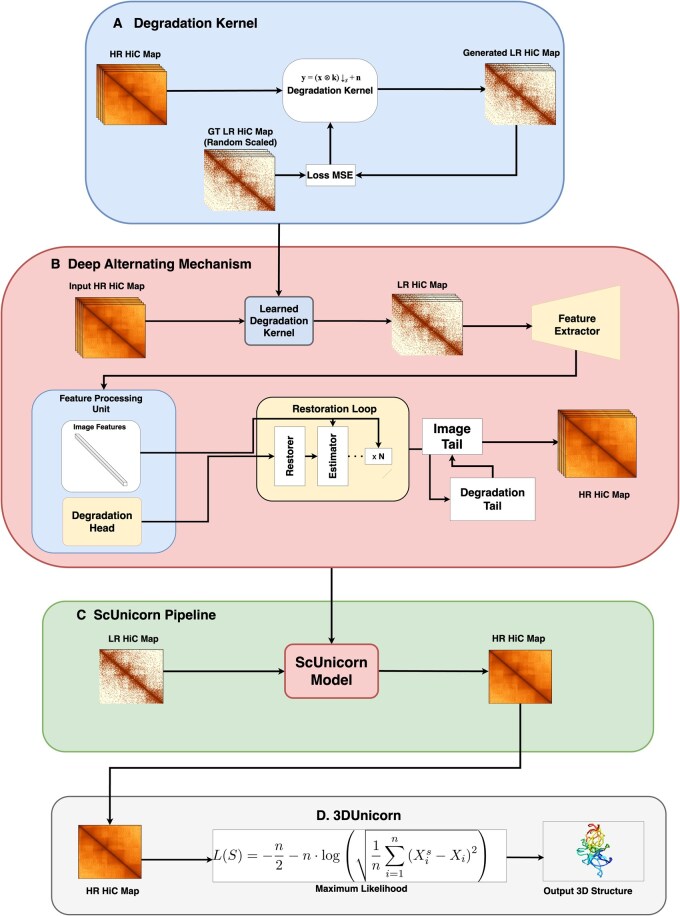 Figure 1
 Figure 2
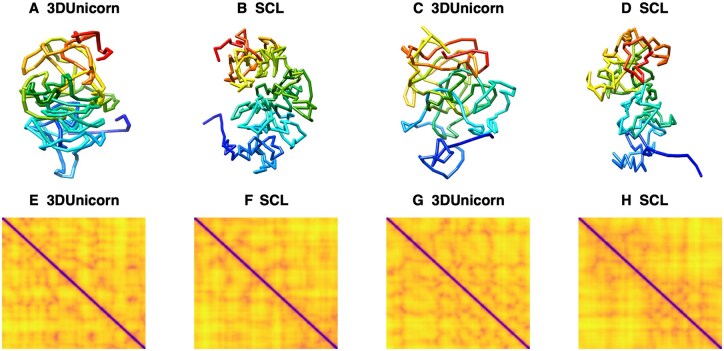 Figure 3
Peer Reviews
No public reviews on file for this paper yet. If you reviewed it on a platform where reviews are public (OpenReview, ICLR, NeurIPS, ICML), you can paste yours below so the community can read it here.
Videos
No videos yet. Explain this paper in a talk, walkthrough, or lecture? Add one.
Taxonomy
TopicsGenomics and Chromatin Dynamics · Single-cell and spatial transcriptomics · Cancer-related molecular mechanisms research