HIDE: hierarchical cell-type deconvolution
Dennis Völkl, Malte Mensching-Buhr, Thomas Sterr, Sarah Bolz, Andreas Schäfer, Nicole Seifert, Jana Tauschke, Austin Rayford, Oddbjørn Straume, Helena U Zacharias, Sushma Nagaraja Grellscheid, Tim Beissbarth, Michael Altenbuchinger, Franziska Görtler

TL;DR
HIDE is a new method for analyzing bulk RNA data to better understand cell type composition, using a hierarchical approach that improves accuracy and clarity.
Contribution
HIDE introduces a hierarchical framework for cell-type deconvolution that leverages cell differentiation structures to enhance performance and interpretability.
Findings
HIDE outperforms existing methods in simulation studies by producing more reliable and consistent results.
The method successfully identifies major cell populations and their subpopulations in bulk transcriptomics data.
HIDE was applied to breast cancer specimens from TCGA, demonstrating its practical utility.
Abstract
Cell-type deconvolution is a computational approach to infer cellular distributions from bulk transcriptomics data. Several methods have been proposed, each with its own advantages and disadvantages. Reference based approaches make use of archetypic transcriptomic profiles representing individual cell types. Those reference profiles are ideally chosen such that the observed bulks can be reconstructed as a linear combination thereof. This strategy, however, ignores the fact that cellular populations arise through the process of cellular differentiation, which entails the gradual emergence of cell groups with diverse morphological and functional characteristics. Here, we propose Hierarchical cell-type Deconvolution (HIDE), a cell-type deconvolution approach which incorporates a cell hierarchy for improved performance and interpretability. This is achieved by a hierarchical procedure that…
Genes, proteins, chemicals, diseases, species, mutations and cell lines named across the full text — each resolved to its canonical identifier and authoritative record.
Click any figure to enlarge with its caption.
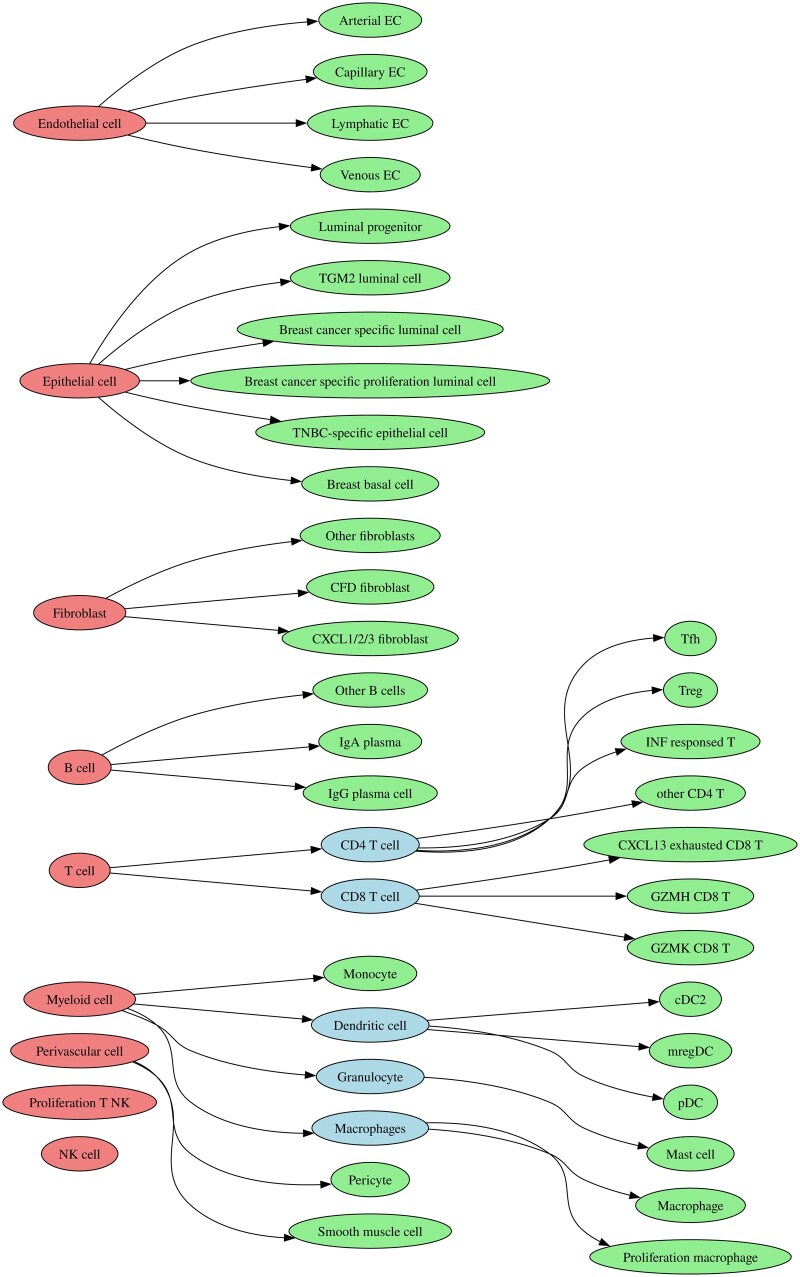 Figure 1
Peer Reviews
No public reviews on file for this paper yet. If you reviewed it on a platform where reviews are public (OpenReview, ICLR, NeurIPS, ICML), you can paste yours below so the community can read it here.
Videos
No videos yet. Explain this paper in a talk, walkthrough, or lecture? Add one.
Taxonomy
TopicsSingle-cell and spatial transcriptomics · Cell Image Analysis Techniques · Gene Regulatory Network Analysis