A novel traction device applying the “anchor traction method” during pharyngeal endoscopic submucosal dissection
Keisaku Yamada, Masahiro Tajika, Tsutomu Tanaka, Nobuhito Ito, Akihiro Takagi, Yasumasa Niwa

Abstract
Genes, proteins, chemicals, diseases, species, mutations and cell lines named across the full text — each resolved to its canonical identifier and authoritative record.
Click any figure to enlarge with its caption.
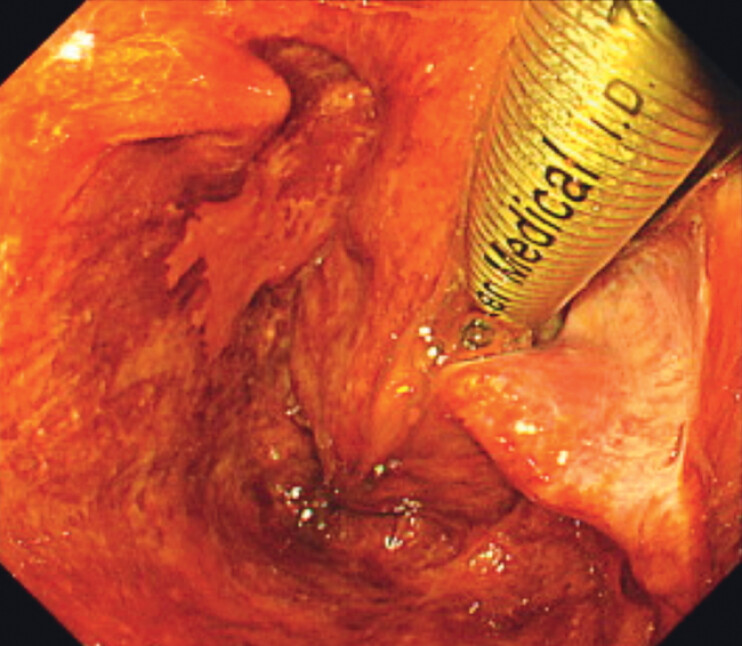 Fig. 1
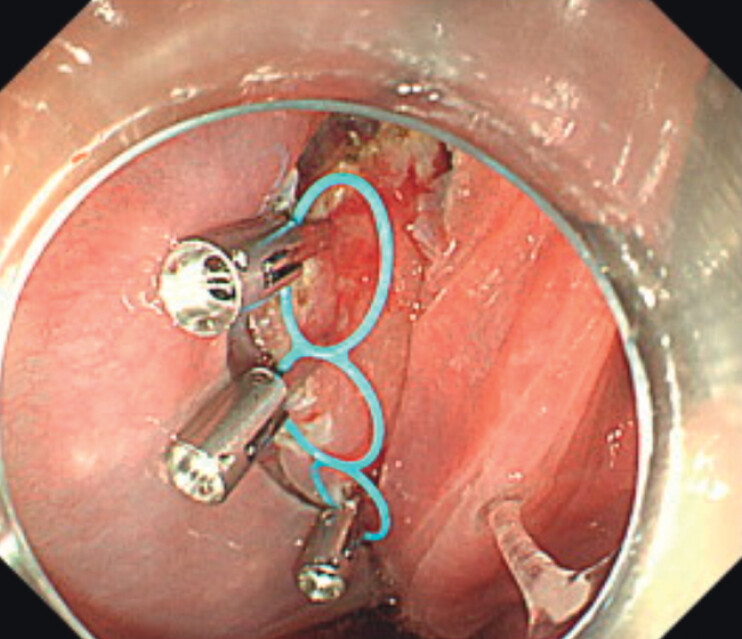 Fig. 2
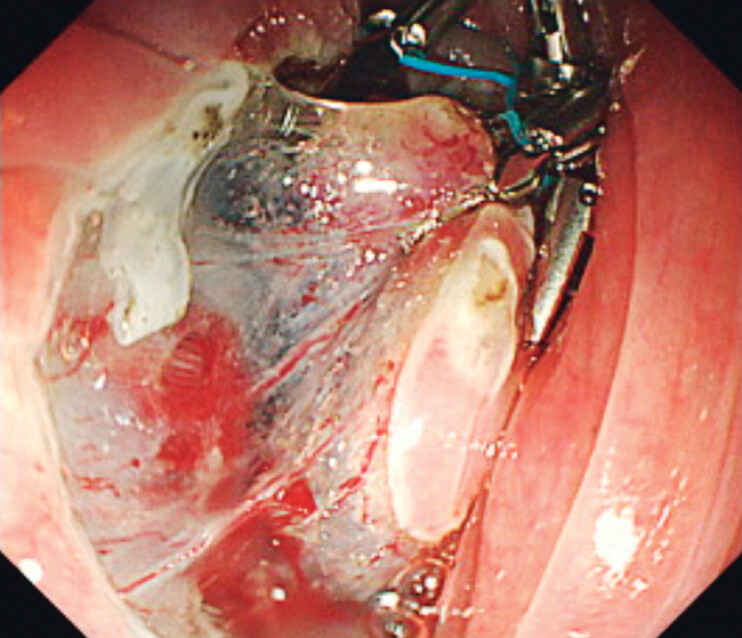 Fig. 3
Peer Reviews
No public reviews on file for this paper yet. If you reviewed it on a platform where reviews are public (OpenReview, ICLR, NeurIPS, ICML), you can paste yours below so the community can read it here.
Videos
No videos yet. Explain this paper in a talk, walkthrough, or lecture? Add one.
Taxonomy
TopicsGastric Cancer Management and Outcomes · Metastasis and carcinoma case studies · Dysphagia Assessment and Management
Endoscopic submucosal dissection (ESD) for pharyngeal cancer can be an effective method of preserving organ function. In this procedure, laryngeal forceps are used to directly grasp and pull the lesion; however, there are limitations in endoscopic manipulation owing to interference between the laryngeal forceps and the endoscope. Therefore, several methods that reduce interference have been reported 1 2 . We previously reported a new method using a multi-loop traction device (MLTD; Boston Scientific Co. Ltd., Tokyo, Japan), named the “anchor traction method” to enable multiple traction points in colorectal ESD 3 4 . Here, we report a useful technique in which this method was applied during ESD for pharyngeal cancer ( Video 1 ).
A novel traction device applying the anchor traction method during pharyngeal endoscopic submucosal dissection.Video 1
The lesion was a 15-mm 0–IIa lesion at the left pyriform sinus ( Fig. 1 ). After the otolaryngologist performed laryngeal expansion to create the space, marking and full-circumferential incision were done. The middle loop of the MLTD was attached to a reopenable clip (SureClip; MicroTech, Nanjing, China), and placed on the oral side of the lesion, and the two additional loops of the MLTD were then attached to the lesion, as previously reported in the anchor traction method ( Fig. 2 ). The otolaryngologist grasped the middle loop using laryngeal forceps, and effective traction could be applied ( Fig. 3 ). Successful traction was maintained with multiple points and en bloc resection was completed. Pathological analysis revealed that the lesion was squamous cell carcinoma pTis.
The lesion was a 15-mm 0–IIa lesion at the left pyriform sinus.
The multi-loop traction device was attached to the lesion as previously reported for the anchor traction method.
A good field of view was obtained with multi-point traction using the multi-loop traction device.
The advantages of this method are as follows. First, as with other methods 1 2 , the use of the MLTD reduces interference between the endoscope and forceps, and also decreases lesion damage by reducing the number of times the forceps must re-grasp the lesion. Furthermore, as the MLTD can be tractioned at three points, the field of view is better than with traction at a single point. This method is therefore potentially useful for ESD in pharyngeal cancer.
Endoscopy_UCTN_Code_TTT_1AO_2AG_3AD
The reference list from the paper itself. Each links out to its DOI / PubMed record.
- 1Iwagami H Shimoyama M Terashita T Effective traction using a clip with rubber band and grasping forceps in endoscopic laryngopharyngeal surgery Endoscopy 202355 E 566E 56736958353 10.1055/a-2045-7726 PMC 10036207 · doi ↗ · pubmed ↗
- 2Matsuno K Miyamoto H Shono T Efficacy of a new traction method using ring shaped thread for endoscopic submucosal dissection in the pharynx Esophagus 20232025626336456753 10.1007/s 10388-022-00971-0 · doi ↗ · pubmed ↗
- 3Yamada K Tajika M Tanaka TA novel traction method using a multi-loop traction device in colorectal endoscopic submucosal dissection: anchor traction method Endoscopy 202456 E 780E 78110.1055/a-2408-978739299280 PMC 11412764 · doi ↗ · pubmed ↗
- 4Yamada K Tajika M Tanaka T Modified anchor traction method allows safe colorectal endoscopic submucosal dissection: the T-shaped traction method Endoscopy 202557 E 64E 6510.1055/a-2512-429739875132 PMC 11774657 · doi ↗ · pubmed ↗