Suture-loop anchoring at the distal end of a pancreatic stent: a novel approach to prevent proximal migration
Mingwen Guo, Wenguang Yang, Ping Wang, Yuhong Ren, Bin Yang, Sichao Wen, Danqing Liu

Abstract
Genes, proteins, chemicals, diseases, species, mutations and cell lines named across the full text — each resolved to its canonical identifier and authoritative record.
Click any figure to enlarge with its caption.
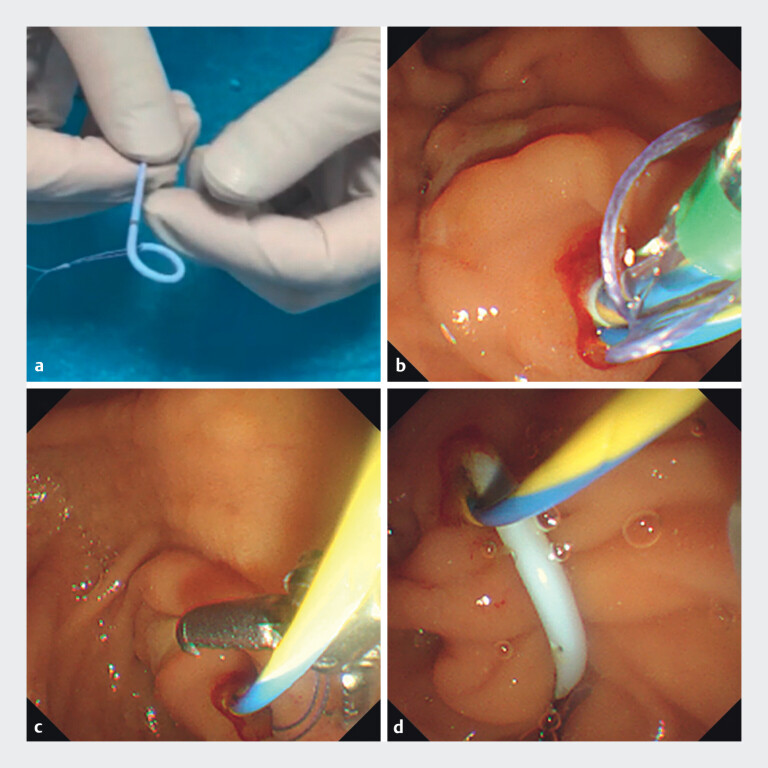 Fig. 1
Peer Reviews
No public reviews on file for this paper yet. If you reviewed it on a platform where reviews are public (OpenReview, ICLR, NeurIPS, ICML), you can paste yours below so the community can read it here.
Videos
No videos yet. Explain this paper in a talk, walkthrough, or lecture? Add one.
Taxonomy
TopicsGallbladder and Bile Duct Disorders · Pancreatic and Hepatic Oncology Research · Esophageal and GI Pathology
Proximal migration of pancreatic stents, though rare (0.2%) 1 , remains a serious complication of endoscopic retrograde cholangiopancreatography (ERCP) that requires complex retrieval methods including endoscopic grasping, pancreatoscopy, or surgery 2 . Recent advances include endoscopic ultrasound (EUS)-guided retrieval 3 , yet these approaches demand expertise and resources.
We propose an innovative preventive strategy. An absorbable suture is threaded through the terminal side hole, and the length of the suture after knotting is kept at approximately 3 cm ( Fig. 1 a ). The video documents a 78-year-old jaundiced patient in whom a trainee inadvertently deployed a 5-Fr stent deeply into the pancreatic duct ( Fig. 1 b ). The supervising physician grasped the externalized suture with rat tooth forceps ( Fig. 1 c , Video 1 ), successfully repositioning the stent ( Fig. 1 d ) and enabling subsequent biliary stenting. This suture-loop technique provides a simple yet reliable solution for preventing pancreatic stent migration. The technique is particularly suitable for trainees and is recommended for widespread clinical adoption.
Novel suture-loop anchoring at the distal pancreatic stent: Technique demonstration and migration rescue. a Suture-loop anchoring technique: An absorbable suture is threaded through the distal side hole of the pancreatic stent, with the knotted suture length maintained at 3 cm. b Deep migration of a 5-Fr pancreatic stent during trainee-led deployment in a jaundiced patient. c Retrieval of the migrated stent via the externalized suture-loop using a rat tooth forceps. d Repositioned pancreatic stent enabling subsequent biliary intervention.
Demonstration of suture-loop technique for pancreatic stent fixation via externalized suture retrieval, enabling migration rescue.Video 1
Endoscopy_UCTN_Code_TTT_1AR_2AZ
The reference list from the paper itself. Each links out to its DOI / PubMed record.
- 1Cai YL Wang F Zhang J Incidence, risk factors and endoscopic retrieval of proximally migrated pancreatic stents: 25 years of experience in a high-volume center – a case controlled study Int J Surg 20251113115311910.1097/JS 9.000000000000227339878160 PMC 12175794 · doi ↗ · pubmed ↗
- 2Jayanna SH Bush N Sharma R Endoscopic removal of proximally migrated pancreatic duct stents: a case series and literature review Ann Gastroenterol 20253823023610.20524/aog.2025.095440124426 PMC 11928899 · doi ↗ · pubmed ↗
- 3Akiyama S Tanke G Inokuma T Successful retrieval of a migrated pancreatic stent via endoscopic ultrasound-guided transluminal drainage using an ultraslim upper endoscope Dig Endosc 202510.1111/den.1501540079202 · doi ↗ · pubmed ↗