Titanium cis‐DACH Salan Catalyst for the Efficient Epoxidation of Nonactivated Olefins with Hydrogen Peroxide‐Terminal‐Selective Epoxidation of Multiply Unsaturated Terpenes
Christina Wartmann, Jörg.‐M. Neudörfl, Albrecht Berkessel

TL;DR
A new titanium catalyst efficiently epoxidizes nonactivated olefins using hydrogen peroxide, with high regioselectivity for terminal double bonds in complex terpenes.
Contribution
A novel titanium salan catalyst with pentafluorophenyl substituents enables efficient and selective epoxidation of nonactivated olefins and multiply unsaturated terpenes.
Findings
The catalyst achieves up to 95% yield at 0.5 mol-% loading for epoxidation of nonactivated olefins.
It shows high regioselectivity (up to 49:1) for terminal double bond epoxidation in multiply unsaturated terpenes.
Syn/anti selectivity of up to 9:1 is observed in the epoxidation of chiral substrates like (S)-citronellene and (R)-linalool.
Abstract
We report a new generation of highly active and readily available homogeneous titanium catalysts for the epoxidation of nonactivated olefins with aqueous hydrogen peroxide. Key feature is the introduction of pentafluorophenyl substituents into a salan ligand derived from cis‐1,2‐diaminocyclohexane (cis‐DACH). Our novel salan ligand is accessible in one single step by reductive alkylation of cis‐DACH with 3‐(pentafluorophenyl)salicylic aldehyde. In situ complexation with Ti(OiPr)4 of the cis‐DACH salan provides the titanium catalyst, which, in the presence of aqueous hydrogen peroxide, smoothly epoxidizes a broad spectrum of olefins with up to 95% yield at a catalyst loading of 0.5 mol‐% only. The achiral cis‐DACH salan catalyst showed syn‐selectivity (4.7:1) in the epoxidation of a chiral, racemic terminal allylic alcohol. This catalyst furthermore allows the regioselective (up to 49:1)…
Genes, proteins, chemicals, diseases, species, mutations and cell lines named across the full text — each resolved to its canonical identifier and authoritative record.
Click any figure to enlarge with its caption.
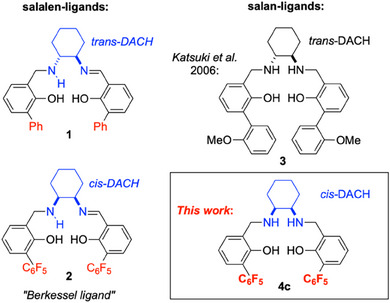 Figure 1
 Scheme 1
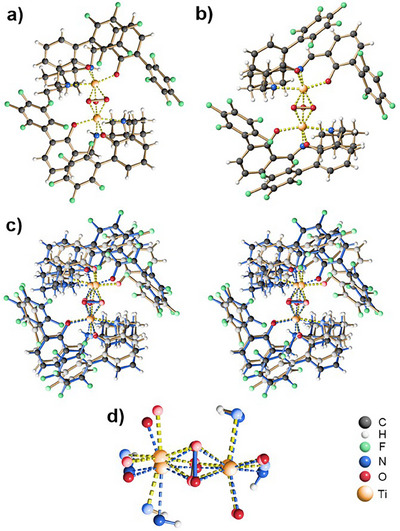 Figure 2
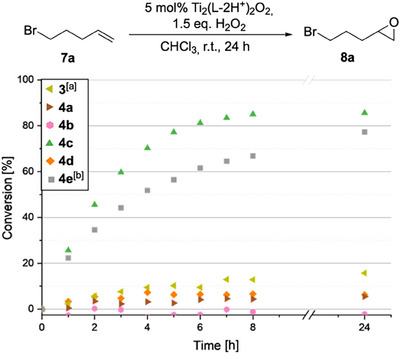 Figure 3
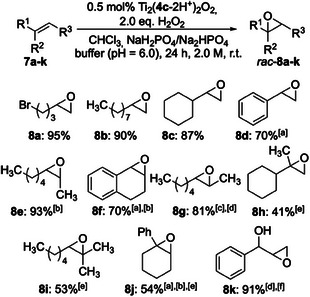 Scheme 2
|
| ||||||
|---|---|---|---|---|---|---|
| Entry | Sub‐strate | Ligand L | Catalyst Loading [mol‐%] | Yield [%] 10,12,14 | Regioselectivity |
|
| 1 |
|
| 2.0 | 48 | 49:1 | ‐ |
| 2 |
|
| 0.5 | 79 | 24:1 | ‐ |
| 3 |
|
| 1.5 | 51 | 6:1 | 3:2 |
| 4 |
|
| 0.5 | 54 | 3:1 | 1:25 |
| 5 |
|
| 0.5 | 50 | 6:1 | 50:1 |
| 6 |
|
| 2 | 23 | 3:1 | 9:1 |
| 7 |
|
| 1.5 | 42 | 19:1 | 24:1 |
| 8 |
|
| 1.5 | 22 | 3:1 | 1:4 |
- —Fonds der Chemischen Industrie10.13039/100018992
Peer Reviews
No public reviews on file for this paper yet. If you reviewed it on a platform where reviews are public (OpenReview, ICLR, NeurIPS, ICML), you can paste yours below so the community can read it here.
Videos
No videos yet. Explain this paper in a talk, walkthrough, or lecture? Add one.
Taxonomy
TopicsPolyoxometalates: Synthesis and Applications · Chemical Synthesis and Reactions · Oxidative Organic Chemistry Reactions
Introduction
1
Epoxides are highly valuable building blocks in organic synthesis, both in the academic laboratory and in the chemical industries.^[^ 1, 2 ^]^ They are typically prepared by oxygen transfer to olefins, with hydrogen peroxide being one of the most favorable terminal oxidants.^[^ 3 ^]^ The latter oxygen transfer typically requires hydrogen peroxide activation by a catalyst, and among the countless metal‐based and metal‐free systems investigated, titanium‐based catalysts clearly stand out. For example, the industrial epoxidation of propylene with hydrogen peroxide to propylene oxide (the HPPO process) is effected by substrate‐size‐limited titanium silicalite catalysts, such as TS‐1, at a scale exceeding 10^6^ t/a.^[^ 4 ^]^ With regard to homogeneous olefin epoxidation with hydrogen peroxide, the discovery by Katsuki et al. in 2005 of the titanium salalen motif^[^ 5 ^]^ has served as the basis of our own investigation and development of this catalyst class. An early example is represented by formula 1 (Figure 1).^[^ 6 ^]^ The Ti‐catalyst obtained from the in situ combination of the trans‐1,2‐diaminocyclohexane (trans‐DACH) derived ligand 1 (Figure 1) with Ti(OiPr)4 readily epoxidizes electron‐rich olefins such as indene or 1,2‐dihydronaphthalene in high yield (90%) and ee (up to 98%).^[^ 6 ^]^ In contrast, low yields and enantioselectivities resulted for electron‐poor substrates, such as the “difficult” terminal olefin 1‐octene (6%, 60% ee). Several stages of development finally afforded the “Berkessel ligand” 2 (Figure 1): as crucial features, this ligand is derived from cis‐DACH and carries two pentafluorophenyl substituents ortho to the phenolic hydroxy groups.^[^ 7, 8, 9 ^]^ The titanium catalyst derived from ligand 2 (“Berkessel‐Katsuki catalyst”, BKC) allows the asymmetric epoxidation of terminal olefins (and many other types of olefins) in high yield and enantiopurity (typically >90% epoxide yield, > 95% ee) at catalyst loadings ≤1 mol‐%.^[^ 9, 10 ^]^
Salalen (left) and salan (right) ligands used in titanium‐catalyzed epoxidations of olefins with hydrogen peroxide.
In 2006, one year after disclosing the first titanium salalen complex for epoxidation catalysis, Katsuki et al. reported that the related salan complexes show catalytic activity as well.^[^ 11 ^]^ As the most efficient ligand, the trans‐DACH‐derived salan 3 (Figure 1), carrying two (2‐methoxyphenyl)‐substituents ortho to the phenolic hydroxy groups, emerged from these studies.^[^ 11 ^]^ As in the case of our “early” salalen ligands (e.g., 1, Figure 1), the titanium catalyst derived from Katsuki's salan 3 efficiently epoxidizes electron‐rich olefins, such as indene: 91% yield and 98% ee were reported at 2 mol‐% catalyst loading.^[^ 11 ^]^ Again in parallel to the “early” salalen ligand 1, low yields and enantioselectivities resulted for electron‐poor substrates, such as terminal olefins (e.g., 25% yield and 50% ee for 1‐octene).
After the advent of the chiral BKC, the need for a simple, yet universally applicable homogeneous titanium catalyst for the non‐asymmetric epoxidation of a broad spectrum of olefins with hydrogen peroxide persisted.^[^ 12 ^]^ In contrast to their salalen counterparts, salan ligands can be accessed by simultaneous one‐step reductive alkylation of both N‐atoms of the diamine building block employed–thus making salan ligand synthesis extremely facile. Our extensive mechanistic studies on the “Berkessel‐Katsuki‐catalyst” (BKC), that is, the dimeric titanium complex derived from the cis‐DACH salalen ligand 2, had revealed that the pentafluorophenyl substituents of ligand 2 enhance the reactivity of the oxygen transferring Ti‐OOH intermediate by virtue of their π‐acidity.^[^ 13, 14 ^]^ With this in mind, we set out to investigate the effect of pentafluorophenyl‐substitution on the epoxidation activity of titanium cis‐DACH salan complexes–hoping to arrive at a catalyst that, despite its simplicity, may be suitable for the epoxidation of low‐reactivity olefins.
Results and Discussion
2
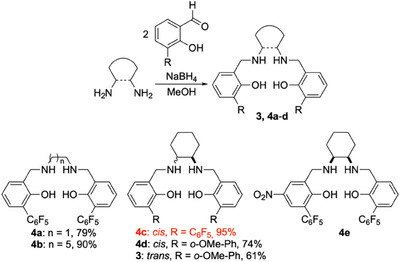
The one‐step synthesis of the salan ligands 3 and 4a‐d is summarized in Scheme 1. Note that for comparison, we also included simplified non‐DACH derived salans, namely the salans 4a and 4b, derived from ethylenediamine and hexamethylenediamine, respectively. Compound 4d is the cis‐DACH analogue of Katsuki's salan 3, while the ligand 4c combines both new features, namely cis‐DACH backbone and pentafluorophenyl substituents. Additionally, the (chiral) ligand 4e was accessed by NaBH_4_ reduction of a nitro‐derivative of the salalen 2, described by us earlier.^[^ 10 ^]^
Top: one‐step synthesis of salan ligands such as 3,4a‐d by reductive alkylation of diamines; bottom: structures of the ligands 3, 4a‐e.
It was already shown by Katsuki et al. in 2006 that titanium complexes of salan ligands form dimeric di‐μ‐oxo bridged dimers.^[^ 11 ^]^ Also, the salan ligands shown in Scheme 1 readily form titanium complexes upon reaction with Ti(OiPr)4. Upon exposure to hydrogen peroxide, we were able to crystallize the μ‐oxo‐μ‐peroxo dimer 5, derived from the novel cis‐DACH salan ligand 4c, its X‐ray crystal structure is shown in Figure 2a (see Supporting Information for crystallization conditions).^[^ 15 ^]^ For comparison, we also prepared and crystallized the μ‐oxo‐μ‐peroxo dimeric titanium complex derived from the racemic “Berkessel ligand” (rac‐2, Figure 1), its X‐ray crystal structure is shown in Figure 2b.^[^ 15 ^]^ Although derived from a salan (as in 5) and a salalen (as in 6) ligand, these two complexes show surprising structural similarity. First, the titanium centers in both complexes are coordinated in cis‐β mode. Second, both Ti‐complexes form racemic crystals composed of homochiral Λ,Λ‐, and Δ,Δ‐dimers. Figure 2a exemplarily shows the Λ,Λ‐dimer found in the crystals of 5, while Figure 2b shows the Λ,Λ‐dimer of 6. In the dimers, the homochiral subunits are oriented relative to one another in “trans” fashion.^[^ 16, 17 ^]^ To further demonstrate the structural similarity of 5 and 6, Figure 2c provides a stereoscopic overlay of their crystal structures, and Figure 2d shows an overlay of the Ti centers of 5 and 6, together with the O‐ and N‐atoms of their first coordination sphere.
X‐ray crystal structures of dimeric μ‐oxo‐μ‐peroxo titanium complexes. a) Λ,Λ‐dimeric complex 5, derived from the salan ligand 4c; b) Λ,Λ‐dimeric complex 6 , derived from the salalen ligand rac‐2; c) overlay of the X‐ray crystal structures of complexes 5 and 6, in stereoscopic view; d) comparison of the titanium primary coordination spheres in complexes 5 and 6; dark colors/blue bonds refer to complex 5, while light colors/yellow bonds refer to complex 6.
Figure 3 summarizes our assessment of the catalytic activity of the salan ligands 3, 4a‐e.^[^ 18 ^]^ The titanium complexes were generated in situ, simply by adding Ti(OiPr)4 to a solution of the ligand. As a demanding test substrate, we chose the terminal olefin 5‐bromo‐1‐pentene (7a). We were delighted to see that both pentafluorophenyl‐substituted cis‐DACH salan ligands 4c and 4e indeed provided catalytic activity, with ligand 4c giving the best result: at a catalyst loading of 5 mol‐%, 85% of the terminal olefin 7a was converted to the racemic epoxide rac‐8a within 8 hours. We had observed before that the introduction of a nitro group into the salalen ligand 2 resulted in a substantial increase in reactivity.^[^ 10 ^]^ The analogous introduction of a nitro group into the salan ligand 4c, however, had an adverse effect on its reactivity (ligand 4e, 78% conversion, “second best”). Interestingly, the latter ligand induced some enantioselectivity [47% ee of the epoxide (R)‐8a]. All other ligands afforded less than 20% conversion of the terminal olefin 7a, even after prolonged reaction times (up to 24 hours). Note that the failure of our “minimalistic” pentafluorophenyl‐substituted salan ligands 4a,b underpins the importance of the active catalysts' cis‐DACH subunit.
Comparison of the salan ligands 3, 4a‐e in the epoxidation of 5‐bromo‐1‐pentene (7a). a) epoxide (R)‐8a: 74% ee; b) epoxide (R)‐8a: 47% ee.
As the cis‐DACH salan ligand 4c showed the highest reactivity in the preceding assessment, we continued on with this ligand to the optimization of reaction conditions (solvent, substrate concentration, catalyst loading, addition of buffer, etc.; see Supporting Information for details). Scheme 2 summarizes the isolated yields of (racemic) epoxides (rac‐8a‐j) obtained from a variety of olefinic structural motifs (7a‐j) under optimized conditions. At a catalyst loading as low as 0.5 mol‐%, nonconjugated terminal (7a‐c) and cis‐1,2‐disbstituted (7e) olefins gave the best results, with epoxide yields in the range of 87–95%. cis‐2‐Octene (7e) gave exclusively cis‐configurated epoxide rac‐8e, thus confirming the stereospecificity of the epoxidation. The epoxidation of trans‐2‐octene (7 g) required slightly higher catalyst loading (1 mol‐%), only trans‐epoxide (rac‐8 g) was formed. For conjugated olefins such as styrene (7d) or 1,2‐dihydronaphthalene (7f), yields of racemic epoxide reached 70%. 2,2‐Disubstituted olefins (7h) and trisubstituted ones (7i,j) could be transformed as well, albeit at 41–54% yield. The epoxidation of the terminal allylic alcohol rac‐7k revealed a pronounced syn‐selectivity of the Ti‐catalyst derived from salan ligand 4c: the racemic product epoxides syn‐ and anti‐rac‐8k were obtained in a ratio of 4.7:1 in a combined yield of 91%.^[^ 19 ^]^
Epoxidation of various olefins using hydrogen peroxide and the Ti‐salan catalyst derived from ligand 4c. a) 67 mM phosphate buffer of pH 6.7 was added; b) relative configuration: cis; c) relative configuration: trans; d) 1 mol% Ti2(4c‐2H+)2O2 was used; e) 2 mol% Ti2(4c‐2H+)2O2 were used; f) syn/anti = 4.7:1.
Intrigued by the high reactivity–in particular toward terminal C ═ C double bonds–of the new titanium catalyst derived from salan 4c, we decided to evaluate this system in the selective epoxidation of multiply unsaturated terpenes. We chose myrcene (9), (S)‐citronellene (11), and (R)‐linalool (13) as substrates (Table 1). Note that for these three monoterpenes, a terminal‐selective epoxidation has only been reported for (R)‐linalool (13): the Sharpless method using tert.‐butyl hydroperoxide (TBHP) as oxidant in the presence of catalytic VO(acac)2 gives almost exclusively the epoxide 14a.^[^ 20, 21 ^]^ For obtaining the terminal epoxides of myrcene (9) and citronellene (11), alternative synthetic approaches had to be developed.^[^ 22 ^]^
Our results obtained from the epoxidation of the terpenes 9, 11, and 13 are summarized in Table 1. For the epoxidation of the chiral substrates 11 and 13, we also included the two enantiomers of the BKC [Ti_2_(2–2H^+^)2_O_2 and Ti_2_(ent‐2–2H^+^)2_O_2] in this study. Inspection of Table 1, entry 1 reveals that in the epoxidation of (achiral) myrcene (9), the new titanium salan catalyst derived from ligand 4c indeed achieved unprecedented selectivity for the epoxidation of myrcene's (9) terminal C ═ C bond (49:1, vs. epoxidation of the 2,2‐disubstituted double bond). The salalen 2 provides a regioselectivity of 24:1, but at higher yield (entry 2). Note that other electrophilic oxidants (both catalytic and stoichiometric) exclusively epoxidize the triply substituted double bond of both myrcene (9) and citronellene (10)–the opposite of what is observed for our catalytic process(es).^[^ 23 ^]^ In the chiral monoterpenes (S)‐citronellene (11) and (R)‐linalool (13), the terminal double bond is sterically more hindered, due to the allylic mono/disubstitution. Nevertheless, in the presence of all three catalysts, epoxidation occurs predominantly at the terminal double bond (Table 1, entries 3–8), reaching a maximum regioselectivity of 19:1 in the epoxidation of (R)‐linalool (13, entry 7) using the salalen ligand 2. For (R)‐linalool (13), this substrate‐catalyst combination represents the “matched pair” (compare entries 7 and 8), as it also achieved the highest syn/anti‐ratio of the product epoxide (24:1, terminal epoxide). For (S)‐citronellene (11), the enantiomeric catalyst, derived from the salalen ligand ent‐2 appears to be the “matched” catalyst (entry 5), affording a 6:1 regioselectivity and a 50:1 syn/anti‐ratio. Still, the “mismatched” catalyst derived from ligand 2 effects a syn/anti‐ratio of 1:25, at a regioselectivity of 3:1 favoring terminal double bond epoxidation. For both (S)‐citronellene (11, entry 3) and (R)‐linalool (13, entry 6), our new Ti‐salan catalyst derived from ligand 4c achieved regioselectivities of 3:1 to 6:1, with syn/anti‐ratios of up to 9:1. It needs to be emphasized at this point that fully terminal‐selective epoxidation of 1,4‐ and 1,6‐dienes with hydrogen peroxide had been achieved before by Strukul et al. using pentafluorophenyl Pt(II) diphosphine catalysts, even with high enantioselectivity (up to 98%).^[^ 24a ^]^ However, this type of catalyst does not tolerate substituents in the terminal double bond's allylic position, and it is retarded by homoallylic substitution.^[^ 24b ^]^ High terminal selectivity in the epoxidation of a 1,4‐ and a 1,6‐diene had also been observed by Mizuno et al., using hydrogen peroxide and polyoxovanadometallates as catalyst.^[^ 24c,d ^]^
Conclusion
3
In summary, our mechanism‐based design of the novel cis‐DACH salan ligands incorporating pentafluorophenyl substituents has afforded the most readily available ligand 4c. Upon in situ complexation with Ti(OiPr)4, the ligand 4c provides a titanium salan catalyst of high activity in the epoxidation of a variety of olefins with hydrogen peroxide: less than 1 mol‐% catalyst loading is typically needed for > 90% conversion of nonconjugated, in particular terminal olefins at ambient temperature and atmosphere. The novel titanium catalyst derived from salan ligand 4c, together with the established BKC derived from ligand 2 (or ent‐2), proved to be highly regioselective in favor of terminal olefin epoxidation. Together with their structural similarity (in the solid state) and the remarkable effect of pentafluorophenyl substitution, this is another indication that the catalytic mechanism of the novel cis‐DACH salan catalyst may in fact parallel that of the BKC.^[^ 13 ^]^
Supporting Information
The authors have cited additional references within the Supporting Information.^[^ 25, 26, 27, 28, 29, 30, 31, 32, 33, 34, 35, 36, 37, 38, 39, 40 ^]^
Conflict of Interests
The authors declare no conflict of interest.
Supporting information
Supporting information
The reference list from the paper itself. Each links out to its DOI / PubMed record.
- 1a) A. Berkessel , H. Engler , T. M. Leuther , in Science of Synthesis, Catalytic Oxidation in Organic Synthesis (Ed.: K. Muñiz ), Thieme, Stuttgart 2018, pp. 245–307;
- 2a) J. H. Teles , W. Partenheimer , R. Jira , F. Cavani , G. Strukul , R. Hage , J. W. Boer , L. Goossen , P. Mamone , O. A. Kholdeeva , in Applied Homogeneous Catalysis with Organometallic Compounds, 3rd ed., Vol. 2, (Ed. B. Cornils , W. A. Hermann , M. Beller , R. Paciello ), VCH, Weinheim 2018, pp. 465–568;
- 3a) C. Wang , H. Yamamoto , Chem. Asian J. 2015, 10, 2056;26061144 10.1002/asia.201500293 · doi ↗ · pubmed ↗
- 4V. Smeets , E. M. Gaigneaux , D. P. Debecker , Chem Cat Chem 2022, 14, e 202101132.
- 5a) K. Matsumoto , Y. Sawada , B. Saito , K. Sakai , T. Katsuki , Angew. Chem. Int. Ed. 2005, 44, 4935; Angew. Chem. 2005, 117, 5015;10.1002/anie.20050131815999379 · doi ↗ · pubmed ↗
- 6a) A. Berkessel , M. Brandenburg , E. Leitterstorf , J. Frey , J. Lex , M. Schäfer , Adv. Synth. Catal. 2007, 349, 2385;
- 7a) A. Berkessel , T. Günther , Q. Wang , J.‐M. Neudörfl , Angew. Chem. Int. Ed. 2013, 52, 8467; Angew. Chem. 2013, 125, 8625;10.1002/anie.20121019823824950 · doi ↗ · pubmed ↗
- 8A. Berkessel , M.‐C. Ong , M. Nachi , J.‐M. Neudörfl , Chem Cat Chem 2010, 2, 1215.