PREACT-digital: study protocol for a longitudinal, observational multicentre study on digital phenotypes of non-response to cognitive behavioural therapy for internalising disorders
Leona Hammelrath, Annette Brose, Manuel Heinrich, Pavle Zagorscak, Sebastian Burchert, Till Langhammer, Christine Knaevelsrud

TL;DR
This study uses wearable devices and smartphone data to track real-time changes in patients undergoing cognitive behavioral therapy for mental health issues, aiming to predict who might not respond well to treatment.
Contribution
The study introduces a novel approach combining ecological momentary assessment and passive sensing to identify dynamic markers of non-response to cognitive behavioral therapy.
Findings
The study will use machine learning to classify non-response to therapy based on real-time data.
It will explore how factors like affect and physical activity change over time during therapy.
Findings may lead to more personalized cognitive behavioral therapy approaches for mental health disorders.
Abstract
Cognitive behavioural therapy (CBT) serves as a first-line treatment for internalising disorders (ID), encompassing depressive, anxiety or obsessive-compulsive disorders. Nonetheless, a substantial proportion of patients do not experience sufficient symptom relief. Recent advances in wearable technology and smartphone integration enable new, ecologically valid approaches to capture dynamic processes in real time. By combining ecological momentary assessment (EMA) with passive sensing of behavioural and physiological information, this project seeks to track daily fluctuations in symptom-associated constructs like affect, emotion regulation (ER) and physical activity. Our central goal is to determine whether dynamic, multimodal markers derived from EMA and passive sensing can predict treatment non-response and illuminate key factors that drive or hinder therapeutic change. PREACT-digital…
Genes, proteins, chemicals, diseases, species, mutations and cell lines named across the full text — each resolved to its canonical identifier and authoritative record.
Click any figure to enlarge with its caption.
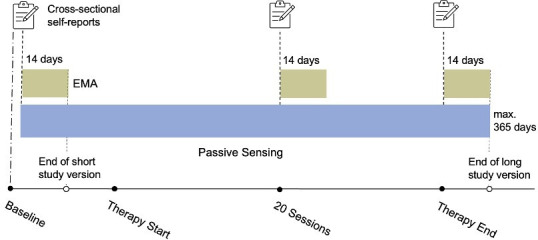 Figure 1
Peer Reviews
No public reviews on file for this paper yet. If you reviewed it on a platform where reviews are public (OpenReview, ICLR, NeurIPS, ICML), you can paste yours below so the community can read it here.
Videos
No videos yet. Explain this paper in a talk, walkthrough, or lecture? Add one.
Taxonomy
TopicsMental Health Research Topics · Digital Mental Health Interventions · Child and Adolescent Psychosocial and Emotional Development