Home-based self-administered transcranial direct current stimulation for women affected by primary dysmenorrhoea in Northeastern Brazil: a protocol study
Tatiana Camila de Lima Alves da Silva, Yvinna Tamiris Rodrigues, Edson Silva-Filho, Paloma Cristina Alves de Oliveira, Thiago Anderson Brito De Araújo, Ervinas Bernatavicius, Alexander Anthony Cook, Emilè Radytè, Rodrigo Pegado, Maria Thereza Micussi

TL;DR
This study tests if home-based brain stimulation can reduce menstrual pain and improve quality of life for women with primary dysmenorrhoea.
Contribution
It introduces a novel protocol for self-administered tDCS at home to address central nervous system dysfunction in dysmenorrhoea.
Findings
Home-based tDCS will be evaluated for its effects on pain and mental health in women with primary dysmenorrhoea.
The study will assess outcomes like quality of life and electroencephalography changes over multiple menstrual cycles.
Abstract
The prevalence of women with primary dysmenorrhoea is high and negatively impacts physical and mental health. The intense cyclic episodes of pain generate central nervous system dysfunctional processing. In this sense, strategies focused on the central nervous system are important to re-establish normal functioning. Home-based self-administered transcranial direct current stimulation (tDCS) emerges as a strategy to modulate dysfunctional brain areas and improve the symptoms. This protocol aims to evaluate the effects of home-based self-administered tDCS for pain, premenstrual symptoms, physical performance, quality of life, electroencephalography and patient global impression in women affected by primary dysmenorrhoea. This is a single-centre, parallel, randomised, double-blinded clinical trial protocol. 40 women affected by primary dysmenorrhoea will be randomised into two groups…
Genes, proteins, chemicals, diseases, species, mutations and cell lines named across the full text — each resolved to its canonical identifier and authoritative record.
Click any figure to enlarge with its caption.
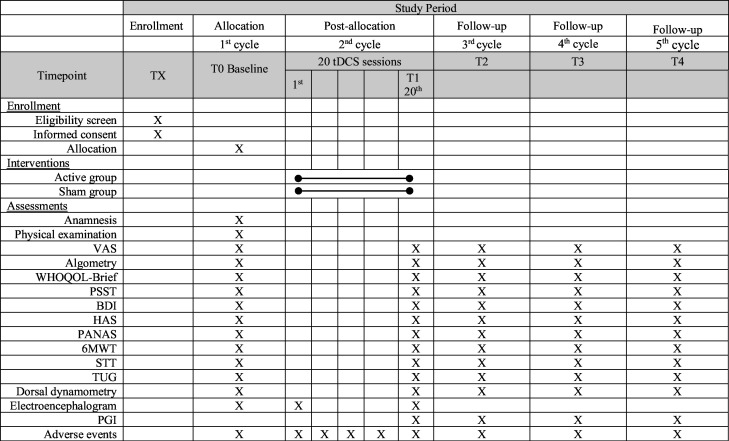 Figure 1
Peer Reviews
No public reviews on file for this paper yet. If you reviewed it on a platform where reviews are public (OpenReview, ICLR, NeurIPS, ICML), you can paste yours below so the community can read it here.
Videos
No videos yet. Explain this paper in a talk, walkthrough, or lecture? Add one.
Taxonomy
TopicsMenstrual Health and Disorders · Perfectionism, Procrastination, Anxiety Studies · Music Therapy and Health