Walking the good road of life: a longitudinal evaluation of American Indian youth suicide prevention training
Clayton Small, Ernie Big Horn, Geri Small, Kellie Webb, Edwina Brown Bull, Maha Charani Small, Ruthie Cedar Face, Warren Pourier, Hawkeye Montileaux, Lance Christiansen, Brian Bradley, Wayne Trottier, Paola Trottier, Mike Geboe, Emily R. Beamon, Bethany Fatupaito

TL;DR
This study evaluates a culturally-centered suicide prevention training for American Indian youth, showing it improves knowledge and wellness across multiple domains.
Contribution
The study introduces a new conceptual model for suicide prevention grounded in socioecological and trans-ecological theories tailored to AI/AN communities.
Findings
The Good Road of Life training significantly improved students' knowledge of suicide prevention and generational knowledge domains.
Middle school students showed greater knowledge gains compared to high school students after the training.
The program highlights the effectiveness of early intervention and community-led approaches in suicide prevention.
Abstract
American Indian/Alaska Native (AI/AN) populations have the highest suicide rate in the United States. Research on effective, culturally-centered, multi-level approaches to prevent suicide in AI/AN populations are limited. This multi-site longitudinal evaluation employed a retrospective pre-posttest design, utilizing a self-report survey administered daily following the training. Daily surveys included four areas related to suicide prevention, holistic wellness, generational knowledge, behavior change, and legacy impacts. The first objective of this study was to explore how the Good Road of Life training impacted participant knowledge regarding suicide and related risk factors while also exploring protective behaviors and impacts from a culturally-centered, strengths-based lens. A second objective was to present a conceptual model grounded in socioecological and trans-ecological…
Genes, proteins, chemicals, diseases, species, mutations and cell lines named across the full text — each resolved to its canonical identifier and authoritative record.
Click any figure to enlarge with its caption.
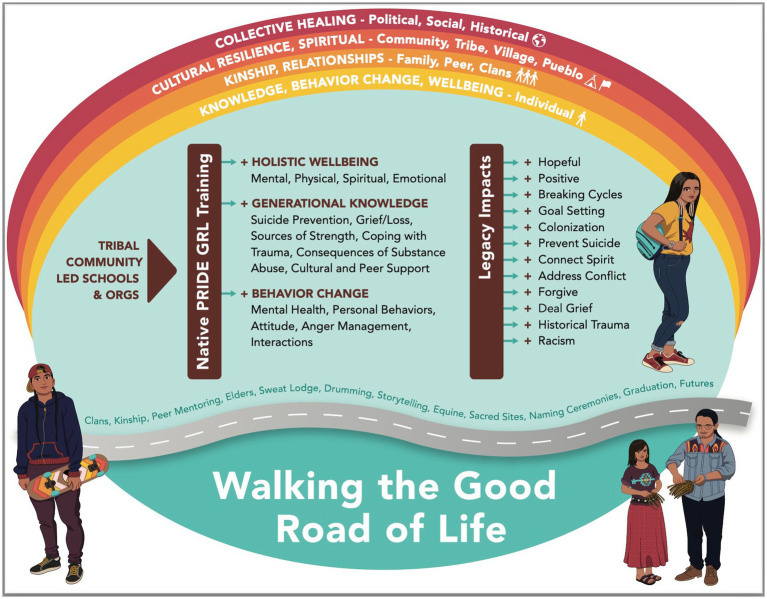 Figure 1
Peer Reviews
No public reviews on file for this paper yet. If you reviewed it on a platform where reviews are public (OpenReview, ICLR, NeurIPS, ICML), you can paste yours below so the community can read it here.
Videos
No videos yet. Explain this paper in a talk, walkthrough, or lecture? Add one.
Taxonomy
TopicsSuicide and Self-Harm Studies · Mental Health Treatment and Access · Migration, Health and Trauma