Over eight years of transfusion independence with continuous erythropoietin receptor activator and Roxadustat in transfusion-dependent low-risk myelodysplastic syndrome
Tatsuyoshi Ikenoue, Yoshiyuki Furumatsu, Tetsuya Kitamura

TL;DR
A 65-year-old woman with a blood disorder avoided needing blood transfusions for over eight years using a combination of two drugs.
Contribution
This case demonstrates long-term transfusion independence in low-risk MDS using CERA and roxadustat.
Findings
The patient remained transfusion-independent for over eight years with CERA and roxadustat.
No serious adverse events like leukemia progression or thyroid issues were observed.
The treatment combination provided sustained hemoglobin improvement without major complications.
Abstract
We report a case of a 65-year-old Japanese woman with low-risk myelodysplastic syndrome (MDS) on hemodialysis who achieved transfusion independence for over eight years with combined epoetin beta pegol (continuous erythropoietin receptor activator, CERA) and roxadustat. Transfusion-dependent since 2008, she showed a temporary response to darbepoetin and CERA, initiated in August 2016. Roxadustat was added in January 2020, leading to sustained transfusion independence. No serious adverse events, such as progression to acute leukemia or clinically significant thyroid dysfunction, were observed during this period.
Genes, proteins, chemicals, diseases, species, mutations and cell lines named across the full text — each resolved to its canonical identifier and authoritative record.
Click any figure to enlarge with its caption.
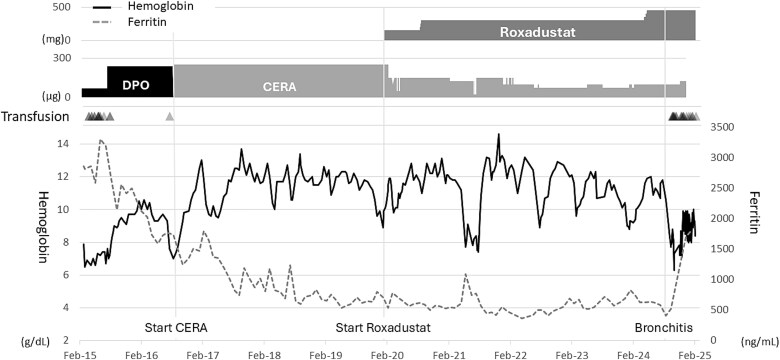 Figure 1
Peer Reviews
No public reviews on file for this paper yet. If you reviewed it on a platform where reviews are public (OpenReview, ICLR, NeurIPS, ICML), you can paste yours below so the community can read it here.
Videos
No videos yet. Explain this paper in a talk, walkthrough, or lecture? Add one.
Taxonomy
TopicsAcute Myeloid Leukemia Research · Erythropoietin and Anemia Treatment · Hemoglobinopathies and Related Disorders