Novel 1H/19F double‐tuned coil using an asymmetrical butterfly coil
Suk‐Min Hong, Chang‐Hoon Choi, Jörg Felder, N. Jon Shah

TL;DR
This paper introduces a new MRI coil design that efficiently captures both proton and fluorine signals, improving imaging quality for applications like cell tracking.
Contribution
The asymmetrical butterfly coil design enables dual-tuning for 1H and 19F without signal loss, offering higher efficiency than traditional methods.
Findings
The asymmetrical butterfly coil achieved higher quadrature efficiency at both 1H and 19F frequencies.
It demonstrated superior receive sensitivity and SNR compared to a single-tuned loop coil.
The split resonance peak effectively spanned the 19F to 1H frequency range without losses.
Abstract
Background: Fluorine‐19 (19F) magnetic resonance imaging (MRI) is a non‐invasive imaging tool for the targeted application of fluorinated agents, such as cell tracking, and for the demonstration of oximetry. However, as the SNR of 19F is significantly weaker than that of proton (1H) imaging, the 19F coil must be combined with 1H coils for anatomical co‐registration and B0 shimming. This is difficult due to the strong coupling between the coils when they are in proximity, and is problematic since the Larmor frequency of 19F is 94% that of 1H, further increasing the potential for coupling between the 1H and 19F elements. Purpose: Conventional double‐tuned coil methods tend to generate loss compared to single‐tuned reference coils. The asymmetrical butterfly coil has a split resonance peak, which can cover frequencies of 1H and 19F without losses arising from lossy traps or switching…
Genes, proteins, chemicals, diseases, species, mutations and cell lines named across the full text — each resolved to its canonical identifier and authoritative record.
Click any figure to enlarge with its caption.
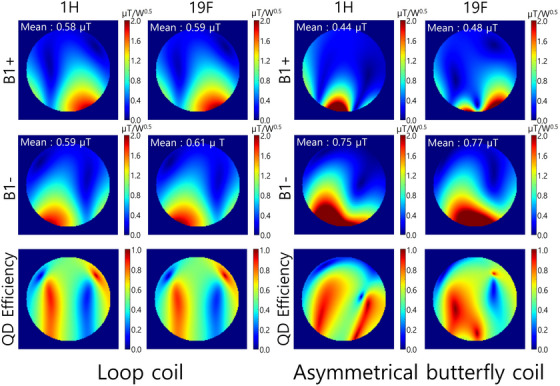 Figure 1
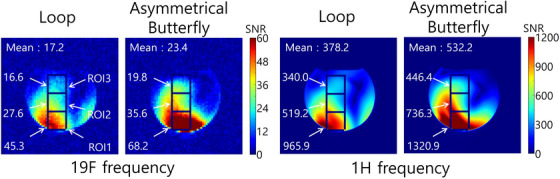 Figure 2
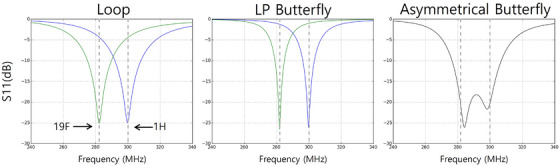 Figure 3
 Figure 4
Peer Reviews
No public reviews on file for this paper yet. If you reviewed it on a platform where reviews are public (OpenReview, ICLR, NeurIPS, ICML), you can paste yours below so the community can read it here.
Videos
No videos yet. Explain this paper in a talk, walkthrough, or lecture? Add one.
Taxonomy
TopicsAdvanced MRI Techniques and Applications · Advanced NMR Techniques and Applications · Atomic and Subatomic Physics Research