Abnormally Long O–O Bond in trans-HOON: An Exemplary Charge-Shift Bond
Huaiyu Zhang, Jia Wei, Rui Ma, Jinshuai Song, Wei Wu, Yirong Mo

TL;DR
This paper explains why the O–O bond in trans-HOON is unusually long and weak using valence bond theory, comparing it to the more stable O–S bond in trans-HOSN.
Contribution
The study reveals that trans-HOON's O–O bond is a charge-shift bond with enhanced hyperconjugation, unlike trans-HOSN's simpler bond structure.
Findings
Trans-HOON's O–O bond is a three-center four-electron charge-shift bond with nitrene-like characteristics.
Hyperconjugation from the nitrogen lone pair to the σ*O–O orbital weakens and elongates the O–O bond in trans-HOON.
Trans-HOSN has a two-center two-electron charge-shift bond and is stabilized by conjugation and hyperconjugation.
Abstract
Nitrous acid (HONO) plays a significant role in atmospheric and combustion chemistry. While extensive attention has been devoted to the study of HONO, its isomer (HOON) has remained relatively unexplored until recent experimental and theoretical analyses revealed its unusually long and weak O–O bond. In contrast, its sulfur-substituted analogue, HOSN, exhibits a normal O–S bond. Here, we explored the intriguing bonding nature of trans-HOXN (X = O, S) from the perspective of the ab initio valence bond (VB) theory in order to elucidate the different behaviors of the O–O and O–S bonds therein. Our results demonstrated that the bonding in trans-HOON can be described as a three-center four-electron charge-shift bond, where the ON moiety most closely resembles nitric oxide, with some nitrene characters. Since the π bond in ON is a dative bond resulting from one lone pair on the oxygen atom,…
Genes, proteins, chemicals, diseases, species, mutations and cell lines named across the full text — each resolved to its canonical identifier and authoritative record.
Click any figure to enlarge with its caption.
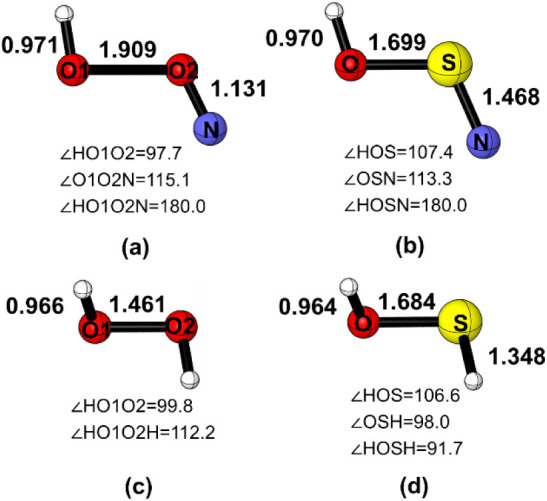 Figure 1
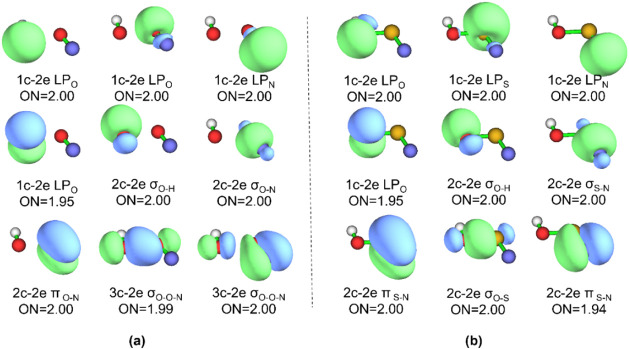 Figure 2
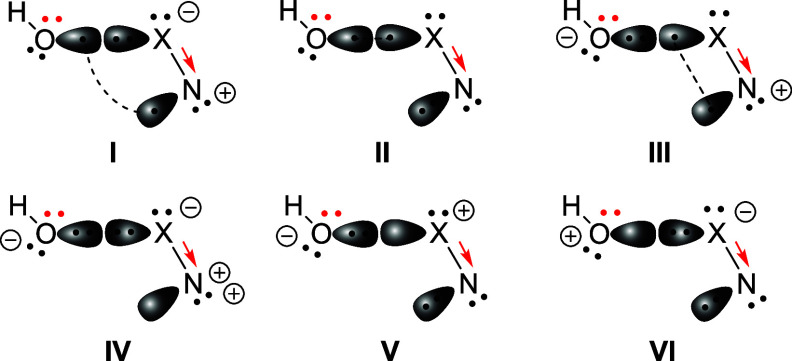 Figure 3
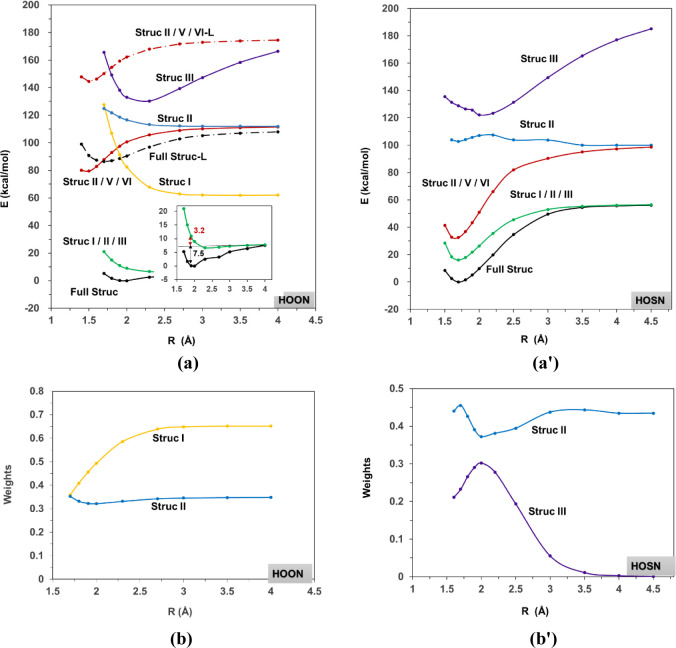 Figure 4
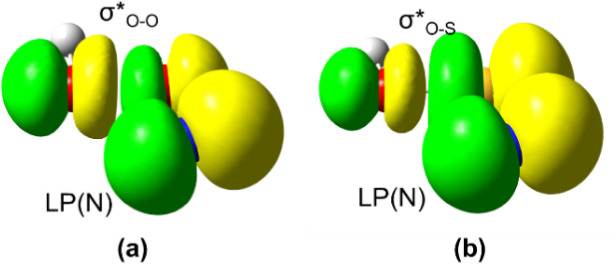 Figure 5
 Figure 6
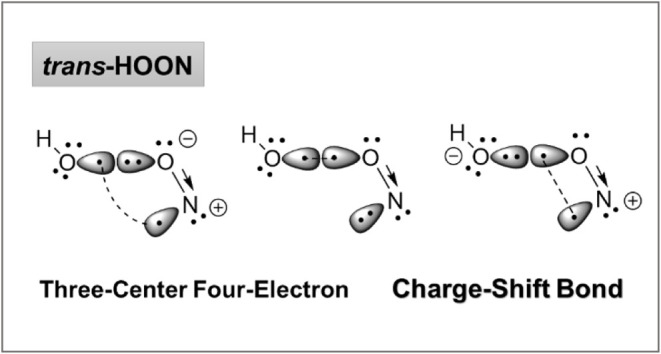 Figure 7
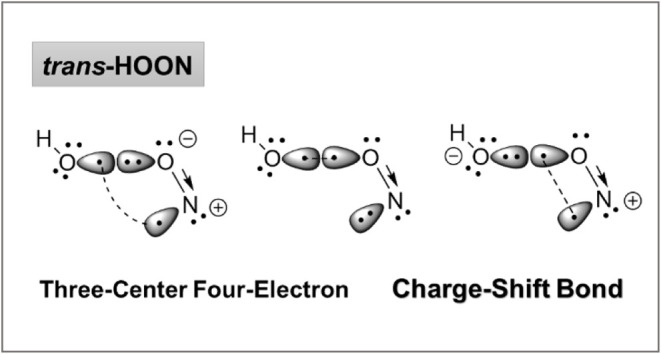 Figure 8
 Figure 9
 Figure 10
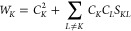 Figure 11
Peer Reviews
No public reviews on file for this paper yet. If you reviewed it on a platform where reviews are public (OpenReview, ICLR, NeurIPS, ICML), you can paste yours below so the community can read it here.
Videos
No videos yet. Explain this paper in a talk, walkthrough, or lecture? Add one.
Taxonomy
TopicsElectron Spin Resonance Studies · Lanthanide and Transition Metal Complexes · Nitric Oxide and Endothelin Effects