Differentiating mega cisterna magna from cisterna magna arachnoid cysts: The diagnostic utility of quantitative diffusion‐weighted imaging parameters
Quanxiang Li, Zhe Feng, Haichao Cheng, Xin Cao, Yaping Ge, Hao Shi, Jun‐Ying Wang

TL;DR
This study shows that diffusion imaging can help distinguish between two similar brain conditions using specific imaging parameters.
Contribution
The study demonstrates the diagnostic utility of ADC and eADC in differentiating mega cisterna magna from arachnoid cysts.
Findings
MCM had significantly lower eADC values compared to CMAC and TAC.
ADC values of MCM were significantly different from both CMAC and TAC.
eADC did not significantly differentiate CMAC from TAC.
Abstract
To explore the utility of diffusion‐weighted imaging (DWI)‐derived apparent diffusion coefficient (ADC) and exponential apparent diffusion coefficient (eADC) parameters in differentiating mega cisterna magna (MCM) from cisterna magna arachnoid cysts (CMAC). Retrospective analysis of MRI data from 40 MCM patients, 46 CMAC patients (confirmed via clinical follow‐up and imaging criteria), and 36 temporal arachnoid cysts (TAC) as controls was performed. Independent sample t‐tests were used to compare ADC and eADC values among the three groups. The eADC values of MCM, CMAC, and TAC were (3.75 ± 0.27) × 10−2, (4.53 ± 0.54)×10−2, and (4.35 ± 0.30) ×10−2 mm2/s, respectively. There was no significant difference in the eADC value between CMAC and TAC (p = 0.191). However, the eADC value of MCM was significantly different from the two groups (p = 0.000). The ADC values of MCM, CMAC, and TAC were…
Genes, proteins, chemicals, diseases, species, mutations and cell lines named across the full text — each resolved to its canonical identifier and authoritative record.
Click any figure to enlarge with its caption.
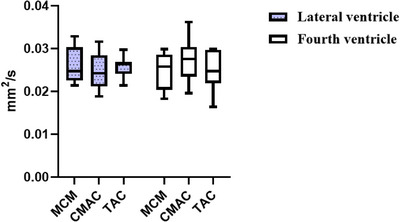 Figure 1
 Figure 2
 Figure 3
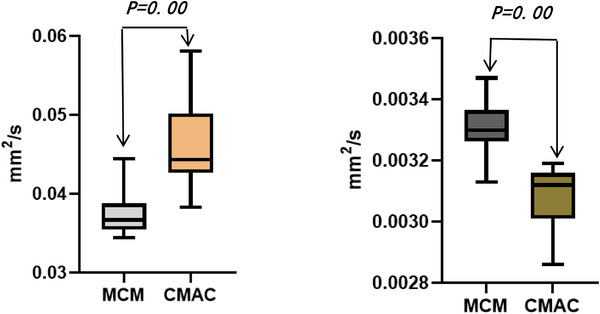 Figure 4
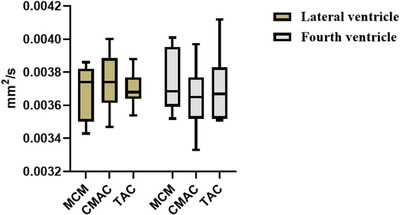 Figure 5
 Figure 6
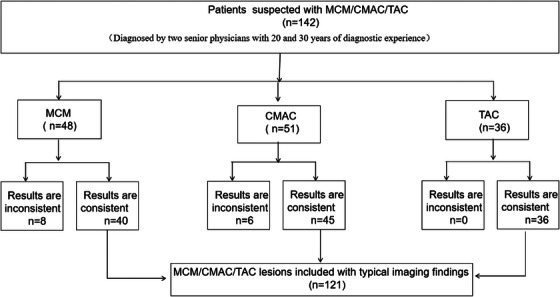 Figure 7
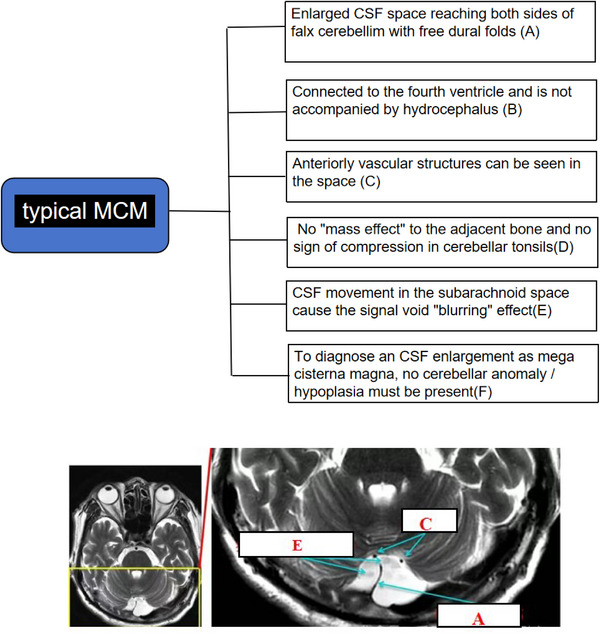 Figure 8
 Figure 9
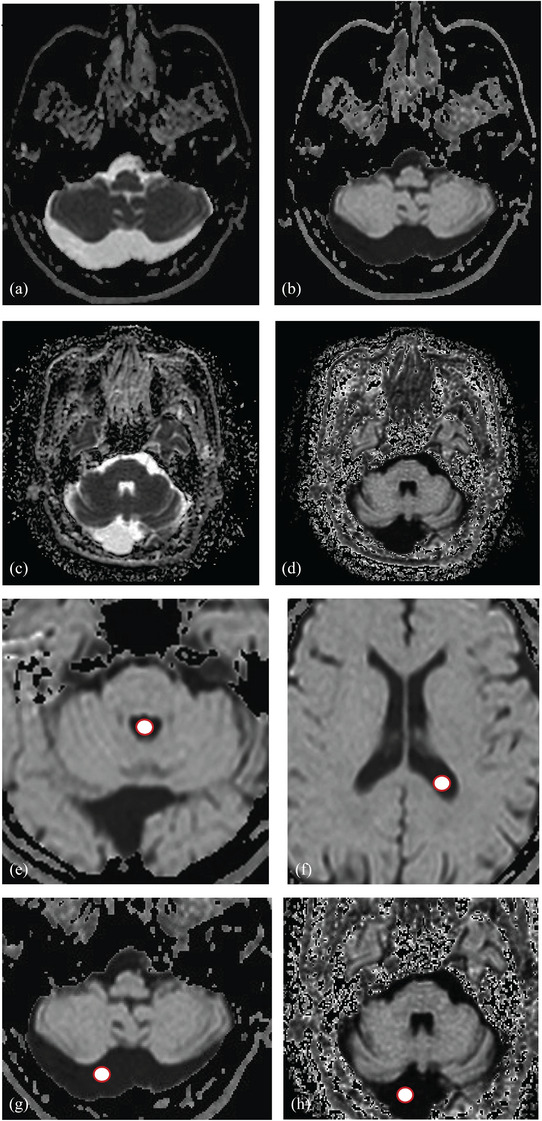 Figure 10
 Figure 11
Peer Reviews
No public reviews on file for this paper yet. If you reviewed it on a platform where reviews are public (OpenReview, ICLR, NeurIPS, ICML), you can paste yours below so the community can read it here.
Videos
No videos yet. Explain this paper in a talk, walkthrough, or lecture? Add one.
Taxonomy
TopicsCerebrospinal fluid and hydrocephalus · Spinal Dysraphism and Malformations · Fetal and Pediatric Neurological Disorders