Implementing team science in undergraduate medical physics research
Ashley J. Cetnar

TL;DR
This paper describes a 10-week summer program for undergraduate students using a Team Science approach to introduce them to medical physics research and improve their attitudes toward science.
Contribution
The paper introduces a novel Team Science framework for undergraduate medical physics education, emphasizing collaborative and authentic research experiences.
Findings
Student attitudes toward problem-solving and experimental physics improved by 9.8% and 14.2%, respectively.
Students gained experience in real-world research and team dynamics through multiple projects in the program.
The program helped students understand the practical aspects of research and its relevance to future careers.
Abstract
Many undergraduate students are eager to learn more about potential career opportunities. While physics majors are often aware of research opportunities within their home department, students may not be aware of how physics can be applied in medicine. An alternate framework for a 10‐week summer undergraduate research experience using a collaborative Team Science approach is presented. The Team Science program is described, with feasibility shared based on the experiences of four students who piloted the program. Students explored four different projects throughout the summer as part of the 10‐week program and assumed different team roles for each project fostering experience understanding team dynamics. Changes in student attitudes toward science research were quantified using validated surveys and qualitative responses are also summarized. Average self‐reported student scores in the…
Genes, proteins, chemicals, diseases, species, mutations and cell lines named across the full text — each resolved to its canonical identifier and authoritative record.
Click any figure to enlarge with its caption.
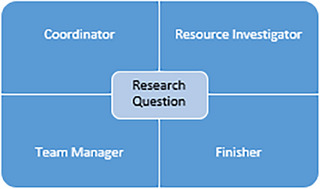 Figure 1
Peer Reviews
No public reviews on file for this paper yet. If you reviewed it on a platform where reviews are public (OpenReview, ICLR, NeurIPS, ICML), you can paste yours below so the community can read it here.
Videos
No videos yet. Explain this paper in a talk, walkthrough, or lecture? Add one.
Taxonomy
TopicsBiomedical and Engineering Education · Interdisciplinary Research and Collaboration · Advances in Oncology and Radiotherapy