Colpocleisis for recurrent pelvic organ prolapse after tension-free vaginal mesh repair: a case report
Akihiko Misawa, Eizo Kimura, Miho Inoue, Shion Mitsuya, Makoto Osaka, Yasunori Sato, Kiyono Osanai, Atsushi Suzuki

TL;DR
This case report describes a patient with recurrent pelvic organ prolapse after a mesh-based surgery, treated successfully with vaginal closure surgery.
Contribution
The case highlights the potential for recurrent prolapse after tension-free vaginal mesh repair and the viability of colpocleisis as a management option.
Findings
Recurrent posterior vaginal wall prolapse can occur after tension-free vaginal mesh repair for anterior wall prolapse.
LeFort colpocleisis is a safe and effective treatment option when conservative management is not feasible.
Abstract
Tension-free vaginal mesh repair surgery (TVM) has decreased due to complications related to mesh use and the lack of superiority compared to native tissue repair (NTR). In japan it is still performed as a treatment for pelvic organ prolapse (POP). However, recurrent prolapse after TVM does occur, necessitating appropriate management. The patient was underwent TVM-A surgery at another hospital 12 years ago for cystocele. POP-Q stage II rectocele was observed, and the LeFort colpocleisis was performed. Although TVM surgery is effective via the vaginal approach, recurrent posterior vaginal wall prolapse may occur over time, as seen in this case, even in patients who had single-mesh procedures for anterior vaginal wall repair. When conservative treatment is difficult, vaginal closure surgery, a traditional approach, can be safely performed.
Genes, proteins, chemicals, diseases, species, mutations and cell lines named across the full text — each resolved to its canonical identifier and authoritative record.
Click any figure to enlarge with its caption.
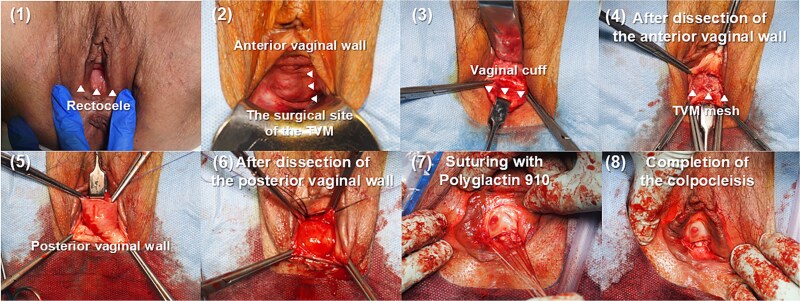 Figure 1
Peer Reviews
No public reviews on file for this paper yet. If you reviewed it on a platform where reviews are public (OpenReview, ICLR, NeurIPS, ICML), you can paste yours below so the community can read it here.
Videos
No videos yet. Explain this paper in a talk, walkthrough, or lecture? Add one.
Taxonomy
TopicsPelvic floor disorders treatments · Anorectal Disease Treatments and Outcomes · Pelvic and Acetabular Injuries