Synthetic Plantaricins Derived from Lactiplantibacillus plantarum KM2 Induce Cell Lysis of Listeria monocytogenes
Seung-Eun Oh, Sojeong Heo, Minkyeong Kim, Yura Moon, Sumin Lee, Chaerin Park, Huieun Sung, Gawon Lee, Jina Kim, Moon-Hee Sung, Do-Won Jeong

TL;DR
This study shows that synthetic plantaricins from Lactiplantibacillus plantarum KM2 can kill Listeria monocytogenes, a dangerous foodborne pathogen, by damaging its cell wall.
Contribution
The study introduces synthetic plantaricin combinations as effective and stable antibacterial agents against L. monocytogenes.
Findings
Synthetic plantaricins caused cell wall damage and lysis in L. monocytogenes.
spPlnE&F and spPlnE&J were most effective at disrupting the bacterial cell wall.
Plantaricin combinations remained stable and effective under various pH and temperature conditions.
Abstract
Listeria monocytogenes is a deadly foodborne pathogen that presents significant challenges in food safety management due to its high resilience in various environments. This study evaluated antibacterial activities of synthetic plantaricins derived from Lactiplantibacillus plantarum KM2 against L. monocytogenes. The minimum inhibitory concentrations of the five synthetic plantaricin combinations—spPlnA, spPlnJ, spPlnE&F, spPlnE&J, and spPlnJ&K—were 1.4, 1.5, 1.8, 1.6, and 1.6 μg/ml, respectively, Raman spectroscopy and transmission electron microscopy demonstrated that the synthetic plantaricins induced morphological alterations, including cell wall damage and cell lysis. Notably, spPlnE&F and spPlnE&J were shown to effectively disrupt the bacterial cell wall. Furthermore, assessments of antibacterial stability under varying temperatures and pH conditions showed that plantaricin…
Genes, proteins, chemicals, diseases, species, mutations and cell lines named across the full text — each resolved to its canonical identifier and authoritative record.
Click any figure to enlarge with its caption.
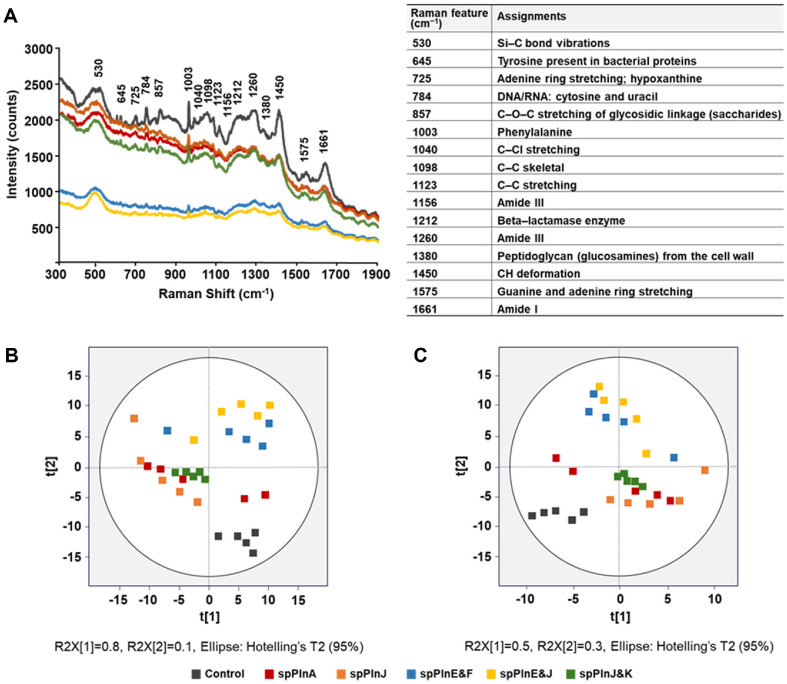 Figure 1
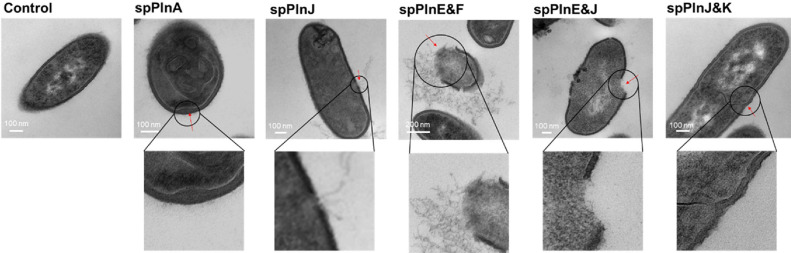 Figure 2
Peer Reviews
No public reviews on file for this paper yet. If you reviewed it on a platform where reviews are public (OpenReview, ICLR, NeurIPS, ICML), you can paste yours below so the community can read it here.
Videos
No videos yet. Explain this paper in a talk, walkthrough, or lecture? Add one.
Taxonomy
TopicsMedicinal Plant Pharmacodynamics Research · Natural product bioactivities and synthesis · Microbial Metabolism and Applications