Mapping QTLs for Pyricularia leaf spot, nematode resistance, and yield related traits in pearl millet [Cenchrus americanus (L.) Morrone]
Sairam Vutla, Joseph E. Knoll, Anvesh Sankuratri, Risha G. Nayak, Limei Liu, Peng W. Chee, Raghupathy Karthikeyan, Bashasab Fakrudin, Mahendar Thudi, Patricia Timper, Karen Harris-Shultz, Jason G. Wallace, Hari Singh, Bharat Singh, Somashekhar M. Punnuri

TL;DR
This study identifies genetic regions in pearl millet linked to traits like disease resistance, plant height, and yield, which can help breed better varieties.
Contribution
The study maps 45 QTLs for multiple traits in pearl millet, revealing genetic links and potential for marker-assisted breeding.
Findings
45 QTLs were identified across eight traits, explaining 6.31 to 32.51% of phenotypic variance.
Plant height and days to heading were colocalized on LG2 and LG5, showing genetic linkage.
Five QTLs on LG3 suggest simultaneous improvement of plant height, stem diameter, and panicle traits.
Abstract
Pearl millet [Cenchrus americanus (L.) Morrone, formerly Pennisetum glaucum (L.) R. Br.] is the sixth most important cereal globally and is used for forage and feed in the U.S. To identify genomic regions governing important physiological, agronomic and yield related traits, a recombinant inbred line population derived from the cross between Tift 99D2B1 × Tift 454 was phenotyped in the field in 2006, 2007 and 2013. In addition, the population was phenotyped for root-knot nematode resistance in the greenhouse during 2009. Using a previously generated genetic map containing 505 single nucleotide polymorphism markers and composite interval mapping, we identified 45 QTLs for eight traits (plant height, stem diameter, days to heading, panicle diameter, panicle length, 1000 seed weight, Pyricularia leaf spot disease, and root-knot nematode egg mass) across almost all linkage groups. These…
Genes, proteins, chemicals, diseases, species, mutations and cell lines named across the full text — each resolved to its canonical identifier and authoritative record.
Click any figure to enlarge with its caption.
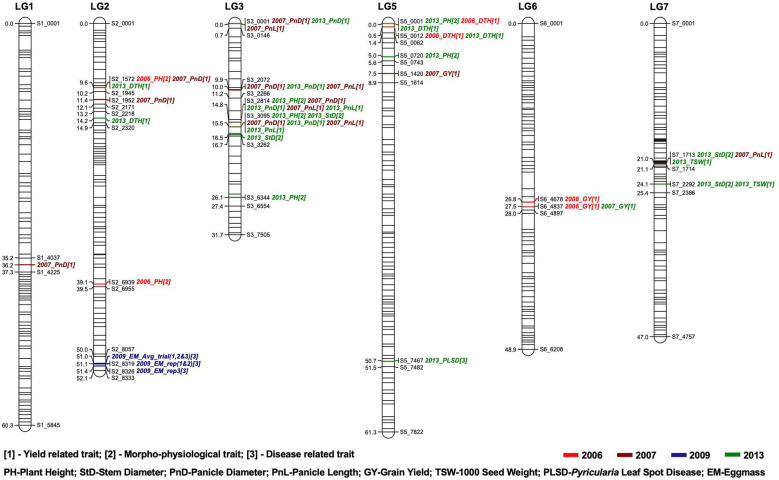 Figure 1
Peer Reviews
No public reviews on file for this paper yet. If you reviewed it on a platform where reviews are public (OpenReview, ICLR, NeurIPS, ICML), you can paste yours below so the community can read it here.
Videos
No videos yet. Explain this paper in a talk, walkthrough, or lecture? Add one.
Taxonomy
TopicsWheat and Barley Genetics and Pathology · Genetic Mapping and Diversity in Plants and Animals · Plant nutrient uptake and metabolism