A semi‐automated workflow for cohort‐wise preparation of radiotherapy data for dose‐response modeling, including autosegmentation of organs at risk
Louise Mövik, Anna Bäck, Kerstin Gunnarsson, Christian Jamtheim Gustafsson, Andreas Hallqvist, Niclas Pettersson

TL;DR
This paper introduces a semi-automated workflow to efficiently prepare radiotherapy data for risk modeling, using deep learning to automatically segment organs at risk.
Contribution
The novel contribution is a semi-automated workflow for cohort-wise data preparation and a superior deep learning-based autosegmentation model for organs at risk.
Findings
The DL-based methods outperformed atlas-based methods for segmenting the proximal bronchial tree and esophagus.
The in-house DL model achieved the highest Dice similarity coefficient across all organs at risk.
The workflow successfully processed 80% of test cases without manual intervention.
Abstract
Preparing retrospective dose data for risk modeling using large study cohorts can be time consuming as it often requires patient‐wise manual interventions. This is especially the case when considering organs at risk (OARs) not systematically delineated historically. Therefore, we aimed to develop and test a semi‐automated workflow for cohort‐wise preparation of radiotherapy data from the oncology information system (OIS), including OAR autosegmentation, for risk modeling purposes. A semi‐automated workflow, including cohort‐wise data extraction from a clinical OIS, cleanup, autosegmentation, quality controls (QCs), and data injection into a research OIS was iteratively developed using 106 patient cases. We evaluated two deep learning (DL)‐based methods and compared with four atlas‐based methods for autosegmentation of the proximal bronchial tree (PBT), the heart, and the esophagus that…
Genes, proteins, chemicals, diseases, species, mutations and cell lines named across the full text — each resolved to its canonical identifier and authoritative record.
Click any figure to enlarge with its caption.
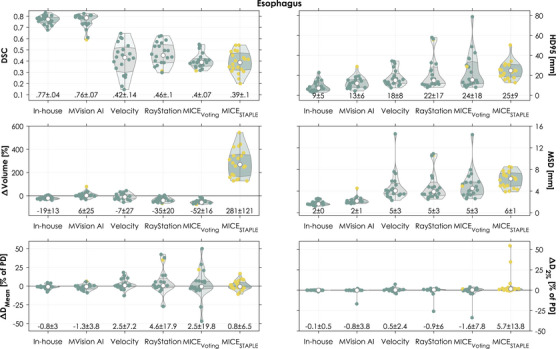 Figure 1
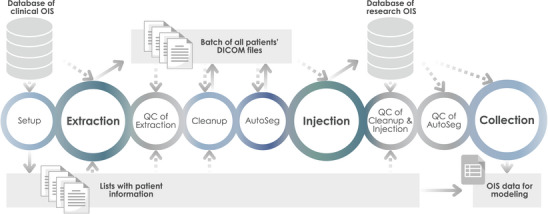 Figure 2
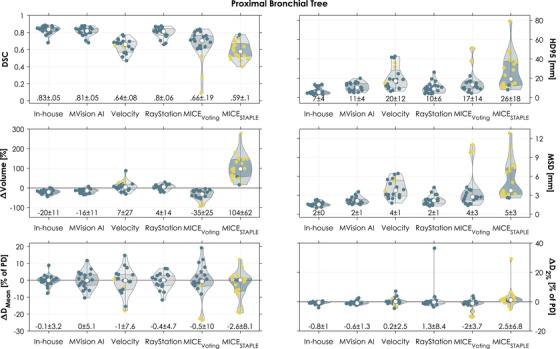 Figure 3
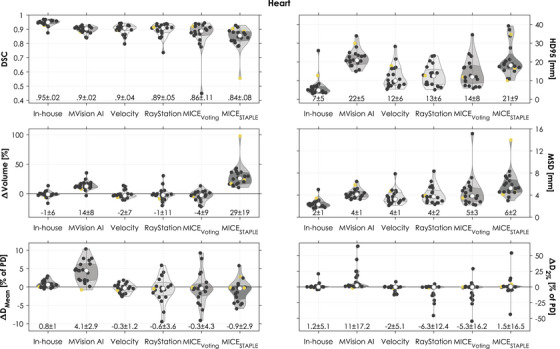 Figure 4
Peer Reviews
No public reviews on file for this paper yet. If you reviewed it on a platform where reviews are public (OpenReview, ICLR, NeurIPS, ICML), you can paste yours below so the community can read it here.
Videos
No videos yet. Explain this paper in a talk, walkthrough, or lecture? Add one.
Taxonomy
TopicsAdvanced Radiotherapy Techniques · Radiomics and Machine Learning in Medical Imaging · Lung Cancer Diagnosis and Treatment