Producing high quality cranial SRS plans with 4Pi planning technique in a commercial clinical solution
Ganesh Narayanasamy, Nishan Shrestha, Milan Bimali, Fen Xia, Zhong Su

TL;DR
This study shows that automated 4Pi planning in Brainlab Elements produces better cranial SRS plans than manual planning in Eclipse, with improved dose control and fewer side effects.
Contribution
Demonstrates that automated 4Pi planning in a commercial system improves SRS plan quality over manual clinical planning.
Findings
Elements 4Pi plans had significantly lower gradient index, monitor units, and doses to critical structures compared to Eclipse.
Elements 4Pi also achieved better dose conformality than both Eclipse and Elements ArcMatch plans.
Automation in Elements produced collision-free, clinically deliverable plans with reduced normal tissue exposure.
Abstract
To generate high‐quality stereotactic radiosurgery (SRS) plans for single cranial lesions using 4Pi planning technique and compare these to our clinical “status quo” plans. Eighteen vestibular schwannoma (VS) patients previously planned with Varian Eclipse RapidArc and treated on a Varian TrueBeam using 6FFF MV photon beams were randomly selected. This cohort was replanned in Brainlab Elements Cranial SRS using an automatic 4Pi trajectory optimization technique (“Elements 4Pi”). “Elements ArcMatch” plans were also created, which utilized the identical arc geometry as the clinical plans in Eclipse, that is, used identical table angles, gantry start and stop angles, and collimator angles to isolate the inherent differences between the two treatment planning systems. SRS plan evaluation metrics included the Inverse Paddick conformity index (IPCI), gradient index (GI), max doses to the…
Genes, proteins, chemicals, diseases, species, mutations and cell lines named across the full text — each resolved to its canonical identifier and authoritative record.
Click any figure to enlarge with its caption.
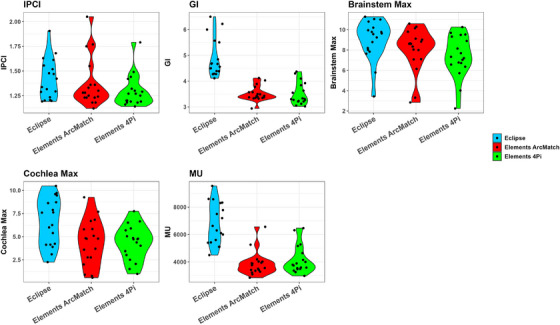 Figure 1
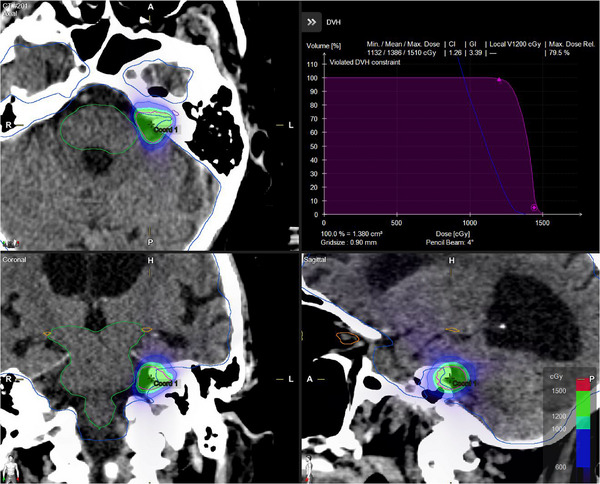 Figure 2
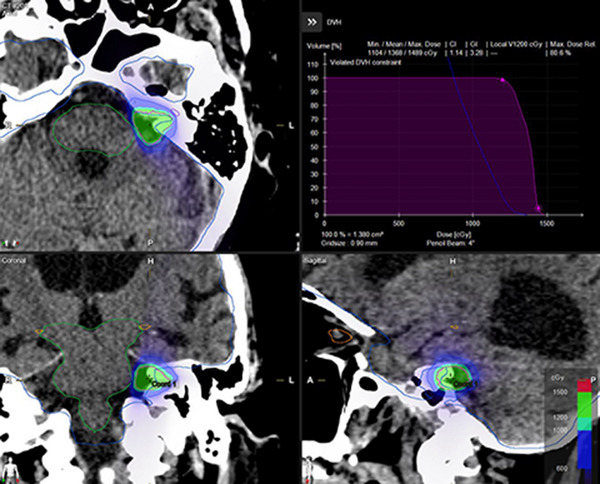 Figure 3
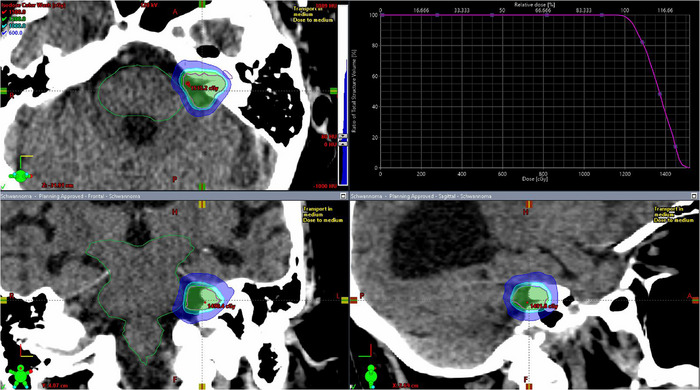 Figure 4
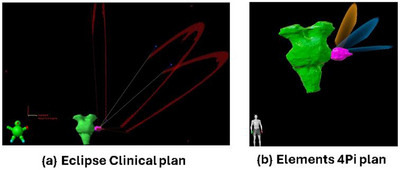 Figure 5
Peer Reviews
No public reviews on file for this paper yet. If you reviewed it on a platform where reviews are public (OpenReview, ICLR, NeurIPS, ICML), you can paste yours below so the community can read it here.
Videos
No videos yet. Explain this paper in a talk, walkthrough, or lecture? Add one.
Taxonomy
TopicsAdvanced Radiotherapy Techniques · Medical Imaging Techniques and Applications · Radiation Dose and Imaging