Orexin-A and motion sickness: a systematic review of animal model studies
Xu Cai, Long Zhao, Xin Wang, Jiahui Chen, Ying Yuan, Biao Gao, Yanli You

TL;DR
This review explores how orexin-A, a brain chemical, may help reduce motion sickness in animals, but more high-quality research is needed to confirm its effectiveness.
Contribution
The paper systematically reviews animal studies to evaluate orexin-A's role in motion sickness and highlights research gaps.
Findings
Orexin-A reduced motion sickness symptoms in rat and cat models.
Benefits may come from improved stomach motility and vestibular function.
Study quality was limited by poor reporting and inconsistent methods.
Abstract
Sensory input mismatches among the vestibular system, autonomic control, and visual perception cause motion sickness. Anticholinergics and antihistamines are commonly used but have limited efficacy and cause significant side effects. Orexin-A, a hypothalamic neuropeptide, has recently garnered attention for its potential role in controlling motion sickness. To summarize current knowledge on the effects and mechanisms of orexin-A in reducing motion sickness, identify gaps, and propose future research directions. Five qualified animal experiments were identified after searching PubMed, Scopus, Cochrane Library, Embase, and WoS. The SYRCLE tool was used to evaluate study quality, followed by a qualitative synthesis. Orexin-A reduced motion-induced behavioral abnormalities, nausea, and vomiting in rat and cat models. These benefits are likely mediated by the modulation of hypothalamic…
Genes, proteins, chemicals, diseases, species, mutations and cell lines named across the full text — each resolved to its canonical identifier and authoritative record.
Click any figure to enlarge with its caption.
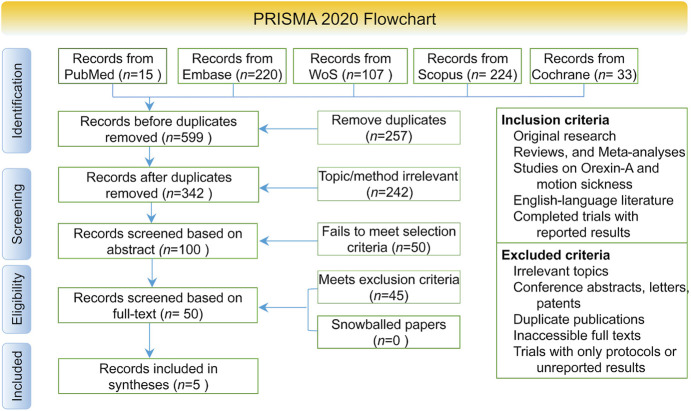 Figure 1
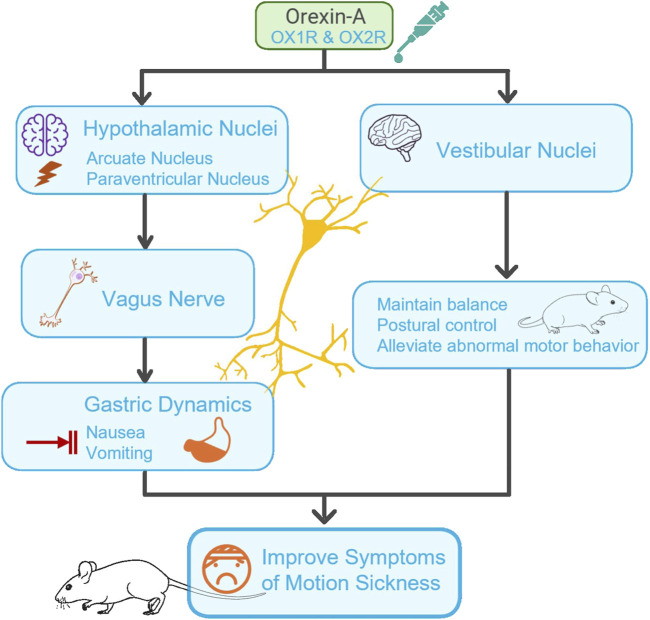 Figure 2
 Figure 3
 Figure 4
Peer Reviews
No public reviews on file for this paper yet. If you reviewed it on a platform where reviews are public (OpenReview, ICLR, NeurIPS, ICML), you can paste yours below so the community can read it here.
Videos
No videos yet. Explain this paper in a talk, walkthrough, or lecture? Add one.
Taxonomy
TopicsSleep and Wakefulness Research · Olfactory and Sensory Function Studies · Vestibular and auditory disorders