Chemotype, maternal genotype, or field neighbors: what influences performance and resource allocation in a perennial plant species the most?
Dominik Ziaja, Rohit Sasidharan, Ruth Jakobs, Elisabeth J. Eilers, Caroline Müller

TL;DR
This study explores how chemotype, maternal genotype, and neighboring plants influence growth and reproduction in a perennial plant species.
Contribution
The study reveals how chemotype and neighborhood chemodiversity affect plant reproduction traits through resource allocation.
Findings
Plants in heterogeneous plots produced more flower heads than those in homogeneous plots.
Maternal genotype influenced growth and reproduction-related traits.
No significant correlations were found between terpenoid diversity and growth traits.
Abstract
Plants have to allocate resources into their growth and reproduction but also in phytochemicals used in interactions with their environment. Some species display an extraordinarily high diversity of such phytochemicals, called chemodiversity. In stands with different neighbors, plot chemodiversity may be even higher and provide associational resistance. Little is known about trade-offs in investment into growth and reproduction versus chemodiversity in plant individuals growing in chemically different neighborhoods. We investigated such trade-offs using the perennial Tanacetum vulgare, which shows differences in leaf terpenoid composition, forming distinct chemotypes. We planted plots consisting of five plants of one of five chemotypes (homogenous neighborhoods) and plots consisting of five different chemotypes (heterogenous) in a field. Plants within each block were offspring from…
Genes, proteins, chemicals, diseases, species, mutations and cell lines named across the full text — each resolved to its canonical identifier and authoritative record.
Click any figure to enlarge with its caption.
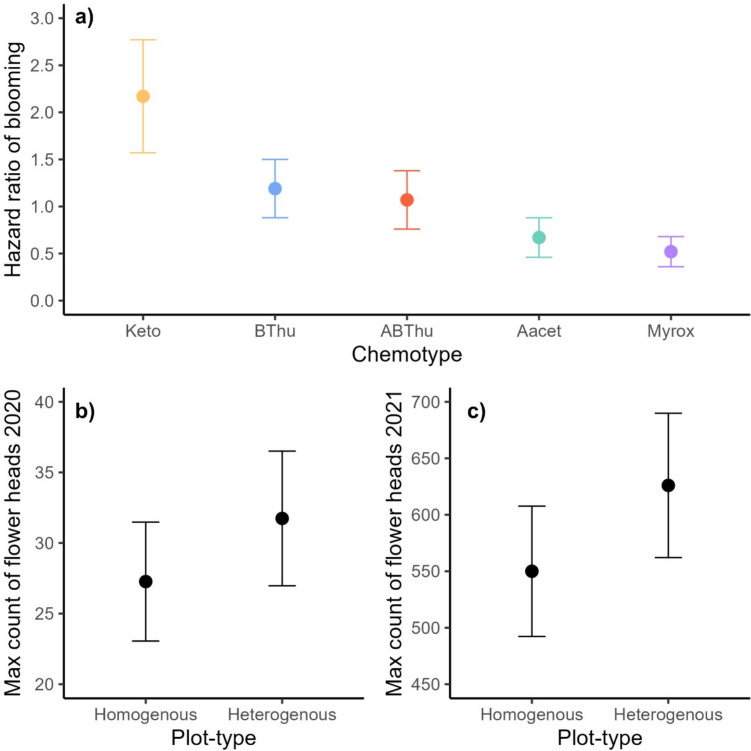 Figure 1
 Figure 2
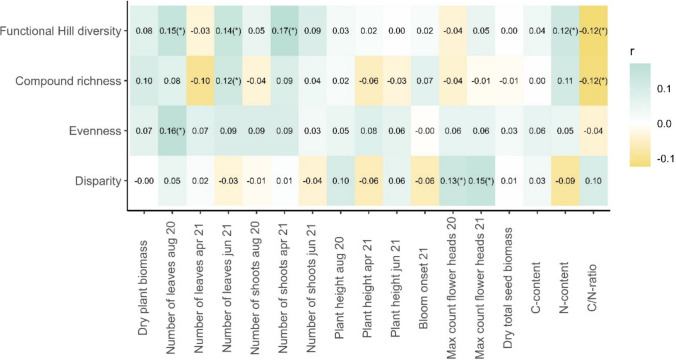 Figure 3
 Figure 4
Peer Reviews
No public reviews on file for this paper yet. If you reviewed it on a platform where reviews are public (OpenReview, ICLR, NeurIPS, ICML), you can paste yours below so the community can read it here.
Videos
No videos yet. Explain this paper in a talk, walkthrough, or lecture? Add one.
Taxonomy
TopicsPlant and animal studies · Plant biochemistry and biosynthesis · Essential Oils and Antimicrobial Activity