Vicialiupanshanensis (Fabaceae), a new plant species from northwestern China

Abstract
Genes, proteins, chemicals, diseases, species, mutations and cell lines named across the full text — each resolved to its canonical identifier and authoritative record.
Click any figure to enlarge with its caption.
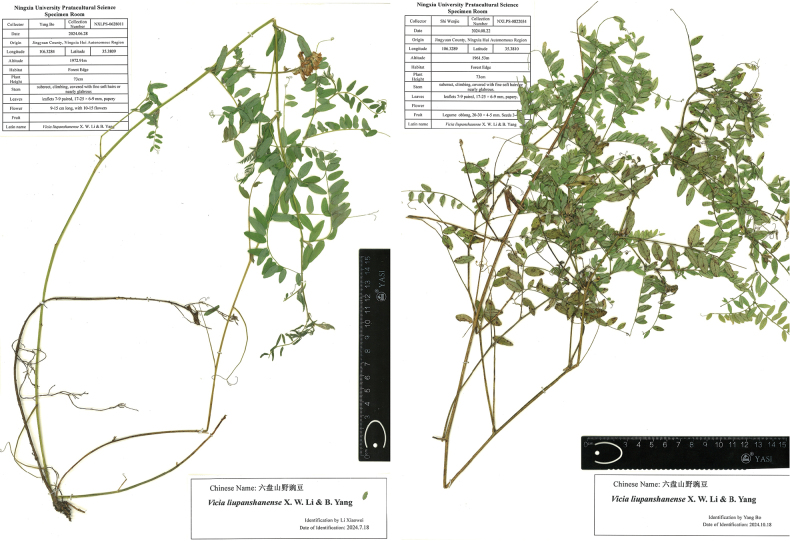 Figure 1
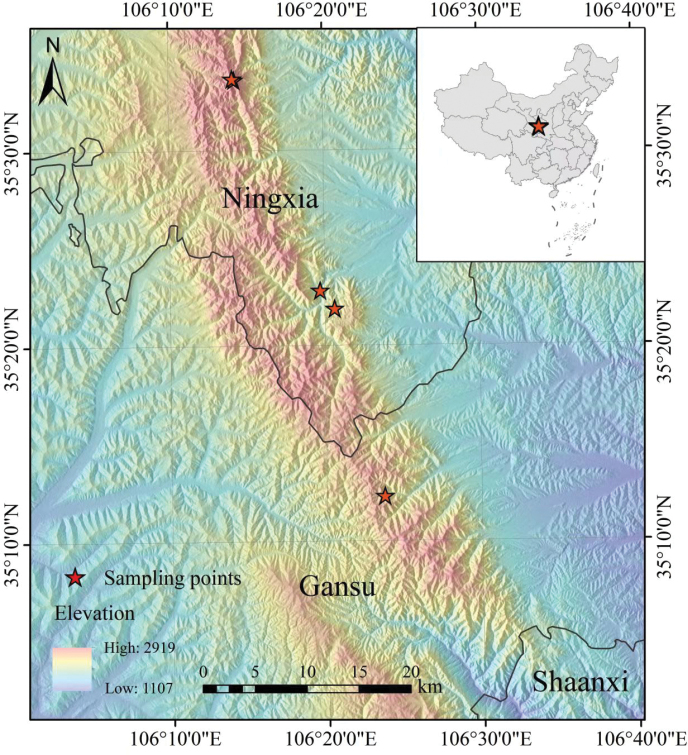 Figure 2
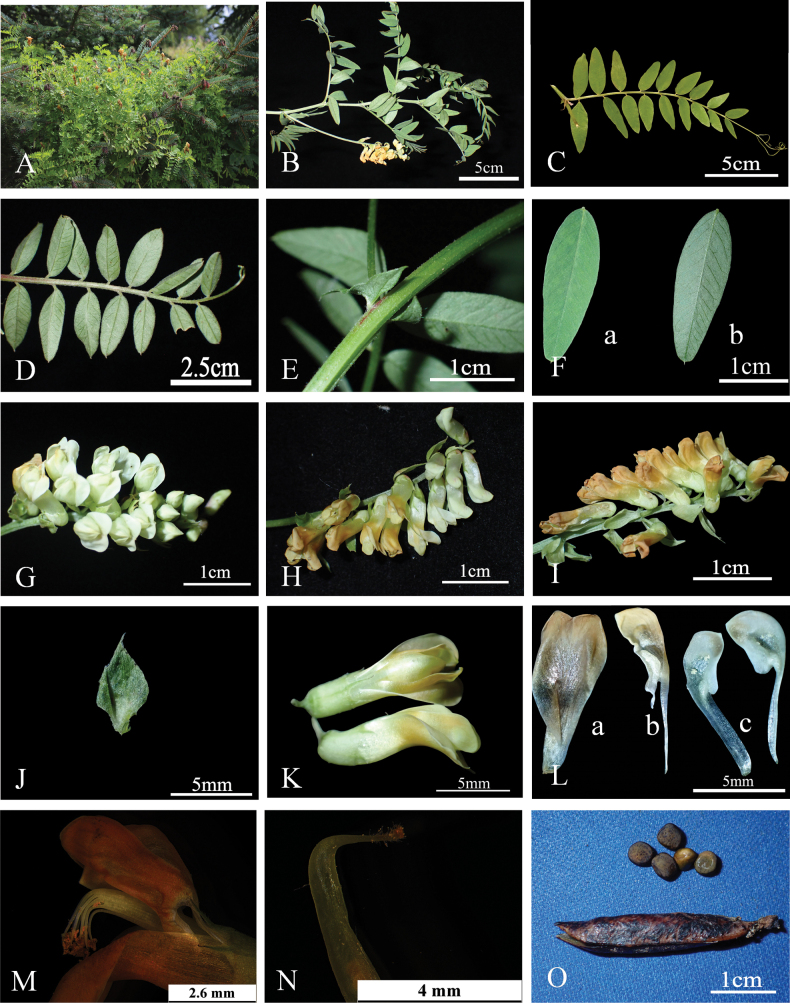 Figure 3
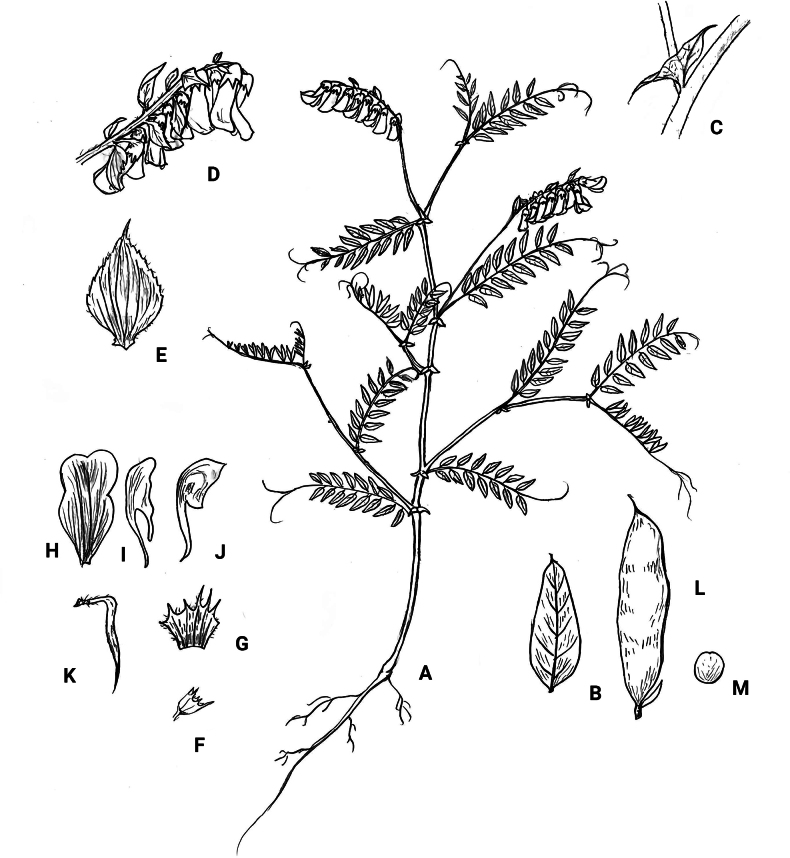 Figure 4
| Characters |
|
|
|
|---|---|---|---|
| Stem height (cm) | 50–150 | 60–100 | 50–180 |
| Plant indumentum | Covered with fine soft hairs or nearly glabrous | Totally glabrous | Totally glabrous |
| Leaf length (cm), tendril excluded | 8–15 | 8–12 | 8–15 |
| Leaflet pairs per leaf | 7–9 | 4–6 | 3–5 |
| Leaflet shape | Oblong-lanceolate or elliptical | Elliptic to ovate-oblong | Elliptic to ovate-oblong |
| Leaflet size (cm) | 1.7–2.5 × 0.6–0.9 | 1.3–5.0 × 0.6–1.5 | 2.3–3.8 × 0.7–1.5 |
| Leaflet texture | Papery | Papery | Papery |
| Stipules | Semi-sagittate | Attached at the lower part, with the upper part being semi-ovate and the tip having a linear-lanceolate shape | Semi-hastate or lanceolate |
| Raceme (number of flowers) | 10–15 | 5–15 | 10–20 |
| Bractlet shape | 5–7 mm long, rhombic, covered with short soft hairs | Absent | 0.2–0.3 × 0.1 cm, subulate |
| Corolla color | Corolla pale greenish-white initially, gradually turning yellow-brown, dark yellow or dark orange | Yellow or brown-yellow | Light yellow or dull orange |
| Calyx shape | Oblique campanulate, hairy, with 5 teeth | Shortly and unequally toothed | Obliquely campanulate, 5 lateral teeth acute, some calyces are cleft |
| Standard | Ovate, about 1 cm long, with a broad claw, the apex concave, the sides constricted in the middle | Narrowly obovate-oblong, constricted at middle, ca. 13 mm, apex retuse | Apex retuse, 1.3–1.4 × 0.4–0.5 cm |
| Wing | Nearly equal (subequal) in length to the standard | 10 mm | Nearly equal (subequal) in length to the standard |
| Keel | Slightly shorter than standard and wing | 10 mm | Nearly equal (subequal) in length to the standard |
| Legume (mm) | Oblong, 20–30 × 4–5 | Oblong-rhomboid, 20–30 × 5 | Falcate, 30–35 × 3 |
| Seed color | Brown with black spots | Brown with black spots | Brown-green |
| Number of seeds per pod | 3–5 | 2–5 | 4–6 |
| 1a | Stipules large, over 10 mm long |
|
| 2a | Leaflets small, 1.3–4 cm long, 0.5–1.8 cm wide; leathery; apex rounded or slightly emarginate, lateral veins fan-shaped, extending to margin without forming reticulation |
|
| 2b | Leaflets large, (2-)3–6(-10) cm long, 1.2–2.5 cm wide; papery; apex acute, lateral veins reaching margin in wavy or dentate connections |
|
| 1b | Stipules small, less than 10 mm long |
|
| 3a | Flowers purple, bluish-purple or red |
|
| 4a | Flowers small, 0.7–1.4 cm long |
|
| 4b | Flowers larger, 10–20 mm long |
|
| 5a | Leaflet venation dense and distinct, lateral veins spreading at right angles |
|
| 6a | Leaflets elliptic or oblong-ovate, 10–16 mm wide; flowers 15–30, densely arranged |
|
| 6b | Leaflets oblong, less than 6 mm wide; flowers 4–15, loosely arranged |
|
| 7a | Stipules small, bifid; inflorescence nearly equaling leaves; flowers 10–11 mm long |
|
| 7b | Stipules triangular, with several teeth; inflorescence longer than leaves; flowers 10–20 mm long |
|
| 5b | Leaflet venation sparse, lateral veins ascending at acute angles |
|
| 8a | Flowers with bracteoles; inflorescence shorter than leaves; stipules semi-sagittate, rhombic to lanceolate; leaflets 6–10 pairs, linear-lanceolate, ovate-lanceolate or oblong |
|
| 8b | Flowers without bracteoles; inflorescence equaling or slightly exceeding leaves; stipules bifid, lobes subulate |
|
| 9a | Leaflets linear-oblong, very narrow, only 1.5–3 mm wide; inflorescence longer than leaves; flowers 13–17 mm long |
|
| 9b | Leaflets elliptic or ovate-lanceolate, 10–20 mm long, relatively broad; inflorescence equaling leaves; flowers 10–14 mm long |
|
| 10a | Leaflets ovate-lanceolate, 4–7 mm wide |
|
| 10b | Leaflets elliptic, broadly elliptic to long-ovate, 6–14 mm wide |
|
| 3b | Flowers dull yellow or white |
|
| 11a | Plants tall, shrubby, white-pubescent; flowers smallca. 7 mm long |
|
| 11b | Plants sparsely pubescent or glabrous; flowers relatively large |
|
| 12a | Leaflets large, 15–49 mm long, 6–15 mm wide |
|
| 13a | Flowers white; inflorescence usually branched, shorter than leaves |
|
| 13b | Flowers dull yellow or pale blue; inflorescence nearly equaling or longer than leaves |
|
| 14a | Stipules entire; inflorescence axis slender |
|
| 15a | Leaflets 4–6 pairs; inflorescence without bracteoles |
|
| 15b | Leaflets 7–9 pairs; inflorescence with bracteoles |
|
| 14b | Stipules divided; inflorescence axis thick and straight |
|
| 16a | Flowers dull yellow; leaflets gray-green beneath; 20–25 flowers |
|
| 16b | Flowers blue-yellow; leaflets gray-green beneath; 15–20 flowers |
|
| 12b | Leaflets small, 6–15 mm long, 2–5 mm wide |
|
| 17a | Flowers white or pale yellow; inflorescence longer than leaves, with 3–11 flowers; leaflets oblong-lanceolate or elliptic; occurring in Xinjiang |
|
| 17b | Flowers yellow; inflorescence equaling or slightly exceeding leaves, with 6–9(-12) flowers; leaflets elliptic; occurring in Southwest China |
|
Peer Reviews
No public reviews on file for this paper yet. If you reviewed it on a platform where reviews are public (OpenReview, ICLR, NeurIPS, ICML), you can paste yours below so the community can read it here.
Videos
No videos yet. Explain this paper in a talk, walkthrough, or lecture? Add one.
Taxonomy
TopicsGenomics and Phylogenetic Studies · Plant and Fungal Species Descriptions · Genetic diversity and population structure
Introduction
The genus Vicia comprises leguminous herbs that are annual, biennial or perennial in nature. These plants frequently exhibit climbing, trailing or creeping growth habits and comprise 150–210 species found in Asia, Europe, and North America, the majority being native to the Mediterranean region (Cacan et al. 2016; Han et al. 2021). Vicia has also been observed to have colonised Hawaii in the Pacific and the middle Atlantic archipelagos of the Canaries, Madeira and Azores. Ball (1968) divided the genus into four sections: Vicia, Faba, Ervum, and Cracca, while Kupicha (1976) subsequently divided it into two subgenera, Vicilla and Vicia. Flora Reipublicae Popularis Sinicae (FRPS) records that there are 43 species and 5 varieties of Vicia in China, and classifies them into seven sections: Cassubicae, Cracca, Ervum, Faba, Lenticula, Oroboidea, and Vicia. The Flora of China (FOC) is an authoritative compendium that documents 40 species of Vicia in China (13 endemic and 3 introduced) (Bao and Turland. 2010). As of the beginning of 2025, there are 45 species, 5 subspecies, 14 varieties, and 9 forms of wild pea plants (http://www.sp2000.org.cn/). These plants are widely distributed across all provinces and regions of the country, reflecting their extensive distribution and adaptability. However, these species are comparatively more abundant in the northwestern, northern, and southwestern parts of China.
Research indicates that the genus Vicia is located in the Vicioid clade and is a polyphyletic group, with distinguishing features including square stems, inwardly curved and flattened hollow styles, and longitudinal rows of hairs on the inner side of the style (Schaefer et al. 2012). A previous systematic study of members in the genus Vicia, based on nuclear ribosomal ITS data and style morphology, demonstrated that both lateral compression of the style and dorsal clustering of trichomes, are more recently evolved features, whereas dorsoventral compression of the style and uniform pubescence are more primitive characteristics (Choi et al. 2006). It is estimated that more than 40 species of Vicia are cultivated due to their economic benefits (El-Bok et al. 2014). Some of these cultivated and domesticated species, such as V.sativa, V.villosa, V.costata, V.bungei, and V.faba, are now extensively cultivated in numerous countries worldwide (Yi et al. 2020; Ahmed and Sattar 2024; Ren et al. 2024). Recent studies have demonstrated the significant anti-tumour, anti-oxidative and anti-inflammatory properties of compounds isolated from V.bungei (Yang et al. 2023; Le et al. 2024).
In 2024, during the course of extensive botanical surveys in the Liupan Mountains, a Vicia-like plant was encountered in Laolongtan and the Mts. Daxueshan, in Jingyuan County, Ningxia Hui Autonomous Region and in Zhuanglang County, Gansu Province, This plant featured a corolla that was greenish-white at first, gradually turning yellow-brown, dark yellow or dark orange, and leaves with 7–9 pairs of lanceolate to elliptic leaflets. Comparison with relevant literature and specimens revealed similarities to V.taipaica and V.mingyueshanensis, yet distinct morphological differences (Table 1) indicate that it is an undescribed species, which is described herein as new.
Materials and methods
The specimens of this novel Vicia species were collected from forest edges of Daxueshan, in the Jingyuan County, Ningxia Hui Autonomous Region (106.3284 E, 35.3809N; 1972.91 m a.s.l.). These plant specimens have been stored in the Herbarium of the Department of Grassland Science at Ningxia University. We conducted extensive surveys in the Liupanshan region, and we collected 28 specimens of this species from Migangshan, Daxueshan, and Erlonghe in Jingyuan County, and 5 specimens from Zhuanglang County and Longde County near Jingyuan County.
We brought specimen plants from the above regions to the laboratory. Once there, some plants were measured for key plant characteristics; others were used to take colour photographs and draw illustrations, and the Flora of China and reports of new species of Vicia spp. in the last decade were consulted. We found that it is most similar to Viciamingyueshanensis and Viciataipaica, but there were obvious differences. Based on the measured empirical data, Adobe Illustrator 2024 software was used to add scale bars to each color photo. The species was then compared to a morphologically similar conspecific. Finally, its conservation status was then assessed according to the International Union for Conservation of Nature (IUCN) Red List criteria and corresponding guidelines (IUCN 2024), to evaluate the protected status of this new species, here named Vicialiupanshanensis. The type specimens and some specimens will be sent to the Herbarium of the Institute of Botany, Chinese Academy of Sciences (PE), while the remaining specimens are currently preserved at Ningxia University.
Taxonomy
Vicia
liupanshanensis
Taxon classificationPlantaeFabalesFabaceae
Xiao Wei Li & Bo Yang sp. nov.
A97F3C37-B5DC-537F-81C8-584B801B9713
urn:lsid:ipni.org:names:77364920-1
Description.
Herb perennial, 50–150 cm tall, stem erect, climbing, covered with fine soft hairs or nearly glabrous. Leaves even-pinnate, 8–15 cm; branched tendrils presented at apex with 3 or 4 branches; stipules semi-sagittate, 8–10 mm; leaflets 7–9 pairs, alternate, oblong-lanceolate or elliptical, 17–25 × 6–9 mm, papery, apex obtuse or acuminate, distinctly mucronate, base rounded or broadly cuneate, upper surface sparsely covered with short and soft hairs, lower surface covered with short hairs with veins densely hairy; veins prominent and raised on lower surface, petiolule ca. 1 mm. Inflorescence a raceme, about the same length as leaves, 8–15 cm long, with–15 flowers; bracts 5–7 mm × 4–5 mm, rhombic, covered with short and soft hairs. Flowers secund, slightly drooping, ca. 1 cm in length, pedicel ca. 1 mm; calyx obliquely campanulate, hairy; lobes 5, lanceolate, 1–3 mm long; corolla pale greenish-white at first, gradually turning yellow-brown, dark yellow or dark orange; standard ovate, ca. 8–10 mm × 4–5 mm, with a broad claw at base, concave at apex, margins constricted in the middle; wings nearly equal in length to the standard, obliquely ovate, auriculated, with a claw 4–5 mm at base; keels ca. 7–9 mm long, apex blunt, shortly auriculated. Ovary linear, glabrous 4–5 ovulued; the style hairy towards upper part; stigma capitate. Pods oblong, 20–30 × 4–5 mm. Seeds 3–5 × 3.5–4 mm, oblate-spheroid, brown, with black speckles. Flowering and fruiting June–August. Figs 1, 3, 4.
Photographs of two collected Vicialiupanshanensis specimens.
Type.
Jingyuan of Ningxia, forest edge (35.3809, 106.3284; 1972.91 m a.s.l.), June 28^th^ 2024, Yang Bo NXLPS-0628011 (holotype: PE).
Etymology.
The species epithet derives from the name of the mountain range (Liupanshan) where this species was discovered.
Vernacular name.
The Chinese name is ‘六盘山野豌豆’ (Liù Pán Shān Yě Wān Dòu)
Distribution and habitat.
Vicialiupanshanensis occurs only at elevations of 1900–2300 m, in Laolongtan, Daxue Mountains, and Migang Mountains in Jingyuan Countyand Longde County, Ningxia Hui Autonomous Region and Zhuanglang County, Gansu Province, in China. It is generally found in alpine scrubs and hillside grasslands. (Fig. 2).
Sampling points where the Vicialiupanshanensis specimens were collected in China.
Photographs of Vicialiupanshanensis (Voucher specimen: NXLPS-0628011 and NXLPS-0822024). A. Life form and habit; B. Upper portion of a V.liupanshanensis individual; C. Leaf front; D. Leaf back; E. Leaves paripinnate; Fa. Leaflets front; Fb. Leaflets back; G–I. Inflorescence; J. Bractlet; La. Standard; Lb. Wing; Lc. Keels; M. Stamen; N. Stigma; O. Pod and seeds.
Drawings of Vicialiupanshanensis parts (Voucher specimen: NXLPS-0628011 and NXLPS-0822024). A. Whole plant; B. Leaflet; C. Leaves paripinnate; D. Inflorescence; E. Bractlet; F, G. Calyx; H. Standard; I. Wing; J. Keel; K. Stigma; L. Pod; and M. Seed.
Conservation assessment.
According to our preliminary conservation assessment, Vicialiupanshanensis is predominantly found in the Liupanshan National Nature Reserve within the Ningxia Hui Autonomous Region. Only four populations have been identified (so far), the rest are sporadic, whose total estimated number of mature individuals does not exceed 1000. Hence, based on the IUCN criteria (IUCN 2024), V.liupanshanensis is here classified as Vulnerable (VU).
Key to Chinese Species of Section Cassubicae
**: **
Discussion
Vicialiupanshanensis belongs to Subgen. Cracca due to its perennial herbaceous and climbing habit, as well as the presence of tendrils. Vicialiupanshanensis is characterized by the following morphological features: leaves that are approximately 2.5 times longer than wide; inflorescences that bear around 15 flowers; leaflets that are elliptic, ovate or lanceolate in shape, with typically conspicuous venation patterns; and a perennial growth habit. Based on these diagnostic characteristics, it should be classified within Section Cassubicae. Upon reviewing the data, we discovered that specimens of V.liupanshanensis were previously misidentified as V.costata. These two species differ distinctly in habitat and morphology. Morphologically, V.costata has leaves with 3–8 pairs of leaflets, racemes longer than their leaves, and yellow to white flowers with bluish-purple veins. In contrast, V.liupanshanensis is distinguished by having leaves with 7–9 pairs of leaflets, racemes that are the same length as their subtending leaves, and pale greenish-creamy-white flowers that turn yellowish-brown to dark orange; these lacking any bluish-purple veins. Additionally, Viciacostata prefers arid deserts, gravelly slopes, and sandy beaches, whereas V.liupanshanensis is found in alpine scrubs or grassy slopes. In comparison to V.costata, both V.taipaica and V.mingyueshanensis are found in relatively humid habitats, such as forest edges and the forest understorey. Additionally, the colour of their flowers changes from pale to dark yellow, and they consistently grow to a length of approximately 1 cm.
Located in northwestern China, the Liupan Mountains have a temperate, semi-humid semi-arid monsoon climate, creating a rather unique ecological environment. This area is rich in biodiversity, including 1347 identified species of wild vascular plants and 384 species of wild vertebrates. This is why it is known as the “gene pool of germplasm resources in northwestern China” (Bao et al. 2023). The discovery of V.liupanshanensis is particularly significant, as it not only enriches the number of known Vicia species, but it could also be instrumental in bolstering the entire flora of the Liupan Mountains. Investigating the key evolutionary characteristics of V.liupanshanensis in comparison to other Vicia species could help to clarify the phylogenetic relationships within this genus. These findings will provide crucial evidence for a more detailed analysis of the complex ecological interactions among leguminous plants in this region. Such knowledge can also be used for improving their in situ conservation in general, and that of V.liupanshanensis in particular.
Supplementary Material
XML Treatment for Vicia liupanshanensis
The reference list from the paper itself. Each links out to its DOI / PubMed record.
- 1Ahmed EZ Sattar AMA (2024) Improvement of Viciafaba plant tolerance under salinity stress by the application of thiamine and pyridoxine vitamins.Scientific Reports 14(1): 22367. 10.1038/s 41598-024-72511-y 39333671 PMC 11436915 · doi ↗ · pubmed ↗
- 2Ball PW (1968) Vicia L. In: Tutin TG Heywood VH Burges NA Valentine DH Walters SM Webb DA (Eds) Flora Europaea.Cambridge University Press, Cambridge, 129–136.
- 3Bao BJ Turland NJ (2010) Vicia. In: Wu ZY Raven PH Hong DY (Eds) Flora of China 10.Science Press, Beijing & Missouri Botanical Garden, St. Louis, 560–572.
- 4Bao Y Wang Y Lu F Liu Z Ma D Yang Y Wu J Zhang Y (2023) Construction of an ecological security pattern and zoning optimization for territorial space in the Liupan Mountain Area.Arid Land Geography 40: 1172–1183.
- 5Cacan E Kokten K Inci H Das A Sengul AY (2016) Fatty Acid Composition of the Seeds of Some Vicia Species.Chemistry of Natural Compounds 52: 1084–1086. 10.1007/s 10600-016-1867-1 · doi ↗
- 6Choi B-H Seok D-I Endo Y Ohashi H (2006) Phylogenetic significance of stylar features in genus Vicia (Leguminosae): An analysis with molecular phylogeny.Journal of Plant Research 119: 513–523. 10.1007/s 10265-006-0015-616941065 · doi ↗ · pubmed ↗
- 7El-Bok S Zoghlami-Khelil A Ben-Brahim T Ouji A Hassen H Lamine O Jabri C Douggari R El-Gazzah M (2014) Chromosome Number and Karyotype Analysis of some Taxa of Vicia Genus (Fabaceae): Revision and Description.International Journal of Agriculture and Biology 16: 1067–1074.
- 8Han S Sebastin R Wang XH Lee KJ Cho GT Hyun DY Chung JW (2021) Identification of Vicia Species Native to South Korea Using Molecular and Morphological Characteristics. Frontiers in Plant Science 12: 20. 10.3389/fpls.2021.608559 PMC 790015533633762 · doi ↗ · pubmed ↗