Lappulamonocarpa, a new synonym of Lappulatenuis (Boraginaceae)

Abstract
Genes, proteins, chemicals, diseases, species, mutations and cell lines named across the full text — each resolved to its canonical identifier and authoritative record.
Click any figure to enlarge with its caption.
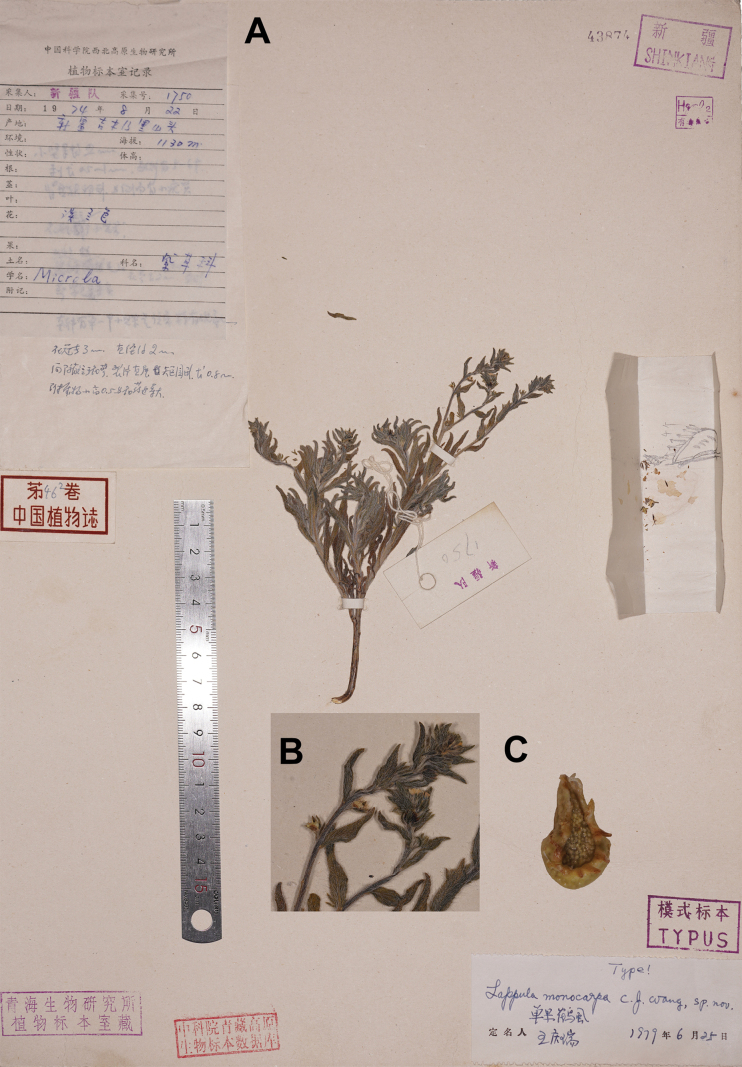 Figure 1
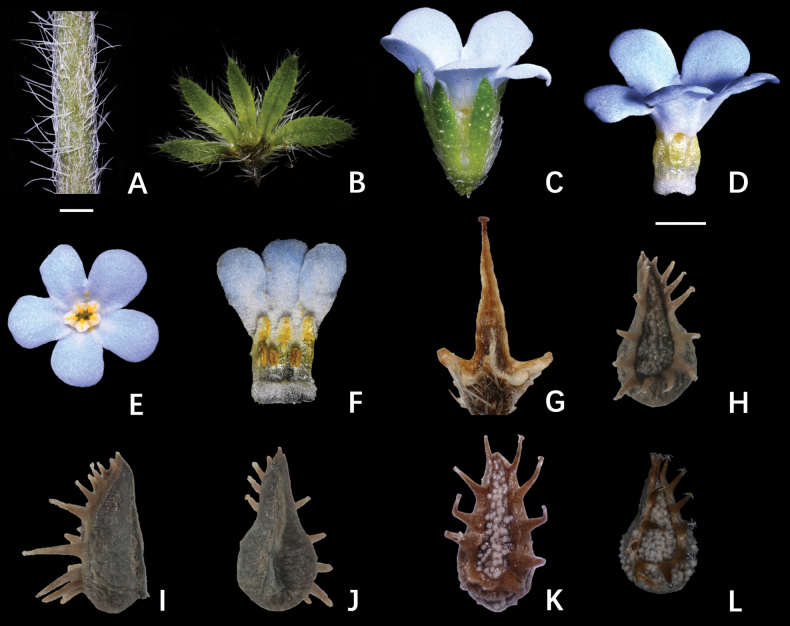 Figure 2
| Characters |
|
|
| |
|---|---|---|---|---|
| Life form | annual | annual | annual | |
| Indumentum | spreading and appressed hair | spreading and appressed hair | spreading and appressed hair | |
| Bracts | leaf-like at the base of the inflorescence, gradually reduced toward the apex | leaf-like at the base of the inflorescence, gradually reduced toward the apex | leaf-like at the base of the inflorescence, gradually reduced toward the apex | |
| Calyx | lobes | linear | linear | linear |
| length | exceeding the fruit | exceeding the fruit | exceeding the fruit | |
| Corolla | length | ca. 3 mm | ca. 3 mm | ca. 3 mm |
| Nutlet | glochids | single row | single row | single row |
| disk shape | ovate | lanceolate | ovate | |
| disk keel | without | with or without | without | |
| margin | not thickened | thickened | not thickened | |
| Style | slightly surpassing nutlet | slightly surpassing nutlet | slightly surpassing nutlet | |
|
Sect. | |||||
|---|---|---|---|---|---|
|
Ser. |
Ser. |
Ser. |
Ser. |
Ser. | |
| Taxa |
|
|
|
|
|
|
|
|
|
| ||
|
|
|
| |||
|
|
| ||||
|
|
| ||||
|
|
| ||||
|
|
| ||||
|
| |||||
|
| |||||
|
| |||||
Peer Reviews
No public reviews on file for this paper yet. If you reviewed it on a platform where reviews are public (OpenReview, ICLR, NeurIPS, ICML), you can paste yours below so the community can read it here.
Videos
No videos yet. Explain this paper in a talk, walkthrough, or lecture? Add one.
Taxonomy
TopicsPlant Diversity and Evolution · Plant and Fungal Species Descriptions · Botany, Ecology, and Taxonomy Studies
Introduction
Lappula Moench is one of the largest genera within the tribe Rochelieae of the family Boraginaceae (Chacón et al. 2016; Vasile et al. 2025). It comprises approximately 50 to 80 species distributed across Eurasia, North Africa, North and South America, and Australia, with a center of diversity located in Central Asia (Wang 1981; Ovczinnikova 2005, 2021; Weigend et al. 2016). Members of Lappula are characterized by blue or white corollas with five throat appendages, a subulate gynobase, and heteromorphic or homomorphic nutlets bearing marginal glochids or wings (Popov 1953; Riedl 1967; Wang 1981; Ovczinnikova 2005). In China, 36 species of Lappula have been recorded (Zhu et al. 1995), of which at least nine are endemic.
Lappulamonocarpa C.J.Wang is a Chinese endemic species, restricted to Xinjiang Province (Wang 1981). It was originally described based on a specimen collected from Heishantou (Black Mountain), Jimunai County, Xinjiang. The species is distinguished by the production of a single, horizontally oriented nutlet per fruit, with a disc margin bearing a single row of glochids. In the protologue, Wang (1981) emphasized that these morphological traits are highly distinctive within Lappula, particularly the presence of a solitary nutlet, which clearly separates L.monocarpa from all other taxa of Lappula. Concurrent with the species description, Wang (1981) also established a new monotypic subsection, Lappulasubsect.Monocarpae C.J.Wang, to accommodate it. However, since its original description, no additional specimens of L.monocarpa have been collected beyond the type specimen.
The nutlets of L.monocarpa bear a single row of marginal glochids with non-connate bases. Based on these traits, Ovczinnikova (2005) assigned L.monocarpa to ser. Strictae, a classification that contradicts Wang’s (1981) earlier taxonomic treatment. Subsequently, Ovczinnikova (2009) proposed that L.monocarpa may represent only a variant of L.stricta, distinguished solely by its production of a single nutlet per fruit. Nutlet characteristics are extensively utilized for infrageneric classification and species delineation within Lappula. These characteristics include the presence of glochids or wings, the number of glochid rows, the length of the glochids, the width of the wings, and the shape of the dorsal disk (Gürke 1894; Popov 1953; Riedl 1967; Wang 1981; Ovczinnikova 2005, 2009, 2021). However, the number of nutlets per fruit has not been employed as a diagnostic character for species delineation, as all currently described species of Lappula typically develop four nutlets per fruit, with the exception of L.monocarpa (Popov 1953; Wang 1981; Ovczinnikova 2005, 2021, 2023; Liu et al. 2024).
Further examination of the type specimen of L.monocarpa revealed that it bears only a few developing fruits, each containing a single nutlet. This nutlet is ovoid and features a single row of glochids (Fig. 1). Apart from the difference in nutlet number, all other nutlet characteristics align fully with those of L.tenuis (Ledeb.) Gürke. These observations suggest that L.monocarpa and L.tenuis represent the same taxonomic entity. To test this hypothesis, field surveys were conducted at the type locality of L.monocarpa, and additional specimens were collected. Morphological comparisons among L.monocarpa, L.tenuis, and L.stricta (Ledeb.) Gürke were then carried out to clarify the taxonomic status of L.monocarpa.
Type specimen of Lappulamonocarpa C.J.Wang. A. Holotype in the herbarium of the Northwest Institute of Plateau Biology, Chinese Academy of Sciences (HNWP); B, C. Details of the holotype; B. Development of a single nutlet per fruit, with the nutlet horizontally oriented; C. Nutlet morphology.
Material and methods
Herbarium specimens of Lappula from ALTB, BNU, HNWP, KUZ, LE, and NSK were thoroughly examined, including the type specimens of L.monocarpa and L.tenuis. A field survey was conducted at the type locality of L.monocarpa in Heishantou (Black Mountain), Jimunai County, Xinjiang Province, China, where additional specimens were collected and deposited at BNU. Detailed morphological features, including stem indumentum, calyx, corolla, nutlets, and gynobase, were documented in situ using a Sony Alpha 7 camera. Comparative morphological analyses of L.monocarpa, L.stricta, and L.tenuis were performed to assess their taxonomic boundaries.
Results
During field investigations, no Lappula specimens matching the original description of producing a single nutlet per fruit were encountered. All collected individuals consistently developed four nutlets per fruit. Aside from this numerical discrepancy, their morphological features were indistinguishable from those described for L.monocarpa. Detailed morphological comparisons among L.monocarpa, L.stricta, and L.tenuis revealed congruent characteristics in stem indumentum, bract morphology, calyx, and corolla (Fig. 2, Table 1). The primary diagnostic differences were confined to nutlet morphology: both L.monocarpa and L.tenuis exhibit ovate dorsal disks (length-to-width ratios of 2.5–3), with the greatest width occurring below the midpoint. These nutlets lack a disk keel and possess non-thickened margins. In contrast, nutlets of L.stricta are lanceolate (length-to-width ratio ~4), may or may not display a disk keel, and typically have thickened margins.
Morphological features of Lappulamonocarpa C.J.Wang (A–J) and nutlet morphology of L.stricta (Ledeb.) Gürke (K) and L.tenuis (Ledeb.) Gürke (L). A. Characteristics of stem trichomes, showing appressed and spreading hairs; B. Calyx; C, D, E, F. Flower morphology; C, D. Lateral view of the flower; E. Top view of the flower; F. Expanded flower morphology, showing the corolla throat appendages and stamens; G. Gynobase morphology; H, I, J. Nutlet morphology; H. Abaxial view of the nutlet; I. Lateral view of the nutlet; J. Adaxial view of the nutlet; K. Nutlet morphology of L.stricta; L. Nutlet morphology of L.tenuis. Scale bars: 1 mm.
Discussion
Ovczinnikova (2005) circumscribed Lappulasect.Lappula to include five series: ser. Lappula, ser. Redowskianae Ovczinnikova, ser. Anisacanthae Ovczinnikova, ser. Strictae M.Pop. ex Ovczinnikova, and ser. Patulae Ovczinnikova (Table 2). Recently, Liu et al. (2025) reconstructed the phylogenetic relationships of Asian Lappula using hundreds of single-copy nuclear genes and complete chloroplast genomes. Their results support the monophyly of sect. Lappula as defined by Ovczinnikova (2005). However, the placement of certain taxa conflicts with this classification. Notably, L.monocarpa clustered with L.consanguinea and L.anocarpa, indicating a closer affinity with ser. Lappula. Furthermore, L.monocarpa and L.stricta occupy distinct, strongly supported subclades within sect. Lappula (Clade IV; Liu et al. 2025). This phylogenetic topology supports neither the inclusion of L.monocarpa in ser. Strictae (Ovczinnikova 2005), nor the hypothesis that L.monocarpa represents a variant of L.stricta (Ovczinnikova 2009).
Ovczinnikova (2005) defined ser. Strictae as comprising taxa with nutlets bearing a single row of glochids, typically with broadened bases or, occasionally, forming marginal wings. In contrast, ser. Lappula includes nutlets with one to several rows of glochids, the bases of which are neither broadened nor winged. Ovczinnikova assigned L.monocarpa to ser. Strictae and L.tenuis to ser. Lappula. However, both the type specimen of L.monocarpa and newly collected material from its type locality reveal that the glochids have neither broadened nor winged bases, and no winged nutlets were observed in the population. These morphological traits are inconsistent with the defining characteristics of ser. Strictae.
Detailed morphological comparisons between the Asian Lappula taxa L.stricta (ser. Strictae) and L.tenuis (ser. Lappula) reveal that the primary distinguishing feature between these two series lies in the shape of the nutlet disk, rather than in the number of glochid rows. The “disk” refers to the flattened area on the dorsal side of the nutlet, the margin of which typically bears glochids or wings (Hilger 2014). Nutlets of ser. Strictae are lanceolate and may or may not possess a keel, whereas those of ser. Lappula are ovate and consistently keel-less. The nutlet disk of L.monocarpa is ovate and lacks a keel, supporting its placement within ser. Lappula on morphological grounds, in agreement with the phylogenetic results of Liu et al. (2025). Additionally, some North American Lappula taxa, such as L.desertorum Greene and L.heterosperma Greene, exhibit a ridge on the dorsal face of the nutlet or lines of tubercles along the midline of the disk (Rolfsmeier 2013). Liu et al. (2025) suggested that these North American taxa may be closely related to Clade IV on the Eurasian continent. The species examined in the present study, L.monocarpa and L.stricta, also belong to Clade IV. While sect. Lappula, as defined by Ovczinnikova (2005), includes only one native North American species, L.occidentalis (S. Watson) Greene, the phylogenetic placement of other North American Lappula taxa remains uncertain and requires further investigation using both molecular and morphological data.
As defined by Ovczinnikova (2005), ser. Lappula comprises seven species, among which only L.tenuis and L.brachycentroides Popov produce nutlets with a single row of spines. Popov (1951) noted that L.brachycentroides is closely related to Echinospermumtenue Ledeb. (now accepted as L.tenuis), differing primarily by the presence of short or absent glochids on the nutlets. The nutlets of L.monocarpa bear a single row of glochids with non-broadened bases and exhibit an ovate, non-lanceolate dorsal disk. Taken together, the molecular phylogenetic findings of Liu et al. (2025) and the morphological evidence presented here support the placement of L.monocarpa within ser. Lappula. This classification supports the reduction of L.monocarpa to a taxonomic synonym of L.tenuis.
Taxonomic treatment
Lappula
tenuis
Taxon classificationPlantaeBoraginalesBoraginaceae
(Ledeb.) Gürke, Nat. Pflanzenfam. 4(3a): 107, 1894
1C10493C-9ACA-5EEA-B92C-8ED01ECE6EAB
≡ Echinospermumtenue Ledeb, Fl. Altaic. 1: 201, 1829. ≡ Hackeliatenuis (Ledeb.) Opiz, Oekon.-Techn. Fl. Böhm. 2(2): 147, 1839. ≡ Myosotistenuis (Ledeb.) Mörch, Cat. Hort. Hafn.: 64, 1839. ≡ Echinospermumredowskiivar.tenue (Ledeb.) Regel, Bull. Soc. Imp. Naturalistes Moscou 41(I): 84, 1868. ≡ Cynoglossospermumtenue (Ledeb.) Kuntze, Revis. Gen. Pl. 2: 437, 1891. = Lappulamonocarpa C.J.Wang, Bull. Bot. Res., Harbin 1(4): 98, 1981. syn. nov. Type. China, Xinjiang province, Jimunai County, 1130 m a.s.l., 22 August 1974, Xinjiang Exped. 1750 (Holotype: HNWP!).
Type.
Russia • Altai, Ad fluv. Tscharysch, 1826, Ledebour, Smejow and Politow s. n. (Lecotype by Ovczinnikova (2018), Lectotype: LE01043915!).
Distribution and habitat.
Lappulatenuis is distributed in China, Kazakhstan, and Russia (Wang 1981, Ovczinnikova 2009, Chepinoga et al. 2024). This species inhabits grasslands and steppes at altitudes of approximately 1,000 meters above sea level.
Phenology.
Flowering and fruiting from June to August.
Taxonomic notes.
Fruits of Lappula typically develop four nutlets; however, an extensive review of herbarium specimens revealed that some individuals, for example, L.caespitosa C.J.Wang (BNU0033484) and L.microcarpa (Ledeb.) Gürke (BNU0030476, BNU0030622, E00843758), sometimes produce only a single developed nutlet. Due to the infrequent and irregular occurrence of such aberrations, nutlet number is considered an unreliable diagnostic character for species delimitation within the genus. During field surveys, L.tenuis was occasionally found growing sympatrically with L.consanguinea (Fisch. & C.A.Mey.) Gürke and L.anocarpa C.J.Wang. Although these three species share similar vegetative morphology and ovoid nutlet shape, they can be reliably distinguished by the arrangement of glochids: L.tenuis has nutlets with a single row of marginal glochids, whereas L.consanguinea and L.anocarpa bear two or three rows.
Ovczinnikova (2005) circumscribed ser. Lappula to include only two species with single-rowed marginal glochids: L.tenuis and L.brachycentroides. Popov (1951) recognized the morphological similarity between these taxa but distinguished L.brachycentroides by the presence of short or absent glochids along the nutlet margins. However, my examination of L.brachycentroides specimens revealed that nutlets on the same individual can exhibit either smooth margins or distinct glochids, with the latter morphology being consistent with that of L.tenuis. Fruit heteromorphism is well documented in the genus Lappula, including variation in glochid presence (glochids or wings, long-glochids, short-glochids, or glochidless) and wing morphology (broad- or narrow-winged). These observations suggest that L.brachycentroides may simply represent a fruit-dimorphic form of L.tenuis. However, as no newly collected material of L.brachycentroides was obtained in this study, the taxonomic status of this species requires further investigation.
Additional specimens examined.
China. Xinjiang: • Altai, Xinjiang Exped. 10669 (PE01361016); • Jimunai County, D.H. Liu BNU2019XJ214 (BNU); • Qinghe County, D.H. Liu BNU2019XJ182 (BNU). Kazakhstan. • Akmola region, Lashchinsky N.N. s.n. (NSK0009103); • East Kazakhstan, Kotukhov A.Yu. s.n. (NSK0008186); • Zharminsky district, Korolyuk A.Yu. 132 (NSK0005792); • Kokpekti district, Popov N.V. 1 (NSK0005797); Russia. • Altai region, Usyk N.A. s.n. (ALTB1100059605, ALTB1100060899); • Kemerovo region, Strelnikova T.O. and Manakov Y.A. KEM18465 (KUZ026052); • Kosh-Agachsky district, Korolyuk A.Yu. 121 (NSK0005798); • Ongudaysky district, Maslova O.M. and Khrustaleva I.A. s.n. (NSK0005819); • Orenburg region, Lashchinsky N.N. L15-174 (NSK0009078).
Supplementary Material
XML Treatment for Lappula tenuis
The reference list from the paper itself. Each links out to its DOI / PubMed record.
- 1Chacón J Luebert F Hilger HH Ovchinnikova S Selvi F Cecchi L Guilliams CM Hasenstab-Lehman K SutorýK Simpson MG Weigend M (2016) The borage family (Boraginaceae s.str.): A revised infrafamilial classification based on new phylogenetic evidence, with emphasis on the placement of some enigmatic genera.Taxon 65: 523–546. 10.12705/653.6 · doi ↗
- 2Chepinoga VV Barkalov VY Ebel AL Knyazev MS Baikov KS Bobrov AA Chkalov AV Doronkin VM Efimov PG Friesen NV German DA Gontcharov AA Grabovskaya-Borodina AE Gureyeva II Ivanenko YA Kechaykin AA Korobkov AA Korolyuk EA Kosachev PA Kupriyanov AN Luferov AN Melnikov DG Mikhailova MA Nikiforova OD Orlova LV Ovchinnikova SV Pinzhenina EA Poliakova TA Shekhovstsova IN Shipunov AB Shmakov AI Smirnov SV Tkach N Troshkina VI Tupitsyna NN Vasjukov VM Vlasova NV Verkhozina AV Anenkhonov OA Efremov AN Glazunov VA Khoreva MG Kiseleva TI Krestov PV Kryukova MV Kuzmin IV Lashchinskiy NN Pospelov IN Pospel · doi ↗
- 3Gürke M (1894) Lappula Moench. In: Prantl K Engler A (Eds) , Die natürlichen Pflanzenfamilien Engelmann, W Engelmann, Leipzig, Vol.4, 106–107.
- 4Hilger HH (2014) Ontogeny, morphology, and systematic significance of glochidiate and winged fruits of Cynoglosseae and Eritrichieae (Boraginaceae).Plant Diversity and Evolution 131(3): 167–214. 10.1127/1869-6155/2014/0131-0080 · doi ↗
- 5Liu DH Zhou YX Shang SJ Wu JJ Li WJ (2024) Lappulaeffusa (Boraginaceae), a new species from Xinjiang, China.Phyto Keys 243: 105–112. 10.3897/phytokeys.243.12346838947550 PMC 11214008 · doi ↗ · pubmed ↗
- 6Liu DH Liu QR Tojibaev KS Sukhorukov AP Wariss HM Zhao Y Yang L Li WJ (2025) Phylogenomics provides new insight into the phylogeny and diversification of Asian Lappula (Boraginaceae). Molecular Phylogenetics and Evolution 208: 108361. 10.1016/j.ympev.2025.10836140287026 · doi ↗ · pubmed ↗
- 7Ovczinnikova SV (2005) The system of the subtribe Echinosperminae (tribe Eritrichieae, Boraginaceae).Botanicheskii Zhurnal 90(8): 1153–1172. [in Russian]
- 8Ovczinnikova SV (2009) The synopsis of the subtribe Echinosperminae Ovczinnikova (Boraginaceae) in the flora of Eurasia.Novosti sistematiki vysshikh rasteniy 41: 209–272. [in Russian] 10.31111/novitates/2010.41.209 · doi ↗