Author Correction: High biocompatible FITC-conjugated silica nanoparticles for cell labeling in both in vitro and in vivo models
Thi Thuy Nguyen, Hoang Nam Nguyen, Thi Ha Lien Nghiem, Xuan-Hai Do, Thanh Thuy To, Thi Xuan Phuong Do, Dieu Linh Do, Huong Giang Nguyen, Huy Manh Nguyen, Ngoc Dinh Nguyen, Manh Quynh Luu, Trong Nghia Nguyen, Thi Bich Ngoc Nguyen, Van Toan Nguyen, Van Thanh Pham

Abstract
Genes, proteins, chemicals, diseases, species, mutations and cell lines named across the full text — each resolved to its canonical identifier and authoritative record.
Click any figure to enlarge with its caption.
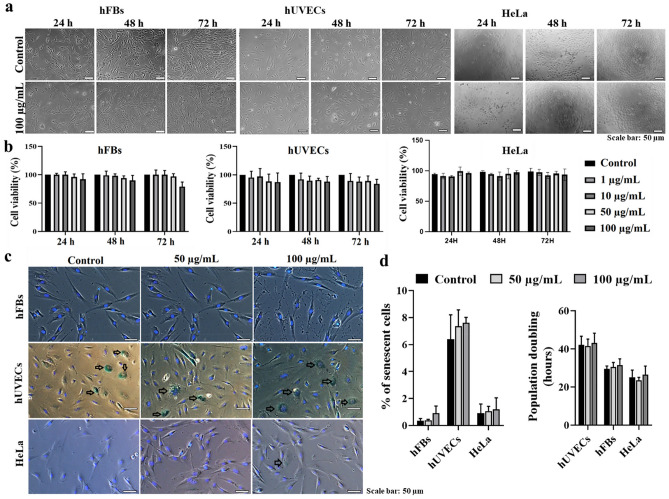 Figure 3
Peer Reviews
No public reviews on file for this paper yet. If you reviewed it on a platform where reviews are public (OpenReview, ICLR, NeurIPS, ICML), you can paste yours below so the community can read it here.
Videos
No videos yet. Explain this paper in a talk, walkthrough, or lecture? Add one.
Taxonomy
TopicsDiatoms and Algae Research
Correction to: Scientific Reports 10.1038/s41598-024-55600-w, published online 23 March 2024
The original version of this Article contained an error in Figure 3, where in panel (C), the 50 ug/mL-treated one is the duplicate of the control.Fig. 3. The effect of FTIC-SiO_2_-COOH NPs on cytotoxicity and cell senescence. (a) The morphology and cell density of hFBs, hUVECs, and HeLa cells in the presence of the NPs. (b) The cell viability (%) of hFBs, hUVECs, and HeLa cells with different doses assessed at 24, 48, and 72 h. (c) The cellular senescence signals detected by β-galactosidase staining; black arrows indicate aging cells. Cell nuclei were stained with Hoechst (blue). (d) The percentage of senescence cells (%) and the population doubling time among hFBs, hUVECs, and HeLa cells***.*** Data was collected from three biological trials (n = 3) and presented as mean ± SD.
The original Article has been corrected.