Trends in Ophthalmic Surgery Among Older Patients in Japan (Fiscal Years 2018 to 2022): A National Claims Database Study on Surgical Shifts and the COVID-19 Pandemic's Impact
Yoshiaki Kabata

TL;DR
This study examines how ophthalmic surgeries among older Japanese patients changed from 2018 to 2022, including the effects of the pandemic and shifts in surgical practices.
Contribution
The study provides new insights into the impact of the COVID-19 pandemic and surgical practice evolution on ophthalmic procedures in Japan's aging population.
Findings
Cataract and vitrectomy surgeries increased overall but dipped in 2020 due to the pandemic.
Glaucoma surgeries, especially minimally invasive ones, showed significant growth despite a small 2020 increase.
Surgical volumes rose faster than population growth in older age groups.
Abstract
Background: Japan has the highest proportion of older adults globally, making its healthcare data crucial for understanding worldwide aging trends. This study investigates trends in ophthalmic surgeries among older Japanese patients using the National Database of Health Insurance Claims (NDB), with a particular focus on the impact of the COVID-19 pandemic. Methods: This retrospective database analysis utilized publicly available aggregated data from the Japanese NDB Open Data portal, managed by the Ministry of Health, Labour and Welfare (MHLW), covering fiscal years (FY) 2018 to 2022. We examined annual trends in the number of cataract surgeries (procedure code K282), glaucoma surgeries (K268), and vitrectomies (sum of K272-K281), stratified by three age groups based on the Japanese Society of Gerontology classification: 65-74 years ("pre-old"), 75-89 years ("old"), and ≥90 years…
Genes, proteins, chemicals, diseases, species, mutations and cell lines named across the full text — each resolved to its canonical identifier and authoritative record.
Click any figure to enlarge with its caption.
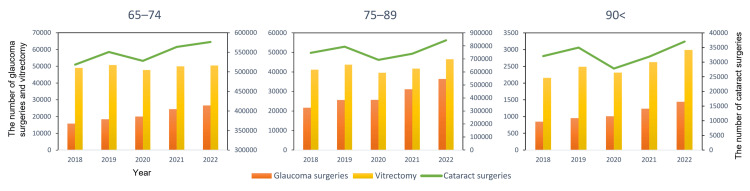 Figure 1
 Figure 2
| Aged 65–74 | Aged 75–89 | Aged 90< | |||||||
| 2018 | 2022 | change (%) | 2018 | 2022 | change (%) | 2018 | 2022 | change (%) | |
| Population of Japan | 9368000 | 7535000 | 80% | 6932000 | 7030000 | 101% | 2000000 | 2450000 | 123% |
| Iridectomy | 339 | 311 | 92% | 457 | 342 | 75% | 42 | 13 | 31% |
| Outflow reconstruction | 7262 | 13294 | 183% | 11081 | 18784 | 170% | 442 | 736 | 167% |
| Trabeculectomy | 5465 | 5868 | 107% | 6502 | 6901 | 106% | 213 | 249 | 117% |
| Tube shunt implantation without plate | 1393 | 1035 | 74% | 1842 | 1403 | 76% | 75 | 70 | 93% |
| Tube shunt implantation with plate | 541 | 1081 | 200% | 617 | 1552 | 252% | 53 | 98 | 185% |
| Trabecular micro-bypass stent with phacoemulsification | 768 | 5019 | 654% | 1184 | 7415 | 626% | 23 | 274 | 1191% |
| Glaucoma surgeries | 15768 | 26608 | 169% | 21683 | 36397 | 168% | 848 | 1440 | 170% |
| Vitrectomy | 49035 | 50492 | 103% | 41080 | 46479 | 113% | 2156 | 2990 | 139% |
| Cataract surgeries | 518476 | 576324 | 111% | 746849 | 842877 | 113% | 32087 | 37020 | 115% |
Peer Reviews
No public reviews on file for this paper yet. If you reviewed it on a platform where reviews are public (OpenReview, ICLR, NeurIPS, ICML), you can paste yours below so the community can read it here.
Videos
No videos yet. Explain this paper in a talk, walkthrough, or lecture? Add one.
Taxonomy
TopicsRetinal and Optic Conditions · Glaucoma and retinal disorders · Cerebral Venous Sinus Thrombosis
Introduction
In 2021, Japan recorded the world's highest proportion of individuals aged 65 and older, constituting 28.7% of its total population [1], a demographic trend projected to continue [2]. As the global leader in population aging, Japan's healthcare landscape offers valuable insights for other nations facing similar demographic shifts. Analyzing Japanese medical data can inform policy development and the redesign of social security systems worldwide [2].
The Ministry of Health, Labour and Welfare (MHLW) established the National Database of Health Insurance Claims and Specific Health Checkups of Japan (NDB) under the Act on Assurance of Medical Care for Older Patients. Accumulating data since 2008, the NDB is one of the most comprehensive national healthcare databases globally [3]. Since Japan's universal healthcare system covers most medical care, the NDB, which includes data from inpatient (including Diagnosis Procedure Combination (DPC)), outpatient, pharmacy, and dental claims, accurately reflects national medical trends and informs government healthcare policy [3]. The NDB Open Data Japan portal provides aggregated summary data for public use.
Ophthalmic surgery, often performed under local anesthesia, is feasible even for the very elderly. Cataract surgery, in particular, is commonly performed on nonagenarians and centenarians [4-6]. A prior study using NDB Open Data examined ophthalmic surgery trends across all age groups from fiscal year (FY) 2014 to FY2020 [7]. The COVID-19 pandemic, with the first case identified in Japan in January 2020, prompted a nationwide postponement of non-emergency surgeries following the state of emergency declared in April 2020. This disruption likely impacted ophthalmic surgery volumes, particularly in FY2020. Because older adults faced higher mortality risks from COVID-19 [8], they may have been more inclined to postpone medical visits and elective surgeries. Therefore, examining surgical trends specifically around the pandemic period (FY2018-FY2022) and focusing specifically on the older population is crucial.
This study aimed to analyze five-year trends (FY2018-FY2022) in the volume of major ophthalmic surgeries-specifically cataract surgery, glaucoma procedures, and vitrectomy-performed on older adults in Japan. Using aggregated data from the NDB, the study also examines how these trends were influenced by the COVID-19 pandemic and age-related demographic shifts.
Materials and methods
This study was a retrospective, descriptive analysis based on publicly available, aggregated data from the NDB Open Data Japan portal [3]. We analyzed data covering FY2018 to FY2022 (April 1, 2018, to March 31, 2023). The analysis included aggregated counts of specific ophthalmic procedures performed on patients within three age groups, following the classification by the Japanese Society of Gerontology: 65-74 years ("pre-old"), 75-89 years ("old"), and ≥90 years ("super-old").
We identified the annual number of specific ophthalmic surgeries using the following Japanese medical procedure codes: cataract surgery, code K282 (phacoemulsification and intraocular lens implantation); vitrectomy, sum of codes K272 through K281; glaucoma surgery, code K268 (this comprehensive code includes iridectomy, outflow reconstruction (trabeculotomy), trabeculectomy, tube shunt implantation without a plate (e.g., EX-PRESS®), tube shunt implantation with a plate (e.g., Ahmed®, Baerveldt® implants), and trabecular micro-bypass stent implantation combined with phacoemulsification (e.g., iStent®)). Consistent with the approach of Tanito [9], laser treatments for glaucoma were not included. This single code represents the entire combined procedure, thus preventing the same surgical event from being counted twice under both the glaucoma code (K268) and the cataract surgery code (K282).
The primary outcomes were the annual number of cataract surgeries, vitrectomies, and total glaucoma surgeries (K268) performed within each age group from FY2018 to FY2022. Secondary outcomes included trends for each specific glaucoma procedure under K268. Data on the annual number of procedures for each specified code were extracted from the NDB Open Data spreadsheets for each fiscal year and age group. A descriptive analysis was conducted to assess trends over the five-year period. All aggregated data used in this study were downloaded from the official NDB Open Data portal provided by the Japanese Ministry of Health, Labour and Welfare.
To quantify changes, we calculated the percentage change in the number of surgeries between FY2018 and FY2022 using the formula Percentage Change (%) = (Number in FY2022 / Number in FY2018) × 100. For context, we obtained Japanese national population estimates for the same age groups for 2018 and 2022 from the Statistics Bureau of Japan [1] and calculated the percentage population change using the same formula. Given the descriptive nature of the study and the use of aggregated data, no advanced statistical modeling was performed.
This study utilized publicly accessible, anonymized, aggregated data and was therefore deemed exempt from formal ethical review and the need for informed consent by the Institutional Review Board of Jikei University School of Medicine. The study adhered to the principles of the Declaration of Helsinki.
Results
Figure 1 illustrates the annual number of vitrectomies, glaucoma surgeries, and cataract surgeries from FY2018 to FY2022, stratified by age. Cataract surgery numbers generally increased from FY2018 but showed a transient decrease in FY2020 before resuming an upward trend. Vitrectomy also demonstrated a temporary decrease in FY2020; however, an overall increasing trend was observed in the 75-89 and ≥90 age groups, while the 65-74 group remained relatively stable, excluding the FY2020 dip. Glaucoma surgeries exhibited a consistent increasing trend across all age groups, although growth was marginal between FY2019 and FY2020.
Trends in ophthalmic surgeries in older adults (FY2018-FY2022)Annual number of vitrectomies and glaucoma surgeries (left y-axis, bars) and cataract surgeries (right y-axis, lines) performed in Japan for age groups 65–74, 75–89, and 90 years and over, based on NDB Open Data. FY = Fiscal Year (April 1 to March 31). The Japanese government declared a state of emergency for COVID-19 in April 2020 (start of FY2020).
Figure 2 illustrates the trends for specific types of glaucoma surgeries. Notably, procedures involving outflow reconstruction, tube shunt implantation with a plate, and trabecular micro-bypass stent implantation combined with phacoemulsification demonstrated substantial increases across most age groups. Conversely, iridectomy and tube shunt implantation without a plate showed decreasing trends.
Trends in specific glaucoma surgeries (FY2018-FY2022)Annual number of specific glaucoma surgery types (iridectomy, outflow reconstruction, trabeculectomy, tube shunt implantation without plate, tube shunt implantation with plate, and trabecular micro-bypass stent with phacoemulsification) performed in Japan for age groups 65–74, 75–89, and 90 years and over. FY = Fiscal Year (April 1 to March 31).
Table 1 shows the population aged 65-74 years decreased to 80% of its 2018 level by 2022, while the 75-89 group slightly increased (101%), and the ≥90 group grew significantly (123%). In contrast, surgical volumes generally outpaced population changes. Glaucoma surgeries increased markedly across all groups: 169% (65-74), 168% (75-89), and 170% (≥90) relative to FY2018. Vitrectomy increases were 103% (65-74), 113% (75-89), and 139% (≥90). Cataract surgery increases were 111% (65-74), 113% (75-89), and 115% (≥90).
Examining specific glaucoma procedures, the increases from FY2018 to FY2022 were substantial. Outflow reconstruction increases were 183% (65-74), 170% (75-89), and 167% (≥90). Tube shunt implantation with plate increases were 200% (65-74), 252% (75-89), and 185% (≥90). Trabecular micro-bypass stent with phacoemulsification increases were 654% (65-74), 626% (75-89), and 1191% (≥90).
Discussion
This study revealed generally increasing trends in cataract, vitrectomy, and glaucoma surgeries among Japanese patients aged 65 and older between FY2018 and FY2022. However, a noticeable decrease or stagnation in surgical volume occurred in FY2020, coinciding with the peak of the first COVID-19 wave and the declaration of a national state of emergency in April 2020. This suggests that the pandemic led to the postponement of many ophthalmic procedures.
Our findings align with Wada et al. [7], who reported decreased numbers of cataract and vitreoretinal surgeries in FY2020, while glaucoma surgeries showed less impact. They hypothesized that cataract and some vitreoretinal surgeries were considered more elective than glaucoma surgery, where delays risk irreversible vision loss [7]. Our results, extending to FY2022, confirm the rebound in cataract and vitrectomy numbers post-FY2020. Interestingly, while the overall glaucoma surgery trend was upward, the stagnated growth between FY2019 and FY2020 suggests that even these procedures were affected, possibly due to older patients' heightened concerns about COVID-19 exposure [8] or temporary resource reallocation within hospitals.
A key finding of this study is the shifting landscape within glaucoma surgery. Procedures involving outflow reconstruction (including ab interno trabeculotomy), tube shunt implantation with a plate (for complex glaucoma), and particularly trabecular micro-bypass stenting combined with phacoemulsification - a form of minimally invasive glaucoma surgery (MIGS) - showed significant growth [10-12]. Conversely, traditional iridectomy and tube shunt implantation without a plate (EX-PRESS®) declined. The EX-PRESS® device, once popular, faced concerns regarding complications and efficacy comparable to trabeculectomy, potentially leading surgeons toward other options like trabeculectomy, valved/non-valved implants, or MIGS, depending on the target intraocular pressure (IOP) [11-14].
The dramatic ascent in combined phacoemulsification and trabecular micro-bypass stent procedures reflects the global trend towards MIGS, especially for patients with mild-to-moderate glaucoma [11,12,15,16]. In Japan, ab interno trabeculotomy (classified under outflow reconstruction) has also gained popularity for its cost-effectiveness and favorable IOP reduction [13,15]. The increasing prevalence of combined cataract and glaucoma surgery [17] synergizes with the high volume of cataract procedures in the aging population and is a major driver of the observed rise in glaucoma surgeries. While formal cost-effectiveness studies for MIGS in the very elderly in Japan are limited [17,18], the potential benefit of reducing medication burden is particularly valuable in this population.
This study has several limitations inherent to claims-based research. The NDB Open Data provides aggregated counts, lacking patient-level clinical details such as disease severity, visual acuity, or comorbidities. Furthermore, claims coding may be subject to institutional or individual variations, potentially introducing inaccuracies. The dataset does not capture the complex multidisciplinary management often required for older surgical patients. Therefore, our findings reflect broad procedural trends rather than detailed clinical practice patterns or outcomes. Furthermore, as our study is a descriptive analysis of aggregated national counts, we did not perform inferential statistical tests to assess the significance of trends. Such tests would be inappropriate without access to patient-level data to account for variance and confounding variables. Therefore, the significance of the observed trends is interpreted based on the magnitude of change and graphical analysis rather than formal statistical proof.
Conclusions
This analysis of the Japanese National Database highlights an overall increase in cataract, glaucoma, and vitreous surgeries among older adults from FY2018 to FY2022, interrupted by a transient decline in FY2020 associated with the COVID-19 pandemic. Within glaucoma surgery, there was a marked shift toward procedures involving outflow reconstruction and tube shunts with plates, alongside a dramatic rise in combined phacoemulsification and trabecular micro-bypass stenting, signaling a paradigm shift toward MIGS. These trends reflect advancements in surgical technology, evolving treatment paradigms, and the growing healthcare demands of Japan's super-aged society. Continued monitoring of these trends is essential for healthcare planning, resource allocation, and optimizing ophthalmic surgical training to meet the needs of an aging global population and enhance their quality of life.
The reference list from the paper itself. Each links out to its DOI / PubMed record.
- 1Population estimates 5 2025 2025 https://www.stat.go.jp/data/jinsui/index.html
- 2Population aging in Japan: policy transformation, sustainable development goals, universal health coverage, and social determinates of health Glob Health Med Nakatani H 310120193333074710.35772/ghm.2019.01011 PMC 7731274 · doi ↗ · pubmed ↗
- 3National Database of Health Insurance Claims and Specific Health Checkups of Japan (NDB) 5 2025 2025 https://www.mhlw.go.jp/stf/seisakunitsuite/bunya/kenkou_iryou/iryouhoken/database/index.html
- 4Cataract surgery outcomes in the very elderly J Cataract Refract Surg Li E Margo CE Greenberg PB 11444420183005595510.1016/j.jcrs.2018.05.025 · doi ↗ · pubmed ↗
- 5Eye surgery in the elderly Clin Interv Aging Raczyńska D Glasner L Serkies-Minuth E Wujtewicz MA Mitrosz K 4074141120162710379410.2147/CIA.S 101835 PMC 4827591 · doi ↗ · pubmed ↗
- 6Changes in visual function after intraocular pressure reduction using antiglaucoma medications Eye (Lond) Prata TS Piassi MV Melo LA Jr 108110852320091867046510.1038/eye.2008.226 · doi ↗ · pubmed ↗
- 7Construction and validation of a novel lysosomal signature for hepatocellular carcinoma prognosis, diagnosis, and therapeutic decision-making Sci Rep Chen J Gao G He Y 226241320233811472510.1038/s 41598-023-49985-3PMC 10730614 · doi ↗ · pubmed ↗
- 8Long term risk of death and readmission after hospital admission with COVID-19 among older adults: retrospective cohort study BMJ Oseran AS Song Y Xu J 0382202310.1136/bmj-2023-076222 PMC 1047583937558240 · doi ↗ · pubmed ↗