Graph Neural Network Determine the Ground State Structures of Boron or Nitride Substitute C60 Fullerenes
Linwei Sai, Beiran Du, Li Fu, Sultana Akter, Chunmei Tang, Jijun Zhao

TL;DR
This paper uses a graph neural network to identify the most stable structures of boron or nitrogen-doped C60 fullerenes.
Contribution
A novel graph neural network is introduced to efficiently and accurately predict ground state structures of substituted fullerenes.
Findings
The GNN achieved an RMSE of 1.713 meV in predicting binding energies of substituted fullerene isomers.
New lower-energy structures were discovered for boron- and nitride-substituted fullerenes with substitution numbers 7–12 and 7–11, respectively.
The GNN can process over six thousand isomers per second on an eight-core PC.
Abstract
Substitutional doping of fullerenes represents a significant category of heterofullerenes. Due to the vast number of isomers, confirming the ground state structure poses considerable challenges. In this study, we generated isomers of C60−nBn and C60−nNn with n ranging from 2 to 12. To avoid overlooking the ground state structures, we applied specific filtering rules: no adjacent nitrogen (N) or boron (B) atoms are allowed, and substitutions in meta-positions within pentagons are prohibited when the substitution number n exceeds nine. Approximately 15,000 isomers across various values of n within the range of 2 to 12 for B and N substituted fullerenes were selected and optimized using density functional theory (DFT) calculations, forming our dataset. We developed a Graph Neural Network (GNN) that aggregates both topological connections and its dual graph with ring types as input…
Genes, proteins, chemicals, diseases, species, mutations and cell lines named across the full text — each resolved to its canonical identifier and authoritative record.
Click any figure to enlarge with its caption.
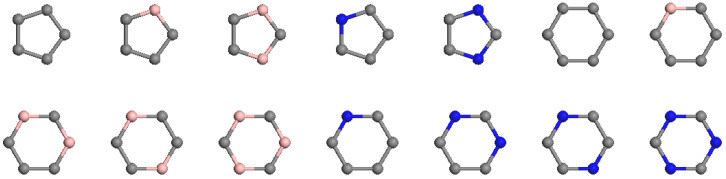 Figure 1
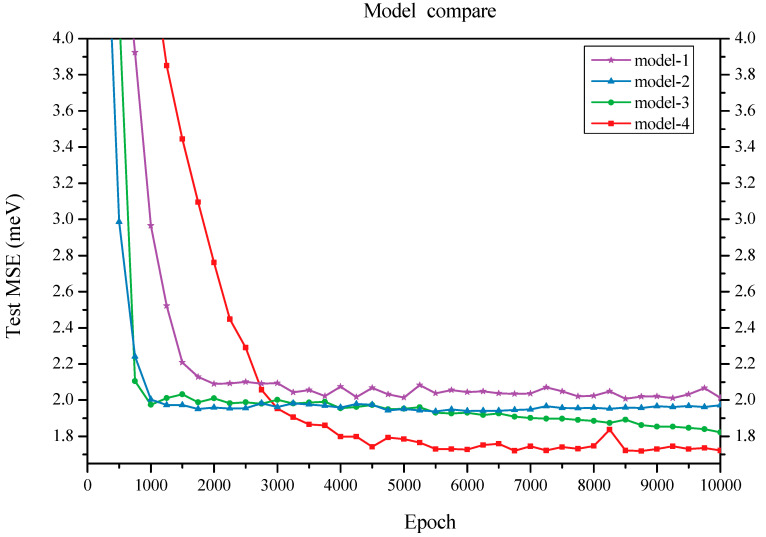 Figure 2
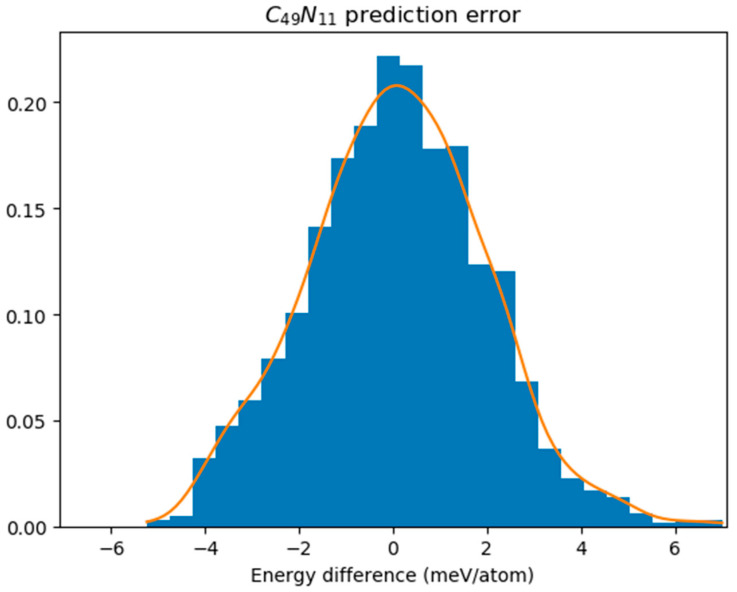 Figure 3
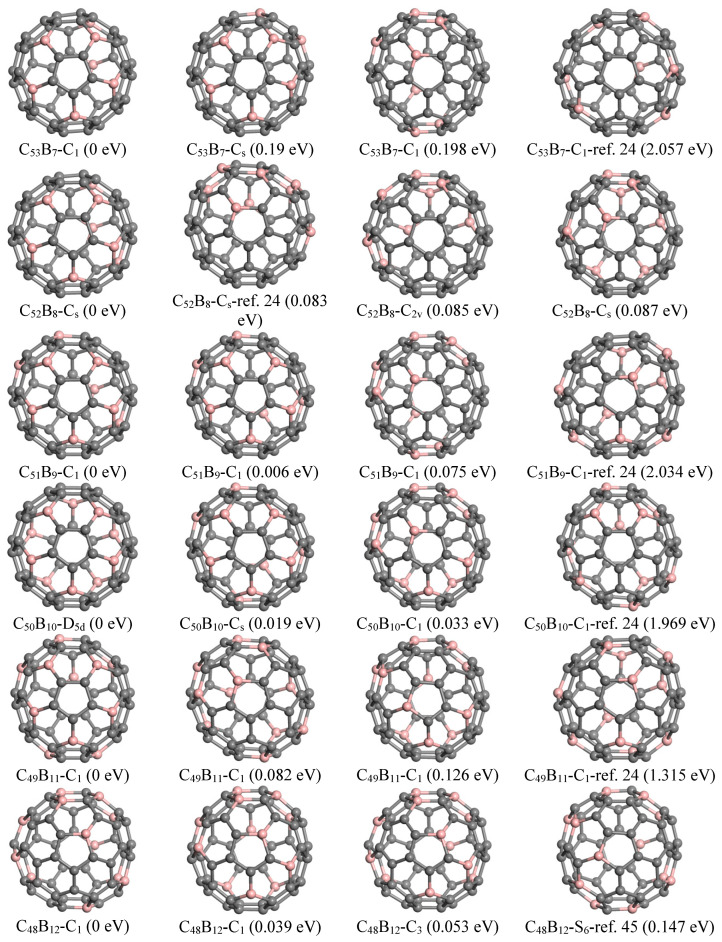 Figure 4
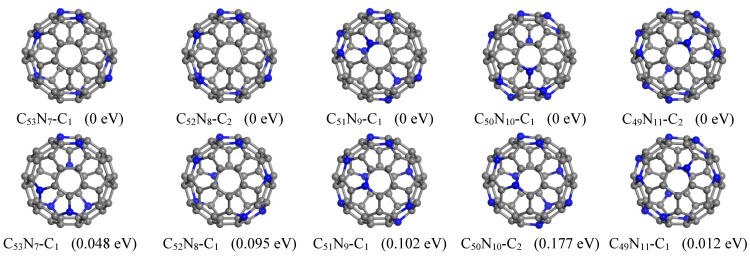 Figure 5
Peer Reviews
No public reviews on file for this paper yet. If you reviewed it on a platform where reviews are public (OpenReview, ICLR, NeurIPS, ICML), you can paste yours below so the community can read it here.
Videos
No videos yet. Explain this paper in a talk, walkthrough, or lecture? Add one.
Taxonomy
TopicsFullerene Chemistry and Applications · Graphene research and applications · Machine Learning in Materials Science