Hydroxyl Derivatives of Oils from Solid Fats as Components for Production of Polyurethane Foams
Elżbieta Malewska, Maria Kurańska, Klara Grelowska, Aleksandra Put, Hubert Ożóg, Julia Sędzimir, Natalia Kowalik, Michał Kucała, Aleksander Prociak

TL;DR
Researchers made polyurethane foams using biopolyols from solid fats, finding that pork fat-based foams had the best properties for thermal insulation.
Contribution
The study introduces the use of solid fats from both plant and animal sources as novel biopolyol components in polyurethane foam production.
Findings
Biopolyols from pork fat produced polyurethane foams with high cell openness and good dimensional stability.
Replacing up to 100% of petrochemical polyol with biopolyols from solid fats is feasible for foam production.
The foams had low apparent density while maintaining advantageous insulation properties.
Abstract
Biopolyols derived from solid fats of both vegetable origin (coconut oil (P/CO) and palm oil (P/PA)) and animal origin (pork fat (P/PO) and duck fat (P/DU)) were used to produce thermal insulation polyurethane foams. The biopolyols were characterized by hydroxyl numbers in the range of 341–396 mgKOH/g, a viscosity of 60–88 mPa·s, and a functionality of 2.3–3.4. Open-cell polyurethane foams were obtained by replacing from 50 to 100 wt.% of a petrochemical polyol with the biopolyols from solid fats. The most advantageous properties were found for the materials modified with the biopolyol based on pork fat, which was attributed to its high degree of cell openness. At a low apparent density, the foam materials were characterized by good dimensional stability. The use of solid fats offers new possibilities for modifying thermal insulation polyurethane foams.
Genes, proteins, chemicals, diseases, species, mutations and cell lines named across the full text — each resolved to its canonical identifier and authoritative record.
Click any figure to enlarge with its caption.
 Figure 1
 Figure 2
 Figure 3
 Figure 4
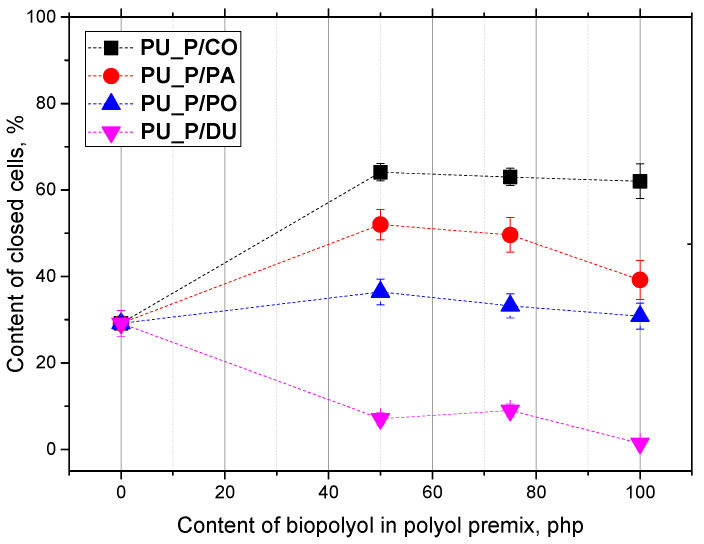 Figure 5
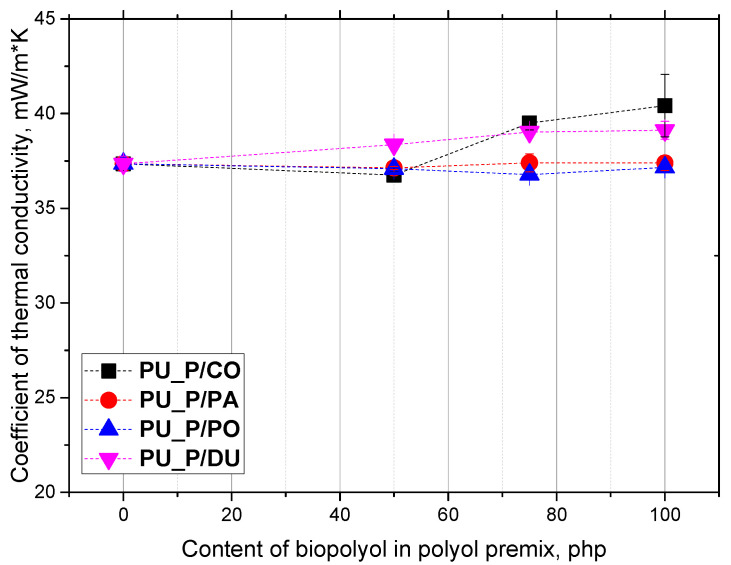 Figure 6
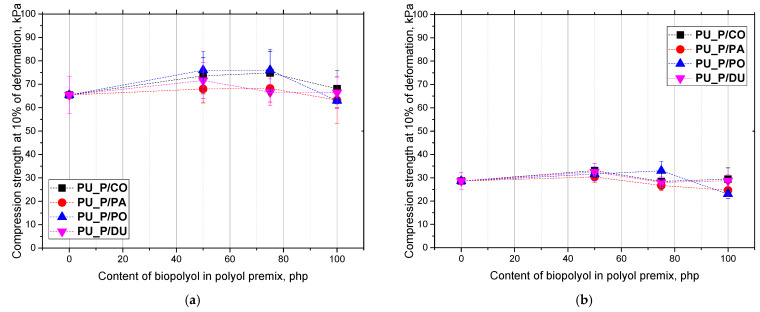 Figure 7
Peer Reviews
No public reviews on file for this paper yet. If you reviewed it on a platform where reviews are public (OpenReview, ICLR, NeurIPS, ICML), you can paste yours below so the community can read it here.
Videos
No videos yet. Explain this paper in a talk, walkthrough, or lecture? Add one.
Taxonomy
TopicsPolymer composites and self-healing · Lignin and Wood Chemistry · Petroleum Processing and Analysis