Inversion Motion of Xanthene and Detection of Its Oxidation Product Xanthone from Gas-Phase Rotational Spectroscopy
Celina Bermúdez, Manuel Goubet, Elias M. Neeman

TL;DR
Scientists used microwave spectroscopy to study the structure and motion of xanthene and its oxidation product xanthone, revealing an inversion motion and energy splitting.
Contribution
The study reports the first detection of xanthone's rotational spectrum and quantifies the inversion splitting in xanthene.
Findings
Xanthene exhibits a non-planar geometry with an inversion motion between conformers.
The inversion splitting energy was measured as ΔE01=4689.7095(10) MHz.
A symmetric double-minimum inversion potential with a barrier of ~45 cm−1 was determined.
Abstract
The rotational spectra of xanthene and its oxidation product xanthone were investigated by combining quantum chemical calculations with Fourier transform microwave spectroscopy in a jet-cooled environment. Xanthone was unexpectedly generated in the experiment when water was present in the reservoir of xanthene leading to the total disappearance of xanthene after few hours. Structurally, xanthone shows a near planar disposition, whereas xanthene exhibits a non-planar geometry with both benzene rings twisted out of the molecular plane. This geometry enables an inversion motion between two equivalent conformers, giving rise to a splitting in the ground vibrational state. A two-state analysis of the vibration–rotation interaction for the v=0 and v=1 states gives an energy separation between these states (inversion splitting) of ΔE01=4689.7095(10)MHz. This large-amplitude motion leads to…
Genes, proteins, chemicals, diseases, species, mutations and cell lines named across the full text — each resolved to its canonical identifier and authoritative record.
Click any figure to enlarge with its caption.
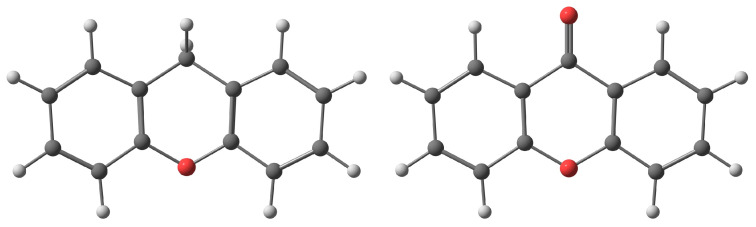 Figure 1
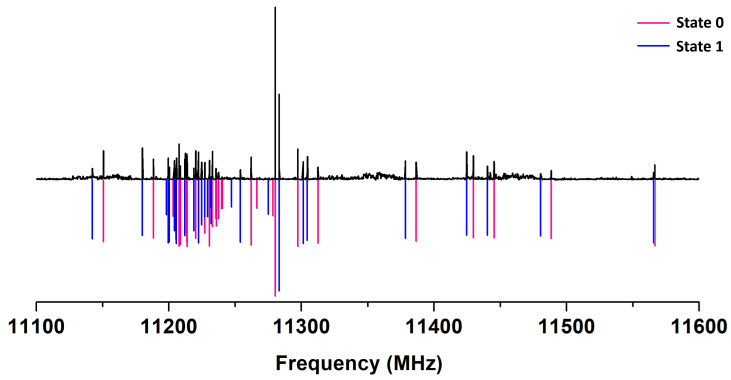 Figure 2
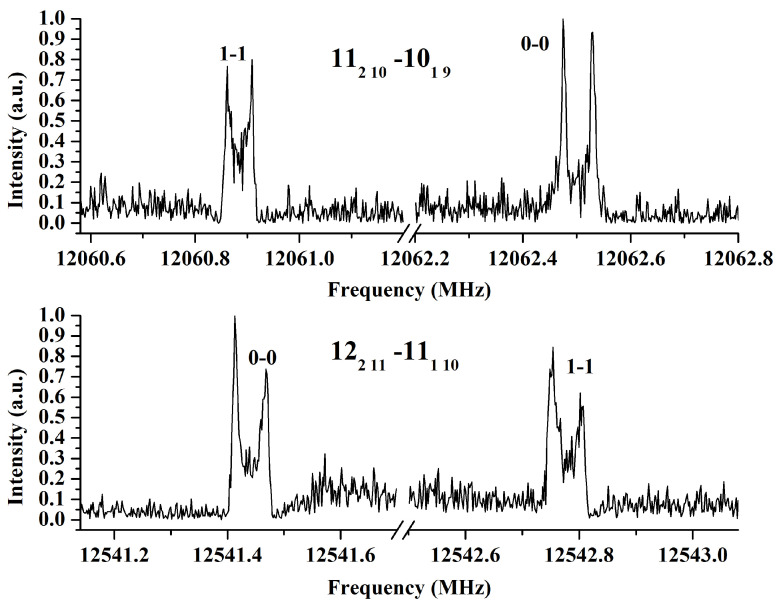 Figure 3
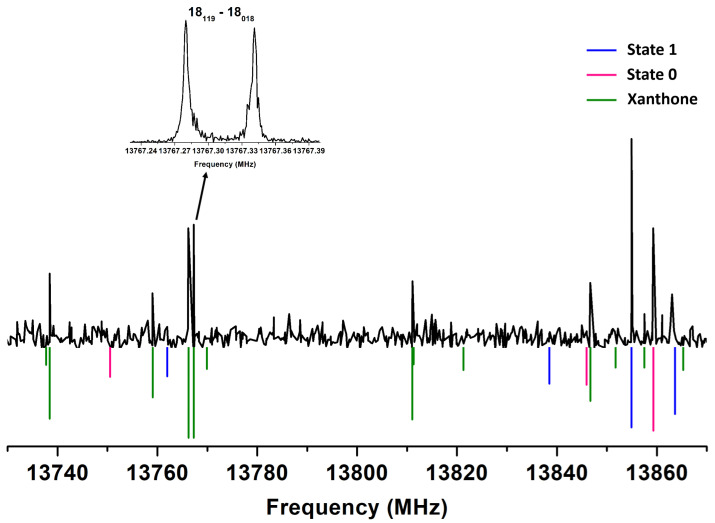 Figure 4
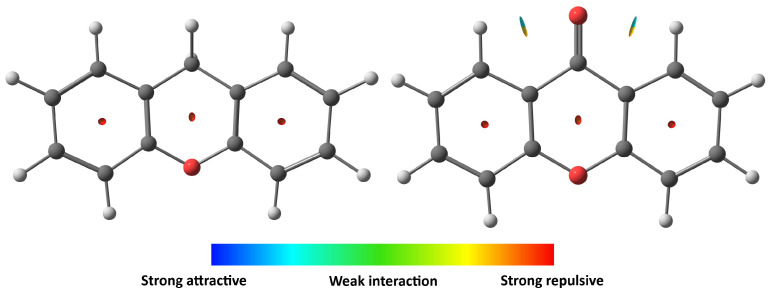 Figure 5
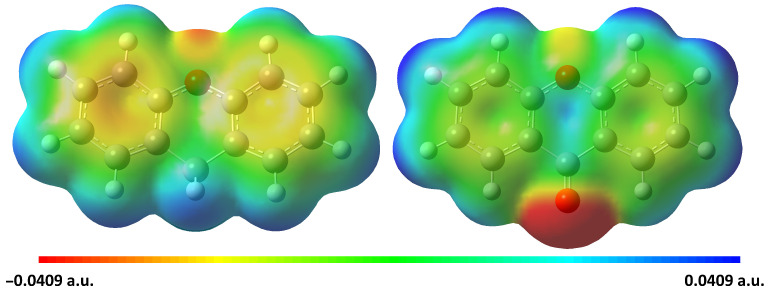 Figure 6
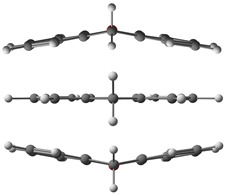 Figure 7
Peer Reviews
No public reviews on file for this paper yet. If you reviewed it on a platform where reviews are public (OpenReview, ICLR, NeurIPS, ICML), you can paste yours below so the community can read it here.
Videos
No videos yet. Explain this paper in a talk, walkthrough, or lecture? Add one.
Taxonomy
TopicsMolecular Spectroscopy and Structure · Advanced Chemical Physics Studies · Spectroscopy and Laser Applications