Biotransformations with Photobiocatalysts for Enantioselective Ester Hydrolysis
Agnieszka Śliżewska, Paulina Majewska, Ewa Żymańczyk-Duda

TL;DR
This study explores using light-sensitive microorganisms to selectively break down ester compounds, achieving high selectivity in producing specific alcohol forms.
Contribution
The research introduces three highly effective photobiocatalysts for enantioselective ester hydrolysis with exceptional selectivity values.
Findings
Nostoc cf-muscorum, Leptolyngbya foveolarum, and Synechococcus bigranulatus achieved high enantioselectivity in ester hydrolysis.
Light exposure significantly influenced the selectivity and efficiency of the biotransformations.
The highest selectivity factor (S) of 283 was achieved with Nostoc cf-muscorum under optimized light conditions.
Abstract
This study investigates the efficient and enantioselective hydrolysis of ester bonds through a series of biotransformations employing various photobiocatalysts. A racemic mixture of 1-phenylethyl acetate served as the model substrate. The described research identified three strains exhibiting the highest biocatalytic activity: Nostoc cf-muscorum (CCALA 129), Leptolyngbya foveolarum (CCALA 76), and Synechococcus bigranulatus (CCALA 187). Their application led to the complete hydrolysis of the starting reagent, yielding both the unreacted ester and its corresponding alcohol in an enantioselective manner. Notably, the selectivity, expressed as S, reached an impressive value of 283 in certain outcomes. The photobiotransformations were conducted under varying conditions, with particular focus on two essential parameters: the duration of the process, crucial for kinetically controlled…
Genes, proteins, chemicals, diseases, species, mutations and cell lines named across the full text — each resolved to its canonical identifier and authoritative record.
Click any figure to enlarge with its caption.
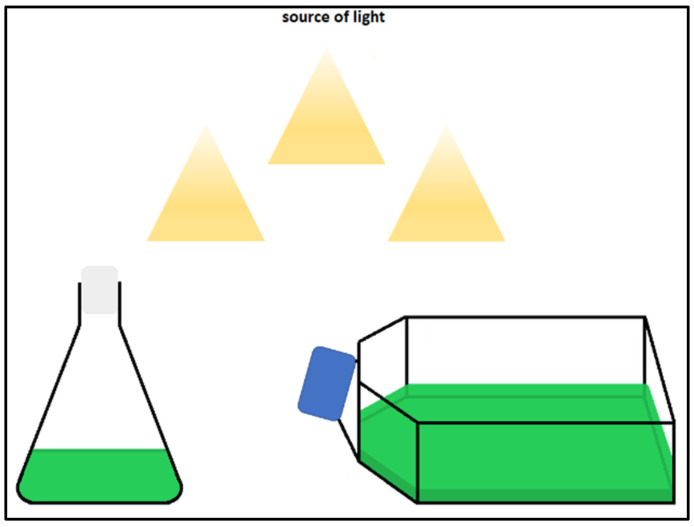 Figure 1
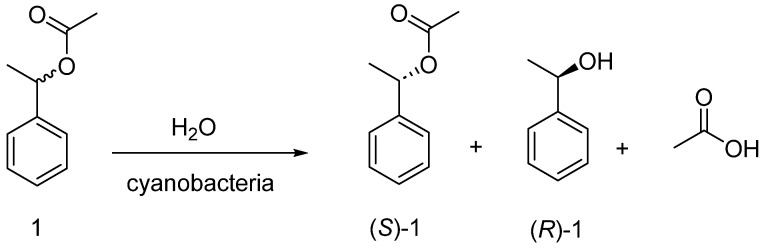 Figure 2
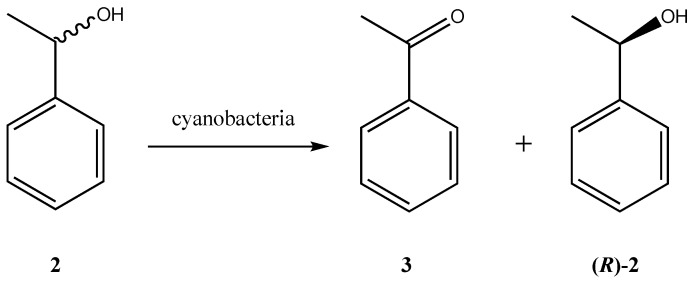 Figure 3
Peer Reviews
No public reviews on file for this paper yet. If you reviewed it on a platform where reviews are public (OpenReview, ICLR, NeurIPS, ICML), you can paste yours below so the community can read it here.
Videos
No videos yet. Explain this paper in a talk, walkthrough, or lecture? Add one.
Taxonomy
TopicsEnzyme Catalysis and Immobilization · Innovative Microfluidic and Catalytic Techniques Innovation · Algal biology and biofuel production