Concave Side of Proximal Thoracic Zone Vulnerable to Pedicle Screw Perforation in Adolescent Idiopathic Scoliosis Surgery: Comparative Analysis of Pre- and Intraoperative Computed Tomography Navigation
Tomohiro Yamada, Yu Yamato, Tomohiko Hasegawa, Go Yoshida, Tomohiro Banno, Hideyuki Arima, Shin Oe, Koichiro Ide, Kenta Kurosu, Yukihiro Matsuyama

TL;DR
This study shows that using intraoperative CT scans improves the accuracy of pedicle screw placement in scoliosis surgery, especially in the concave side of the upper thoracic region.
Contribution
The study introduces the use of intraoperative CT navigation with a second 3D scan to enhance pedicle screw accuracy in adolescent idiopathic scoliosis surgery.
Findings
Intraoperative CT navigation achieved higher screw accuracy (97%) compared to preoperative CT (95%).
Grade D perforations were most common on the concave side of the proximal thoracic zone.
Ten screws were reinserted in the intraoperative group based on second 3D scan findings.
Abstract
Background: The aim of this study was to assess pedicle screw (PS) accuracy and identify perforation patterns using computed tomography (CT) navigation in adolescent idiopathic scoliosis (AIS) surgery. Methods: A total of 107 AIS patients were retrospectively reviewed. Preoperative CT navigation was used in 48 patients (853 screws), and intraoperative CT with a second 3D scan was used in 59 patients (1059 screws). Postoperative CT images were analyzed using the Rampersaud grading system. Results: Overall PS accuracy (grade A + B) was significantly higher in the intraoperative CT group than the preoperative group (97% vs. 95%, p = 0.008). In Lenke type 1 cases, accuracy was also higher in the intraoperative group (97.8% vs. 95.1%, p = 0.014). Grade D perforations were most frequent on the concave side of the proximal thoracic (PT) zone in both groups. Ten screws were re-inserted during…
Genes, proteins, chemicals, diseases, species, mutations and cell lines named across the full text — each resolved to its canonical identifier and authoritative record.
Click any figure to enlarge with its caption.
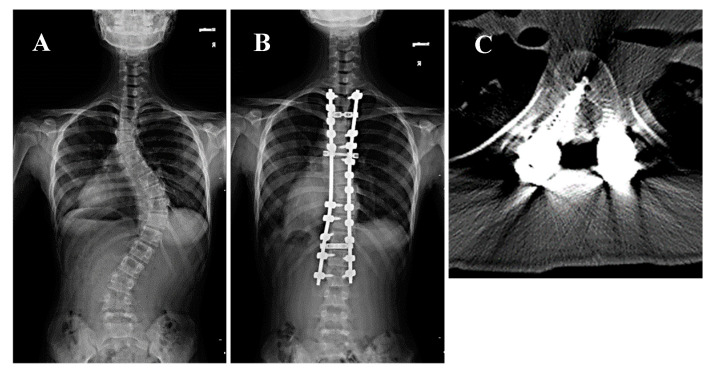 Figure 1
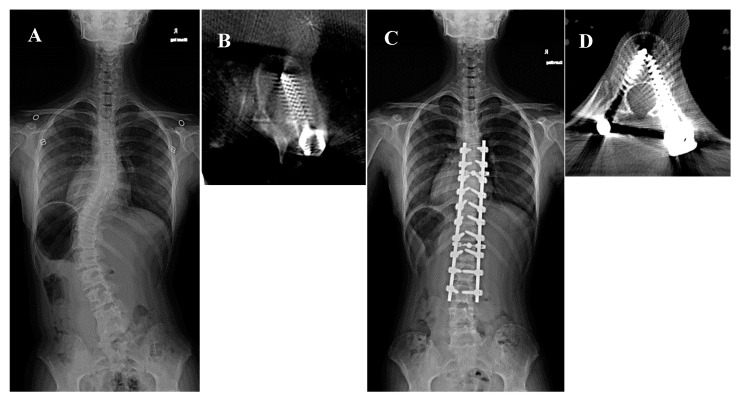 Figure 2
Peer Reviews
No public reviews on file for this paper yet. If you reviewed it on a platform where reviews are public (OpenReview, ICLR, NeurIPS, ICML), you can paste yours below so the community can read it here.
Videos
No videos yet. Explain this paper in a talk, walkthrough, or lecture? Add one.
Taxonomy
TopicsSpinal Fractures and Fixation Techniques · Scoliosis diagnosis and treatment · Pelvic and Acetabular Injuries