Multi-Bit Resistive Random-Access Memory Based on Two-Dimensional MoO3 Layers
Kai Liu, Wengui Jiang, Liang Zhou, Yinkang Zhou, Minghui Hu, Yuchen Geng, Yiyuan Zhang, Yi Qiao, Rongming Wang, Yinghui Sun

TL;DR
This paper presents a 2D material-based RRAM device with improved performance and multi-bit storage for advanced memory applications.
Contribution
A novel Pd-MoO3-Ag RRAM device with multi-bit storage and improved retention using 2D materials is developed.
Findings
The Pd-MoO3-Ag RRAM device achieved low write voltage (~0.5 V) and high switching ratio (>106).
The Gr-MoO3-Ag heterostructure improved retention time by fivefold (>104 s).
2D materials enable high On/Off ratios and long-term data retention in RRAM devices.
Abstract
Two-dimensional (2D) material-based resistive random-access memory (RRAM) has emerged as a promising solution for neuromorphic computing and computing-in-memory architectures. Compared to conventional metal-oxide-based RRAM, the novel 2D material-based RRAM devices demonstrate lower power consumption, higher integration density, and reduced performance variability, benefiting from their atomic-scale thickness and ultra-flat surfaces. Remarkably, 2D layered metal oxides retain these advantages while preserving the merits of traditional metal oxides, including their low cost and high environmental stability. Through a multi-step dry transfer process, we fabricated a Pd-MoO3-Ag RRAM device featuring 2D α-MoO3 as the resistive switching layer, with Pd and Ag serving as inert and active electrodes, respectively. Resistive switching tests revealed an excellent operational stability, low write…
Genes, proteins, chemicals, diseases, species, mutations and cell lines named across the full text — each resolved to its canonical identifier and authoritative record.
Click any figure to enlarge with its caption.
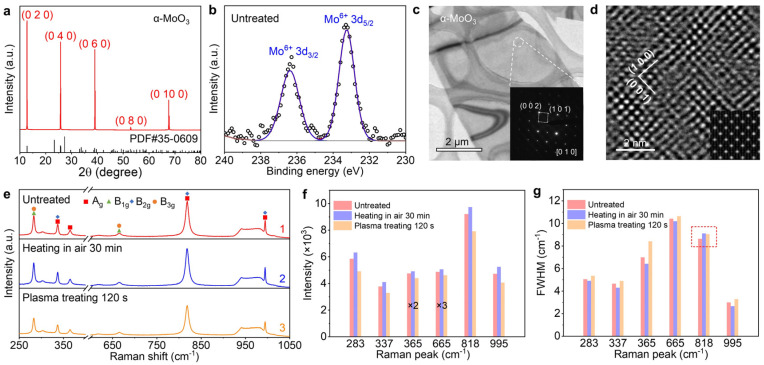 Figure 1
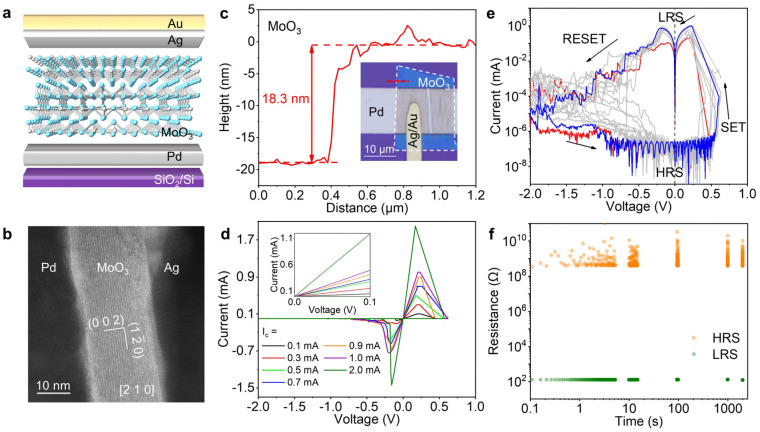 Figure 2
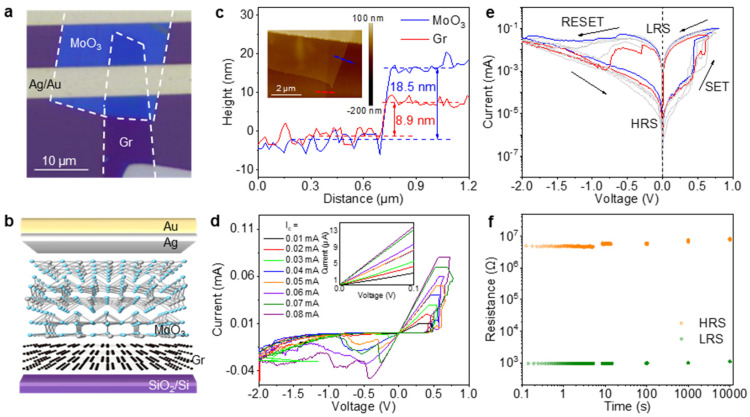 Figure 3
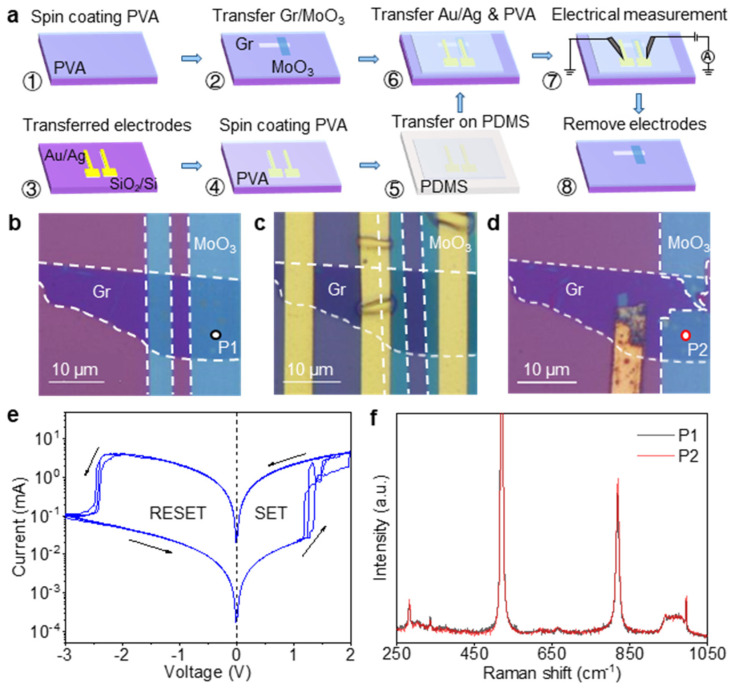 Figure 4
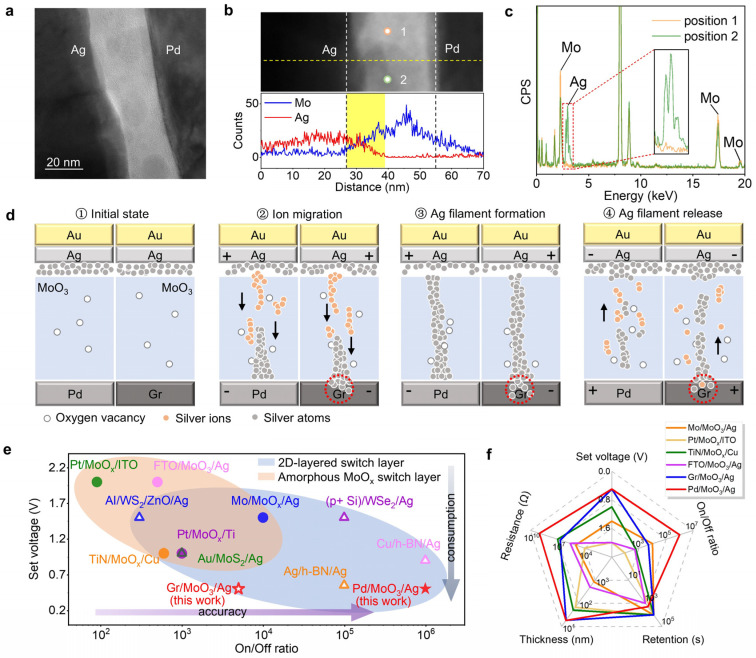 Figure 5
Peer Reviews
No public reviews on file for this paper yet. If you reviewed it on a platform where reviews are public (OpenReview, ICLR, NeurIPS, ICML), you can paste yours below so the community can read it here.
Videos
No videos yet. Explain this paper in a talk, walkthrough, or lecture? Add one.
Taxonomy
TopicsAdvanced Memory and Neural Computing · Transition Metal Oxide Nanomaterials · Ferroelectric and Negative Capacitance Devices