Editorial: Community series in targeting signalling pathways in inflammatory diseases, volume II
Mirza S. Baig, Faaiza Siddiqi, Rajat Atre, Suraj P. Parihar, Syed Faisal, Uzma Saqib

Abstract
Genes, proteins, chemicals, diseases, species, mutations and cell lines named across the full text — each resolved to its canonical identifier and authoritative record.
Click any figure to enlarge with its caption.
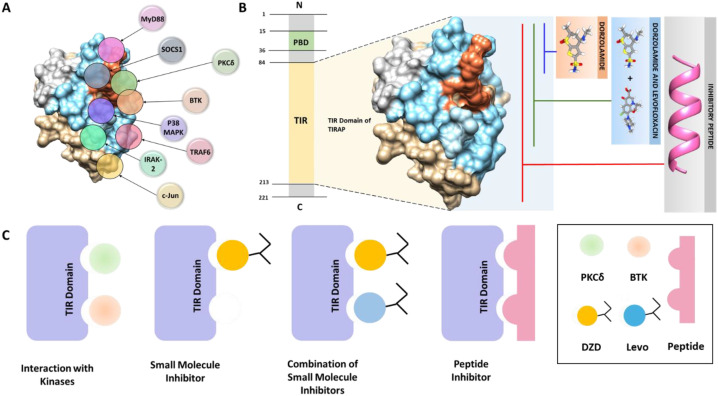 Figure 1
Peer Reviews
No public reviews on file for this paper yet. If you reviewed it on a platform where reviews are public (OpenReview, ICLR, NeurIPS, ICML), you can paste yours below so the community can read it here.
Videos
No videos yet. Explain this paper in a talk, walkthrough, or lecture? Add one.
Taxonomy
TopicsCytokine Signaling Pathways and Interactions · Immune Response and Inflammation · Macrophage Migration Inhibitory Factor
The Toll-interleukin-1 Receptor (TIR) domain-containing adaptor protein (TIRAP) is a critical intracellular facilitator in immune surveillance that coordinates different signaling pathways. Its utility as a bridging entity, and its versatility in binding with diverse components of Toll-like Receptor (TLR) pathway, has been the subject of several investigations (1). During signal transmission, TIRAP undergoes distinct binding mechanisms and conformational changes leading to differential binding with various intracellular mediators thereby contributing to diverse effects in immunological responses. Among its notable interactions, TIRAP engages with proteins such as MyD88, TRAF6, and IRAK-2, facilitating downstream activation of NF-κB and AP-1 (2). Hence, a convoluted mesh of protein-protein interactions forms the foundation of TIRAP signaling, which is regulated through its TIR domain (2) (Figure 1A).
Signaling pathways governed by TIR-domain containing proteins have emerged as a key target for the development of anti-inflammatory therapeutic strategies (3). Dimerization is a central phenomenon required for the functionality of most TIR domains, that span over 200 amino acids and harbor a 14 residues BB loop motif. TIR-mediated signaling mainly relies on the function of the conserved BB loop responsible for signal complex assembly and stabilization (4). TIRAP is a 221 amino acid long protein, which is structured into two main domains namely an N-terminal phosphatidylinositol 4,5-bisphosphate (PIP2) binding domain (PBD) and a C-terminal Toll/interleukin-1 receptor (TIR) domain. TIRAP’s positioning is mediated by Phosphatidylinositol 4-Phosphate 5-Kinase α (PIP5Kα), which generates PIP2, a crucial lipid that serves as a docking site for TIRAP (5, 6). TIRAP’s TIR domain displays structural differences in contrast to the canonic TIR domains. It comprises an extended AB loop that links αA and αB that are developed due to the absence of αB helix classically situated between βB and βC strands (3). These unique structural characteristics of TIRAP have significant implications for immune signaling, as they influence its interactions with other signaling molecules. Consequently, strategies that target and modulate TIRAP-mediated signaling pathways hold promise for the treatment of diseases associated with dysregulated TIR-driven inflammatory responses (3, 7). For example, aberrant TIRAP signaling has been implicated in the pathogenesis of rheumatoid arthritis, where it contributes to destructive inflammation by promoting cytokine production and immune cell activation within affected joints (9).
Mechanistically, TIRAP is known to be activated via a post-translation modification i.e. phosphorylation by kinases namely BTK and PKCδ. Expanding TIR domain targeting through small molecules binding key residues, dual-molecule strategies, or peptide inhibitors spanning the domain, can enhance TIRAP inhibition and disrupt inflammatory signaling (Figure 1B). Previously, Rajpoot et al. explored the TIRAP-PKCδ axis and successfully repurposed an FDA approved compound, Dorzolamide (DZD), targeting the interface residues of PKCδ on TIRAP thereby dampening the downstream inflammatory signaling (8). Though DZD attenuated the PKCδ mediated TIRAP activation, BTK-mediated phosphorylation remains an area to explore.
Recently, Baig et al. proposed a combination therapeutic approach for TIRAP-mediated chronic inflammatory septic condition. They addressed two unique aspects of sepsis progression—the destruction of bacteria and the restoration of damaged organs through homeostasis by developing a novel combination of the broad-spectrum antibiotic Levofloxacin and the repurposed anti-inflammatory medication Dorzolamide (LeDoz) (10). Unlike individual drugs that target a single kinase binding site, we discovered that Levofloxacin and DZD interacted with a section inside the binding groove (19 residues) on the TIRAP TIR domain essential for its interaction with not only PKCδ but also with BTK, which are responsible for its activation (10).
Various such alternative modalities have been investigated to silence TIRAP signaling. In one study, molecular-docking and dynamics simulations predicted that the plant alkaloid Narciclasine binds with high affinity to the TIRAP TIR domain as well as other LPS–TLR4-pathway proteins, stabilizing the complexes and thereby suppressing pro-inflammatory signaling (11). In another investigation, Phycocyanin treatment up-regulated miR-3150a-3p, miR-6883-3p and miR-627-5p, which led to depleted TIRAP transcripts and reduced cellular proliferation, thereby establishing a post-transcriptional checkpoint on adaptor availability (12). Interestingly, one study demonstrated that synthetic decoy peptides derived from the TIRAP TIR domain competitively interrupted TIRAP–MyD88 recruitment, abolishing downstream NF-κB activation and highlighting the value of peptide-based blockade of adaptor–adaptor contacts (13). Collectively, these observations indicate that small molecules and miRNA inducers curtail TIRAP through binding or expression control, whereas peptide modalities can potentially better dismantle the protein-interaction surfaces essential for signal propagation. Based on these insights, a therapeutic peptide has been proposed which targets the entire binding pocket in the TIR domain, dampening TIRAP homo-dimerization required for its functionality. THPdb (Therapeutic Peptides and Proteins Database) was screened against the TIRAP TIR domain, identifying a top candidate peptide. Following it's optimization, the peptide exhibited strong binding to TIRAP, interacting with residues 152–193, including the dimerization pocket. Additionally, its binding outside conventional pockets induced structural conformational changes, enhancing its inhibitory effect on TIRAP.
These findings highlight the potential of targeting this domain of TIRAP using small molecules, dual-molecule strategies, or peptide inhibitors as promising approaches to inhibit TIRAP function and disrupt downstream inflammatory signaling pathways. (Figure 1C). These strategies could pave the way for novel treatments for chronic inflammatory diseases, providing both structural insights and targeted interventions.
The reference list from the paper itself. Each links out to its DOI / PubMed record.
- 1Fitzgerald KA Palsson-Mc Dermott EM Bowie AG Jefferies CA Mansell AS Brady G. Mal (My D 88-adapter-like) is required for Toll-like receptor-4 signal transduction. Nature. (2001) 413:78–83. doi: 10.1038/35092578 11544529 · doi ↗ · pubmed ↗
- 2Rajpoot S Wary KK Ibbott R Liu D Saqib U Thurston TLM. TIRAP in the mechanism of inflammation. Front Immunol. (2021) 12:697588. doi: 10.3389/fimmu.2021.697588 34305934 PMC 8297548 · doi ↗ · pubmed ↗
- 3Saqib U Baig M. Identifying the inhibition of TIR proteins involved in TLR signalling as an anti-inflammatory strategy. SAR QSAR Environ Res. (2018) 29:295–318. doi: 10.1080/1062936 X.2018.1431308 29448819 · doi ↗ · pubmed ↗
- 4Gay NJ Gangloff M. Structure and function of toll receptors and their ligands. Annu Rev Biochem. (2007) 76:141–65. doi: 10.1146/annurev.biochem.76.060305.151318 17362201 · doi ↗ · pubmed ↗
- 5Nguyen TTN Kim YM Kim TD Le OTT Kim JJ Kang HC. Phosphatidylinositol 4-Phosphate 5-Kinase α facilitates toll-like receptor 4-mediated microglial inflammation through regulation of the toll/interleukin-1 receptor domain-containing adaptor protein (TIRAP) location. J Biol Chem. (2013) 288:5645–59. doi: 10.1074/jbc.M 112.410126 PMC 358137023297396 · doi ↗ · pubmed ↗
- 6Bernard NJO’Neill LA. Mal, more than a bridge to My D 88. IUBMB Life. (2013) 65:777–86. doi: 10.1002/iub.1201 23983209 · doi ↗ · pubmed ↗
- 7Atre R Obukhov AG Majmudar CY Nair K White FA Sharma R. Dorzolamide intermediates with potential anti-inflammatory activity. Eur J Pharmacol. (2025) 987:177160. doi: 10.1016/j.ejphar.2024.177160 39631651 · doi ↗ · pubmed ↗
- 8Rajpoot S Kumar A Gaponenko V Thurston TLM Mehta D Faisal SM. Dorzolamide suppresses PKCδ -TIRAP-p 38 MAPK signaling axis to dampen the inflammatory response. Future Med Chem. (2023) 15:533–54. doi: 10.4155/fmc-2022-0260 37129027 · doi ↗ · pubmed ↗