A case of successful removal of 15 magnetic beads causing gastric penetration by endoscopic full-thickness resection
Huihui Zhou, Baohua Yu, Yaowen Zhang

Abstract
Genes, proteins, chemicals, diseases, species, mutations and cell lines named across the full text — each resolved to its canonical identifier and authoritative record.
Click any figure to enlarge with its caption.
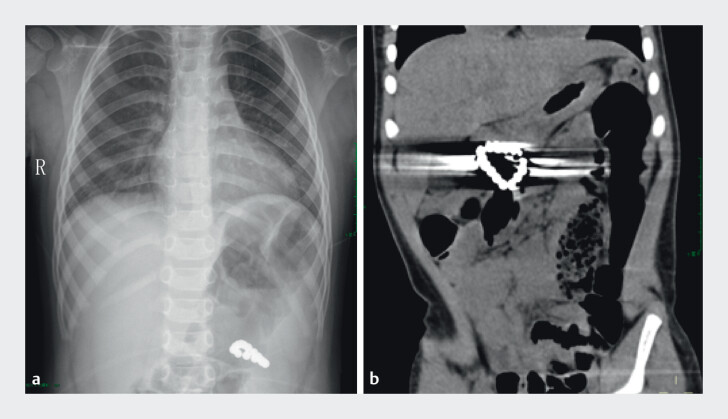 Fig. 1
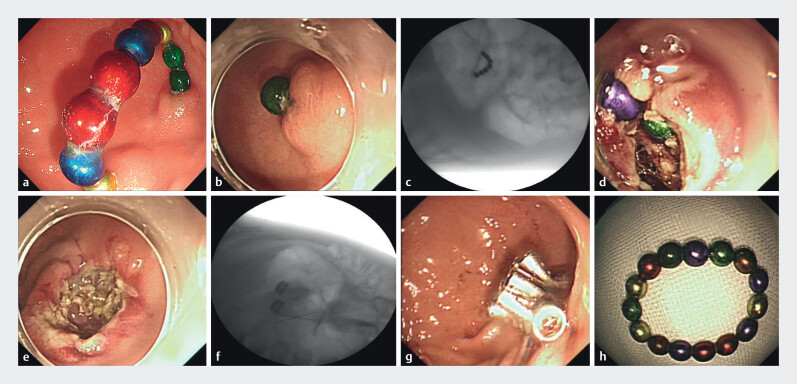 Fig. 2
Peer Reviews
No public reviews on file for this paper yet. If you reviewed it on a platform where reviews are public (OpenReview, ICLR, NeurIPS, ICML), you can paste yours below so the community can read it here.
Videos
No videos yet. Explain this paper in a talk, walkthrough, or lecture? Add one.
Taxonomy
TopicsEsophageal and GI Pathology · Foreign Body Medical Cases · Biliary and Gastrointestinal Fistulas
The incidental finding on the chest X-ray ( Fig. 1 a ) in a 2-year-old boy was as follows: a string of beads-like radiopaque shadow in the left upper abdomen. Abdominal computed tomography ( Fig. 1 b ) was as follows: abnormal density with artifacts in the right upper abdomen. The patient may have ingested the magnetic beads 6 days earlier without discomfort. Esophagogastroduodenoscopy showed ( Fig. 2 a ) a semicircular chain of magnetic beads in the stomach, with both ends penetrating the gastric wall ( Video 1 ). Initially, eight magnetic beads were successfully removed using rat-tooth forceps, and concurrent X-ray imaging ( Fig. 2 b, c ) showed seven remaining magnetic beads, six of which were located outside the gastric wall. Despite repeated attempts to remove the remaining beads, they were deeply embedded and surrounded by tissue, with both ends already perforating the gastric wall, preventing successful removal. One exposed magnetic bead was targeted for endoscopic full-thickness resection. A dual knife was used to incise the mucosal surface, followed by progressive dissection with the IT2-Knife to cut through the muscularis propria until the magnetic bead was fully exposed and reformed into a ring. The bead was then removed with a snare. In total, 15 magnetic beads were removed. A follow-up X-ray showed no residual foreign bodies. After achieving sufficient hemostasis, to avoid delayed perforation, nine metal clips and one nylon loop were used to close the wound ( Fig. 2 d–h ). The patient recovered well and experienced no discomfort after eating.
a The X-ray shows a ring-shaped radiopaque foreign body in the upper left abdomen. b The computed tomography suggests a suspicious ring-shaped foreign body within the intestine, with no evidence of active gastrointestinal perforation.
a Endoscopy revealed a semicircular chain of magnetic beads, with both ends having penetrated the gastric wall. b Endoscopic image after the removal of eight magnetic beads from the stomach. c X-ray showing remaining magnetic beads. d Endoscopic full-thickness resection was performed. e Endoscopic full-thickness resection site after the foreign body removal. f X-ray shows no residual foreign body. g Postoperative wound closure. h The removed magnetic beads.
A case of successful removal of 15 magnetic beads causing gastric penetration by endoscopic full-thickness resection.Video 1
X-rays showing that the magnet was above the pelvic level should be considered to be within the accessible range of the upper gastrointestinal tract for endoscopy 1 2 . Conventional wisdom suggests that deeply embedded magnets are more difficult to remove and often require surgical intervention in the event of fistulae and perforation 3 . Ultimately, we were able to successfully remove the foreign body through endoscopy, thus avoiding more invasive surgical intervention.
Endoscopy_UCTN_Code_TTT_1AO_2AL
The reference list from the paper itself. Each links out to its DOI / PubMed record.
- 1Nugud AA Tzivinikos C Assa A Pediatric Magnet Ingestion, Diagnosis, Management, and Prevention: A European Society for Paediatric Gastroenterology Hepatology and Nutrition (ESPGHAN) Position Paper J Pediatr Gastroenterol Nutr 20237652353210.1097/MPG.000000000000370236947000 · doi ↗ · pubmed ↗
- 2Luo Y Cui X Zhou J Development and Validation of a Clinical Nomogram for Predicting Complications From Pediatric Multiple Magnet Ingestion: A Large Retrospective Study Am J Gastroenterol 202512064264910.14309/ajg.000000000000298339287501 PMC 11864049 · doi ↗ · pubmed ↗
- 3Shaul E Agawu A Wood P Management of Magnet Ingestions at a Large Tertiary Care Childrenʼs Hospital J Pediatr Gastroenterol Nutr 20227533433910.1097/MPG.000000000000350235653435 · doi ↗ · pubmed ↗