Removal of the intrahepatically migrated and impacted plastic stent over malignant stricture using drill dilator
Daiki Yamashige, Susumu Hijioka, Yoshikuni Nagashio, Shota Harai, Mark Chatto, Yutaka Saito, Takuji Okusaka

Abstract
Genes, proteins, chemicals, diseases, species, mutations and cell lines named across the full text — each resolved to its canonical identifier and authoritative record.
Click any figure to enlarge with its caption.
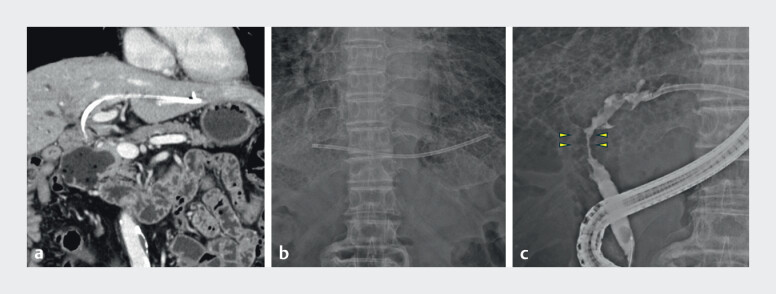 Fig. 1
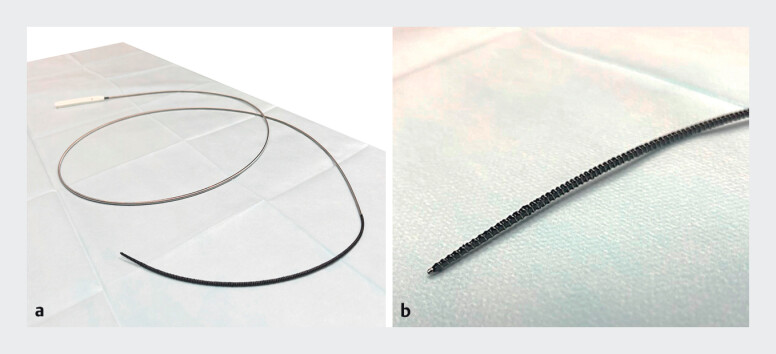 Fig. 2
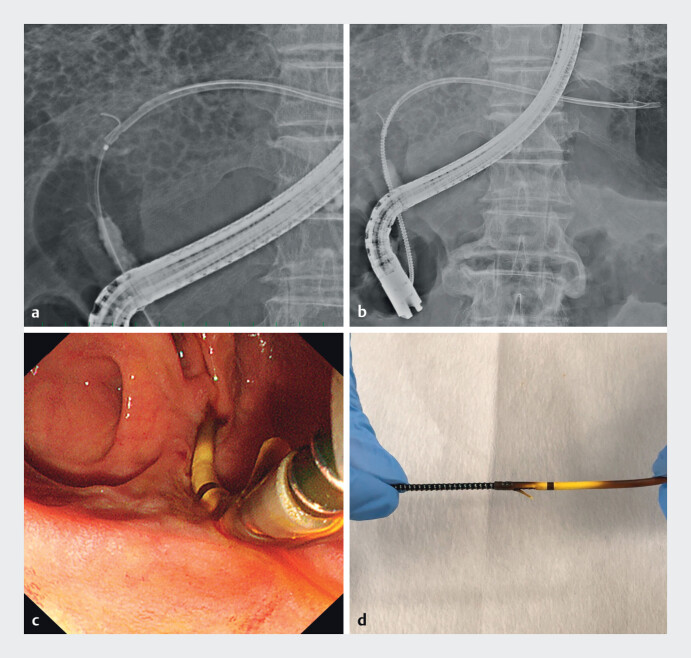 Fig. 3
- —The National Cancer Center Research and Development Fund
Peer Reviews
No public reviews on file for this paper yet. If you reviewed it on a platform where reviews are public (OpenReview, ICLR, NeurIPS, ICML), you can paste yours below so the community can read it here.
Videos
No videos yet. Explain this paper in a talk, walkthrough, or lecture? Add one.
Taxonomy
TopicsEsophageal and GI Pathology · Gallbladder and Bile Duct Disorders · Pancreatic and Hepatic Oncology Research
Endoscopic retrograde cholangiopancreatography-guided stent placement is widely performed; however, stent migration can occur. Migrated stents are typically retrieved using grasping forceps or balloon catheters. However, these conventional devices sometimes fail.
We report a case in which an intrahepatically migrated plastic stent (PS) was successfully retrieved using a drill dilator (Tornus ES, Olympus Co., Japan).
An 84-year-old man with resectable perihilar cholangiocarcinoma (Bismuth type IIIa) developed jaundice. A 7-Fr PS had been previously placed in the left hepatic duct across the papilla. The patient later developed cholangitis. Computed tomography revealed that the PS had migrated toward the hepatic hilum ( Fig. 1 a ).
Intrahepatically migrated and stuck plastic stent over the malignant stricture. a Computed tomography image showing a plastic stent (straight type, 7 Fr) deployed for resectable malignant hilar biliary obstruction migrating to the left intrahepatic duct over the main stricture. b In the fluoroscopic image taken immediately before endoscopic retrograde cholangiopancreatography, the plastic stent has migrated to the deeper side of the left intrahepatic duct. c The plastic stent has migrated over the main malignant stricture (yellow arrows) due to hilar cholangiocarcinoma.
Fluoroscopy confirmed that the stent had migrated deeper into the intrahepatic duct beyond the stricture ( Fig. 1 b, c ). Attempts to retrieve the stent using a balloon catheter were unsuccessful due to its impaction. Additionally, grasping forceps could not pass through the strictures. Consequently, we opted to use a drill dilator for stent removal ( Video 1 ).
An intrahepatically migrated stent in the intrahepatic duct beyond a malignant stricture, which could not be removed with conventional devices, was successfully retrieved using a drill dilator.Video 1
The drill dilator features a coiled sheath, a rotatable handle, and a screw-shaped, tapered tip. It is primarily used for dilation of endoscopic ultrasound-guided biliary drainage 1 2 3 . These design features allow it to pass over a wire and effectively dilate the stricture ( Fig. 2 a, b ). The catheter was advanced to the distal end of the stent, and a 0.025-in. guidewire (J-Wire ST, J-MIT, Japan) was inserted into the lumen ( Fig. 3 a ). The drill dilator was then advanced into the stent using clockwise rotation. Once engagement between the dilator and stent was confirmed, the stent was safely removed through the scope, passing beyond the stricture ( Fig. 3 b, c ). We confirmed the hard engagement with tension manually ( Fig. 3 d ).
What is a drill dilator? a The drill dilator has a coil sheath and a rotatable handle. b A screw-shaped and tapered tip makes it possible to dilate the stricture through the guidewire.
Drill dilator used for stent removal. a The guidewire (J-Wire ST, J-MIT, Japan) was introduced into the stent. b A drill dilator was inserted into the inside of the stent with clockwise rotation. c The stent was successfully removed over the stricture through the scope channel. d The drill dilator strongly involved the plastic stent.
To the best of our knowledge, this is the first report of successful retrieval using a drill dilator. This technique may serve as a viable alternative for removing intrahepatically migrated stents.
Endoscopy_UCTN_Code_CPL_1AK_2AD
The reference list from the paper itself. Each links out to its DOI / PubMed record.
- 1Yamada M Hara K Haba S Endoscopic ultrasound-guided hepaticogastrostomy using a novel drill dilator Endoscopy 202254 E 856E 85710.1055/a-1838-368235636451 PMC 9735340 · doi ↗ · pubmed ↗
- 2Yasuda T Hara K Haba S Dilation of pancreatic duct stenosis using a newly designed drill dilator Dig Endosc 202234 e 73e 7410.1111/den.1426935318735 · doi ↗ · pubmed ↗
- 3Sadek A Hara K Okuno N Safety and efficacy of endoscopic ultrasound-guided pancreatic duct drainage using a drill dilator: a retrospective study in Japan Clin Endosc 20245766667410.5946/ce.2023.27238919059 PMC 11474476 · doi ↗ · pubmed ↗