Investigation of predictors of body awareness of pregnant women
Aslıhan Turan, Hasan Gerçek, Hafize Dağ Tüzmen, Jule Eriç Horasanli

TL;DR
This study found that as pregnancy progresses, women's awareness of their body decreases, suggesting a need for targeted interventions.
Contribution
The novel contribution is identifying gestational weeks as a significant predictor of body awareness in pregnant women.
Findings
Gestational weeks significantly and negatively predict body awareness scores in pregnant women.
Age, number of pregnancies, and physical activity levels did not significantly influence body awareness.
Body awareness decreases as pregnancy progresses, indicating a need for interventions in later stages.
Abstract
The aim of this study was to determine the predictors of body awareness in pregnant women. A cross-sectional study was conducted with 149 women in their second and third trimesters of pregnancy in Turkey between August and November 2024. Participants completed a sociodemographic form, the Body Awareness Questionnaire, and the International Physical Activity Questionnaire-Short Form. Multiple linear regression was used to analyze the effects of age, number of pregnancies, gestational weeks, and physical activity levels on body awareness. Participants had a mean age of 27.69±4.82 years, a mean body mass index of 26.59±3.49, and a mean gestational week of 31.97±6.95. The average body awareness score was 92.52±15.48, and the mean physical activity level was 1,084.56±671.93 metabolic equivalent of task-minutes/week. Regression analysis showed that gestational weeks significantly predicted…
Genes, proteins, chemicals, diseases, species, mutations and cell lines named across the full text — each resolved to its canonical identifier and authoritative record.
Click any figure to enlarge with its caption.
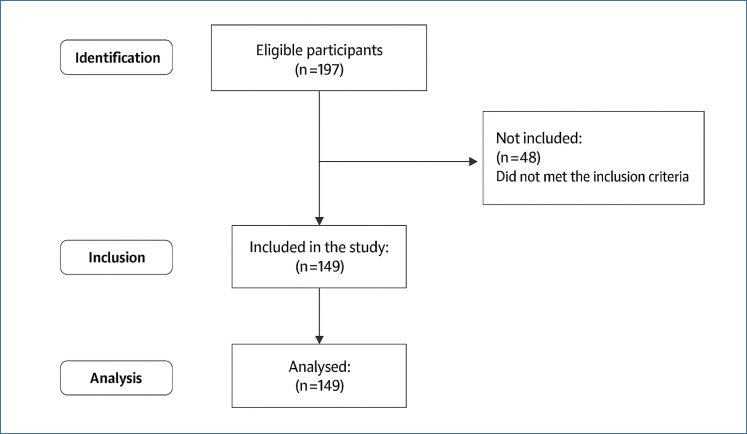 Figure 1
| X±SD/n (%) | ||
|---|---|---|
| Age | 27.69±4.82 | |
| BMI | 26.59±3.49 | |
| Number of pregnancies | 1.67±0.68 | |
| Number of live births | 0.70±0.74 | |
| Gestational weeks | 31.97±6.95 | |
| Trimester | ||
| Second | 25 (16.8) | |
| Third | 124 (83.2) | |
| Body awareness | 92.52±15.48 | |
| Physical activity (MET*min/W) | 1,084.56±671.93 | |
| Physical activity levels | ||
| Low | 64 (43.0) | |
| Moderate | 76 (51.0) | |
| High | 9 (6.0) | |
| Educational status | ||
| Primary school | 6 (4.0) | |
| Middle school | 15 (10.1) | |
| High School | 115 (77.2) | |
| University and above | 13 (8.7) | |
| Income status | ||
| Income less than expenditure | 16 (10.7) | |
| Income equal expenditure | 116 (77.9) | |
| Income higher than expenditure | 17 (11.4) | |
| Employment status | ||
| Yes | 43 (28.9) | |
| No | 106 (71.1) | |
| Variables | Multiple regression analysis for body awareness | |||||
|---|---|---|---|---|---|---|
| B (SE) | Lower 95%CI for B | Upper 95%CI for B | Beta | p | Effect size | |
| Intercept | 108.800 | 92.214 | 125.386 |
| 0.108 | |
| Age | 0.074 | -0.537 | 0.684 | 0.023 | 0.812 | <0.001 |
| Number of pregnancies | 1.612 | -2.377 | 5.601 | 0.071 | 0.426 | 0.004 |
| Gestational weeks | -0.729 | -1.089 | -0.369 | -0.327 |
| 0.100 |
| Physical activity | 0.002 | -0.002 | 0.006 | 0.092 | 0.295 | 0.008 |
Peer Reviews
No public reviews on file for this paper yet. If you reviewed it on a platform where reviews are public (OpenReview, ICLR, NeurIPS, ICML), you can paste yours below so the community can read it here.
Videos
No videos yet. Explain this paper in a talk, walkthrough, or lecture? Add one.
Taxonomy
TopicsEating Disorders and Behaviors · Obesity, Physical Activity, Diet · Physical Activity and Health
INTRODUCTION
Body awareness refers to an individual's more specific awareness of specific body parts by focusing attentively on their internal sensations of their own body^ 1 ^. Another concept related to body awareness is "body image". This concept implies that body awareness involves an external and visual perception channel. Body image has been studied in a wide range of fields, including psychiatry (e.g., anorexia), feminist psychology (e.g., self-objectification), and neuroscience (e.g., rubber hand illusion and amputation), as well as in upper extremity lymphedema after breast cancer surgery, reflecting the priority given to visual appearance rather than internal perceptions of the body^ 2,3 ^. Body awareness is affected by many variables such as age, number of pregnancies, and gestational age^ 4,5 ^.
Pregnancy causes significant physical changes in women's bodies. These rapid physical changes can cause women to reassess their body image^ 6 ^. Pregnancy can affect women's psychological health, including body image and quality of life^ 7 ^. Higher levels of body dissatisfaction during pregnancy, leading in particular to a lower level of trust in bodily signals (trust in the body) and a reduced ability to attend to and listen to bodily sensations^ 8 ^. As the pregnancy progresses, the displacement of the center of gravity and lumbar lordosis increases^ 9 ^, which can have a negative impact on body awareness.
Physical activity and exercise are gaining importance as one of the tools to improve body awareness, and it is also an effective method to increase self-efficacy and self-esteem^ 10,11 ^. It is known that physical activity during pregnancy is generally safe for maternal and fetal health and that physical activity during this period reduces the risk of adverse health outcomes for mother and fetus^ 12 ^. Exercise has been reported to reduce risk factors for body image dissatisfaction such as stress, social support, or body mass index^ 6 ^.
Although there are studies in the literature on the factors affecting body awareness of pregnant women, we did not find any studies examining the effects of age, number of pregnancies, gestational week, and physical activity level^ 1,7,8,13 ^. The hypothesis of this study was that increasing age, number of pregnancies, and gestational week decreased body awareness in pregnant women, while physical activity level increased body awareness. The aim of this study was to determine the relationship between the body awareness of pregnant women and physical activity levels, age, number of pregnancies, and gestational week.
METHODS
This study is a cross-sectional study conducted online via Google Forms between September and November 2024 to determine the effect of age, number of births, gestational week, and physical activity levels on body awareness of pregnant women in Turkey in accordance with the Declaration of Helsinki. A total of 197 people were screened, and 149 women in the second to third trimester of pregnancy (be at least 14 weeks of gestation) were included in the study (Figure 1). Prior to the study, ethical approval was obtained from the local ethics committee of KTO Karatay University [decision number: 2024/038 and prospectively registered at www.clinicaltrials.gov (NCT06648993)]. All participants provided informed consent prior to enrolling in this study. This study has been reported according to the Strengthening the Reporting of Observational Studies in Epidemiology (STROBE) statement to assist in quality reporting.
Flow diagram.
The inclusion criteria of the study were being 18–40 years old, being in the second to third trimester of pregnancy, and volunteering to participate in the study. The exclusion criteria for the study were having a high-risk pregnancy (preeclampsia, threatened preterm labor, gestational diabetes mellitus, etc.), multiple pregnancy, being prohibited from physical activity by the physician, being diagnosed psychiatric disorders (e.g., eating disorders and major depression), neurological conditions affecting sensory or motor function, chronic musculoskeletal pain, and extensive prior experience in body-awareness-based practices (e.g., yoga and Pilates).
Sample size
GPower software package (GPower, Version 3.0.10, Franz Faul, Universität Kiel, Germany) was used to calculate the sample size. A minimum of 89 participants should be included in the study with an effect size of 0.15, which is the medium effect size for the linear multiple regression model, 95% power, and 0.05 Type I error. A total of 149 pregnant women were included to increase the power of the study. The post hoc power of the study was 0.95 with a Type I error of 0.05 and an effect size of 0.09.
Outcome measures
Participants’ age, body mass index, number of pregnancies, number of live births, gestational weeks, educational status, income status, and employment status were collected using a sociodemographic form created by the researchers.
Body awareness
Body Awareness Questionnaire was used to evaluate body awareness. The Body Awareness Questionnaire is valid and reliable and has no cutoff point. The questionnaire consists of 18 questions. Participants were asked to score each statement ranging from 1 (1: Not true at all) to 7 (7: Completely true), and the total score was obtained by summing the score given for each statement. The total score takes a value between 18 and 126. The higher the total score, the better the body awareness^ 14,15 ^.
Physical activity
The physical activity levels of individuals were assessed using the IPAQ-SF, a tool comprising seven questions that gather data on the frequency (in days) and duration (in minutes) of high-, moderate-, and low-intensity activities over the previous week, as well as sedentary behavior. To be included in the scoring, an activity must be sustained for at least 10 min per session. The evaluation involves multiplying the reported minutes and days by the corresponding metabolic equivalent of task (MET) value, with the resulting score expressed as MET-minutes/week. Lower scores indicate lower levels of physical activity^ 16,17 ^.
Statistic
The normality of the distribution of values was examined using visual and analytical methods. As descriptive analyses, mean and standard deviation values were used for normally distributed data and median (minimum–maximum) values for non-normally distributed data. Multiple regression models were constructed to determine regression coefficients and 95% confidence intervals for the relationships between body awareness and age, number of pregnancies, gestational weeks, and physical activity. IBM SPSS Statistics v. 29.0 (IBM SPSS Statistics for Windows, Version 29.0. Armonk, NY: IBM Corp.) was used for statistical analyses. The significance level was accepted as p<0.05.
RESULTS
A total of 149 pregnant women with a mean age of 27.69±4.82 years were included in the study. The mean BMI of the participants was 26.59±3.49; the number of pregnancies was 1.67±0.68; the number of live births was 0.70±0.74, and the gestational weeks were 31.97±6.95. Among the participants, 124 (83.2%) were in the third trimester. The educational status of 115 (77.2%) of the participants was high school. The income status of 116 (77.9%) of the participants was income equal expenditure, while 106 (71.1%) were not employed (Table 1). Of the participants, 76 (51.0%) had a moderate physical activity level. Participants’ body awareness and physical activity levels are given in Table 1.
A multiple linear regression was used to test to predict body awareness based on age, number of pregnancies, gestational weeks, and physical activity. A significant regression equation was found (F=4.363, p=0.002), with an R^ 2 ^adj of 0.083. It was found gestational week significantly predicted body awareness (β=0.327, p<0.001, =0.366) (Table 2).
DISCUSSION
This study was conducted to examine the relationship between body awareness and physical activity levels, age, number of pregnancies, and gestational weeks in pregnant women. The results of this study showed that in a multiple linear regression analysis to examine the predictive power of age, number of pregnancies, gestational week, and physical activity on body awareness, the model was significant, and gestational week was a significant predictor of body awareness. According to the results of the study, most of the participants were in the third trimester of pregnancy and had a moderate physical activity level.
Pregnancy can cause women to become more sensitive to changes in their bodies and lead to increased body awareness. During pregnancy, there is an increase in women's awareness to recognize the changing needs of their bodies^ 18 ^. Physical changes during pregnancy can affect pregnant women's body image, and as the trimesters increase, some women may be affected by these changes and develop negative body image^ 19 ^. Experience is important in the processing of body awareness^ 20 ^. Therefore, past pregnancy experiences may have an impact on body awareness. The results of this study show that participants had less than two pregnancies on average. This may explain the low impact on body awareness. Body awareness is at its lowest in the third trimester of pregnancy^ 5 ^. In the third trimester, which is the last period of pregnancy, the fact that pregnant women are preparing for the role of motherhood may also cause changes in body perception. The findings of the study are similar to the literature. It is thought that the change in body image perception during pregnancy according to trimesters is related to the effect of both psychological and physical changes.
In the literature, it has been reported that physical activity levels of pregnant women are generally inadequate and there is a decrease in physical activity levels of women depending on the trimesters of pregnancy^ 21,22 ^. Approximately half (45.9%) of pregnant women were reported to be sedentary^ 23 ^. There are a limited number of studies in the literature examining the relationship between physical activity and body image among pregnant women, and the results of the studies vary^ 24,25 ^. It is thought that physical problems such as weight gain, fatigue, sleep disorders, and emotional changes during pregnancy may cause changes in the physical activity level; differences in study results may be due to the fact that pregnancy is an individual experience. The results of this study showed that most of the participants had a moderate physical activity level. It is suggested that the fact that most of the participants had moderate physical activity level may lead to inadequate prediction of body awareness.
The body of women who are pregnant for the first time is affected in many ways. Conversations between women and health professionals about women's body image in the early stages of pregnancy can contribute to increased body knowledge, which can have a positive impact in the later stages of pregnancy and in relation to childbirth^ 13 ^. There is no study in the literature examining the effect of number of pregnancies on body awareness. The results of this study showed that the number of pregnancies did not predict body awareness. Considering that each birth has a different nature from each other, we think that the number of pregnancies may be the reason why the number of pregnancies does not predict body awareness.
There is no study examining the relationship between age and body awareness in pregnant women. Somatic signaling decreases with aging^ 26 ^. Decreasing somatic signals may lead to a decrease in body awareness. The results of this study showed that age did not predict body awareness in pregnancy. We think that the reason for this result is that the pregnant women included in the study were in the age group where there would not be significant decreases in the rate of decline of somatic signals.
CONCLUSION
This study highlights the significant impact of gestational weeks on body awareness in pregnant women, showing a decline in body awareness as pregnancy progresses. Although no significant associations were found between body awareness and age, number of pregnancies, or physical activity levels, the findings emphasize the importance of addressing body awareness in prenatal care, particularly in the later stages of pregnancy. It is recommended that health professionals integrate interventions to increase body awareness into prenatal care programs, especially in the later stages of pregnancy.
Limitations
This study had some limitations. One of the limitations of this study is the inclusion of pregnant women in the 2nd and 3rd trimesters. Since it is well known that physical activity levels tend to decrease in the third trimester, future studies may consider including only women in the second or third trimester to obtain more homogenous results. Another limitation was the use of the IPAQ-SF instead of the pregnancy-specific "pregnancy physical activity questionnaire" to determine physical activity levels. This study focused on gestational week, age, number of pregnancies, and physical activity, while other factors that may affect body awareness such as psychological health, social support, and antenatal education were not included. Future research could address these limitations by utilizing a longitudinal design involving a more diverse and representative sample.
The reference list from the paper itself. Each links out to its DOI / PubMed record.
- 1Mehling WE Wrubel J Daubenmier JJ Price CJ Kerr CE Silow T Body awareness: a phenomenological inquiry into the common ground of mind-body therapies Philos Ethics Humanit Med 201166610.1186/1747-5341-6-621473781 PMC 3096919 · doi ↗ · pubmed ↗
- 2Giummarra MJ Gibson SJ Georgiou-Karistianis N Bradshaw JL Mechanisms underlying embodiment, disembodiment and loss of embodiment Neurosci Biobehav Rev 200832114316010.1016/j.neubiorev.2007.07.00117707508 · doi ↗ · pubmed ↗
- 3Pirinççi CŞ Cihan E Yaman F Assessing body awareness and upper extremity functionality in breast cancer survivors with and without lymphedema: a comparative analysis with healthy controls Support Care Cancer 2025332868610.1007/s 00520-024-09138-239789298 PMC 11717817 · doi ↗ · pubmed ↗
- 4Bayram Y Artan T Focus, explore and notıce: mındfulness therapy ın workıng wıth older people Commun Soc Work 202031416801702
- 5Kök G GüvençG Bilsel H Güvener A Does body image perceptions of women differ during pregnancy J Educ Res Nurs 2018154
- 6Linde K Lehnig F Treml J Nagl M Stepan H Kersting A The trajectory of body image dissatisfaction during pregnancy and postpartum and its relationship to body-mass-index P Lo S One 2024198 e 030939610.1371/journal.pone.030939639186513 PMC 11346655 · doi ↗ · pubmed ↗
- 7Fard ZR Azadi A Veisani Y Body image, quality of life, and their predicting factors in pregnant women: a cross-sectional study Kesmas Jurnal Kesehatan Masyarakat Nasional (Nat Public Health J)202217110.21109/kesmas.v 17i 1.XXXX · doi ↗
- 8Crossland A Kirk E Preston C Interoceptive sensibility and body satisfaction in pregnant and non-pregnant women with and without children Sci Rep 2022121161381613810.1038/s 41598-022-20181-z 36168024 PMC 9515153 · doi ↗ · pubmed ↗