Assessing the Determinants of Influenza Vaccine Uptake in Malaysia: Strategies to Improve Public Health and Service Delivery
Prebha Manickam, Tina Varghese, Suwarna Senthilvasan, Rubithra Ramesh, Suveitra Balanei Balasubramaniam

TL;DR
This study explores why people in Malaysia are hesitant to get the influenza vaccine and suggests ways to improve vaccination rates through education and communication.
Contribution
The study identifies key factors influencing influenza vaccine hesitancy in Malaysia and proposes targeted public health strategies.
Findings
54.5% of participants showed vaccine hesitancy, with higher hesitancy among non-healthcare workers.
Previous influenza experience, personal risk perception, and vaccination history significantly influence willingness to vaccinate.
Abstract
Background: Although the Ministry of Health, Malaysia, has emphasized that the public receive their influenza vaccine shots, with the latest announcement of free vaccines for senior citizens in Malaysia, vaccine hesitancy has been prevalent among society and more pronounced within the public who are not involved in the fields of healthcare. The present study aims to identify the influencing factors in receiving the influenza vaccine based on the vaccine hesitancy matrix proposed by the World Health Organization (WHO). Methods: Healthcare personnel and individuals from the non-healthcare fields were enrolled. A structured questionnaire was prepared and shared by the investigators. A mixed sampling approach was employed, initially utilizing convenience sampling, and then, a respondent-driven sampling (RDS) strategy was used to target all participants consenting to fill out the…
Genes, proteins, chemicals, diseases, species, mutations and cell lines named across the full text — each resolved to its canonical identifier and authoritative record.
Click any figure to enlarge with its caption.
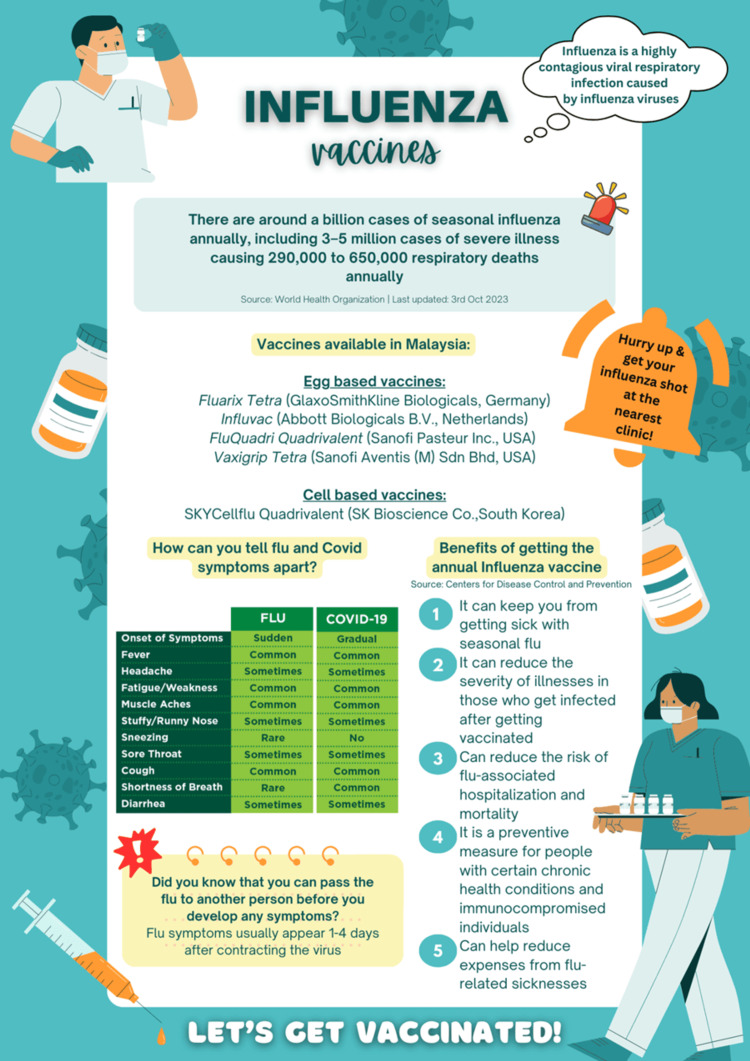 Figure 1
| General | Participant | Attitude toward vaccination | Total | Total % | Chi-square value | p-value* | |||
| Factors | Categories | N1 | N1% | N2 | N2% | N | N% | (χ²) | (<0.05) |
| Gender | Male | 32 | 18.2 | 29 | 16.5 | 61 | 34.7 | 0.06 | 0.686 |
| Female | 64 | 36.4 | 51 | 29 | 115 | 65.3 | |||
| Races | Chinese | 12 | 12.5 | 8 | 10 | 20 | 11.4 | 2.718 | 0.534 |
| Indian | 68 | 70.8 | 62 | 77.5 | 130 | 73.9 | |||
| Malay | 1.1 | 11.5 | 5 | 6.3 | 16 | 9.1 | |||
| Others | 3 | 2.9 | 5 | 5.1 | 10 | 5.9 | |||
| Marital status | Divorced | 2 | 2.1 | 2 | 2.2 | 4 | 2.3 | 0.137 | 0.934 |
| Married | 28 | 15.9 | 25 | 14.2 | 53 | 30.1 | |||
| Single | 66 | 37.5 | 53 | 30.1 | 119 | 67.6 | |||
| Age | 18-30 years | 63 | 35.8 | 52 | 45.2 | 115 | 29.5 | ||
| 31-40 years | 14 | 8 | 9 | 5.1 | 23 | 13.1 | 6.632 | 0.250 | |
| 41-50 | 9 | 5.1 | 11 | 6.3 | 20 | 11.4 | |||
| 51-60 | 5 | 2.8 | 8 | 4.5 | 13 | 7.4 | |||
| 61-70 | 4 | 2.3 | 0 | 0 | 4 | 2.3 | |||
| 71-80 | 1 | 0.6 | 0 | 0 | 1 | 0.6 | |||
| Living with | Children | 13 | 7.4 | 16 | 9.1 | 29 | 16.5 | 4.018 | 0.212 |
| Healthy adults | 60 | 34.1 | 44 | 25 | 104 | 59.1 | |||
| Living with people >65 years | 5 | 2.8 | 10 | 5.7 | 15 | 8.5 | |||
| Chronic diseases | 8 | 4.5 | 3 | 1.7 | 11 | 6.3 | |||
| Non-applicable | 10 | 5.7 | 7 | 4 | 17 | 9.7 | |||
| Education Level | Diploma | 6 | 3.4 | 7 | 4 | 13 | 7.4 | 2.147 | 0.709 |
| Secondary education | 3 | 1.7 | 1 | 0.6 | 4 | 2.3 | |||
| Undergraduate | 59 | 33.5 | 53 | 30.1 | 112 | 63.6 | |||
| Postgraduate | 23 | 13.1 | 17 | 9.7 | 40 | 22.7 | |||
| Others | 5 | 2.8 | 2 | 1.1 | 7 | 4 | |||
| Healthcare | No | 50 | 28.4 | 32 | 18.2 | 82 | 46.6 | 7.314 | 0.110 |
| Yes | 46 | 26.1 | 68 | 27.3 | 94 | 53.4 | |||
| Residence | Rural | 8 | 4.5 | 6 | 3.4 | 14 | 8 | 0.0 | 0.839 |
| Urban | 88 | 50 | 74 | 42 | 162 | 92 | |||
| Immunocompromised | No | 87 | 49.4 | 80 | 39.8 | 157 | 89.2 | 0.022 | 0.506 |
| Yes | 9 | 5.1 | 10 | 5.7 | 19 | 10.8 | |||
| Family history of cancer | No | 67 | 38.1 | 50 | 28.4 | 117 | 66.5 | 0.74 | 0.308 |
| Yes | 29 | 16.5 | 30 | 17 | 59 | 33.5 | |||
| Medical insurance | Maybe | 8 | 4.5 | 3 | 1.7 | 11 | 6.3 | 6.904 | 0.065 |
| No | 111 | 6.3 | 3 | 1.7 | 14 | 8 | |||
| Yes | 77 | 43.8 | 74 | 42.0 | 151 | 85.8 | |||
| Matrix | Factors | Opinion | Attitudes or willingness to be vaccinated | Total | Total% | Chi-square value | p-value* | |||
| Contextual influences | Questions based on hesitancy | Options | N1 | N1% | N2 | N2% | (N) | (N%) | (χ²) | <0.05 |
| Have you ever had influenza? | I don’t know | 30 | 17 | 11 | 6.3 | 41 | 23.3 | 23.444 | 0.000 | |
| Not infected | 57 | 32.4 | 38 | 21.6 | 95 | 54 | ||||
| Yes, and confirmed | 9 | 5.1 | 31 | 17.6 | 40 | 22.7 | ||||
| Have you heard any negative information about vaccines? | No | 47 | 26.7 | 30 | 17 | 77 | 43.8 | 1.886 | 0.127 | |
| Yes | 49 | 27.8 | 50 | 28.4 | 99 | 56.3 | ||||
| Individual and group influences | How much do you know about the influenza vaccine? (1-5) | 1 (very little) | 15 | 8.5 | 4 | 2.3 | 19 | 10.8 | 18.240 | 0.056 |
| 2 (little) | 14 | 8 | 12 | 6.8 | 26 | 14.8 | ||||
| 3 (mod) | 43 | 24.4 | 35 | 19.9 | 78 | 44.3 | ||||
| 4 (just enough) | 20 | 11.4 | 20 | 11.4 | 40 | 7.4 | ||||
| 5 (a lot) | 4 | 2.3 | 9 | 5.1 | 13 | 7.4 | ||||
| Influenza vaccination can help reduce the severity of the disease if I'm infected | Strongly disagree | 2 | 1.1 | 3 | 1.7 | 5 | 2.8 | 18.241 | 0.057 | |
| Disagree | 3 | 1.7 | 4 | 2.3 | 7 | 4 | ||||
| Neutral | 19 | 10.8 | 13 | 7.4 | 32 | 18.2 | ||||
| Agree | 50 | 28.4 | 28 | 15.9 | 78 | 44.3 | ||||
| Strongly agree | 22 | 12.5 | 32 | 18.2 | 54 | 30.7 | ||||
| Influenza vaccination can reduce my probability of being infected with the disease | Strongly disagree | 3 | 1.7 | 2 | 1.1 | 5 | 2.8 | 2.773 | 0.210 | |
| Disagree | 4 | 2.3 | 3 | 1.7 | 7 | 4 | ||||
| Neutral | 20 | 11.4 | 9 | 5.1 | 29 | 16.5 | ||||
| Agree | 50 | 28.4 | 39 | 22.2 | 89 | 50.6 | ||||
| Strongly agree | 19 | 10.8 | 27 | 15.3 | 26.1 | 5 | ||||
| I fear being infected by influenza | Strongly disagree | 6 | 3.4 | 4 | 2.3 | 10 | 5.7 | 1.445 | 0.178 | |
| Disagree | 11 | 6.3 | 5 | 21 | 16 | 9.1 | ||||
| Neutral | 31 | 17.6 | 21 | 11.9 | 52 | 29.5 | ||||
| Agree | 40 | 22.7 | 34 | 19.3 | 74 | 42 | ||||
| Strongly agree | 8 | 4.5 | 16 | 9.1 | 24 | 13.6 | ||||
| I believe the influenza vaccine is a necessity | Strongly disagree | 6 | 3.4 | 4 | 2.3 | 10 | 5.7 | 1.439 | 0.177 | |
| Disagree | 11 | 6.3 | 5 | 21 | 16 | 9.1 | ||||
| Neutral | 31 | 17.6 | 21 | 11.9 | 52 | 29.5 | ||||
| Agree | 40 | 22.7 | 34 | 19.3 | 74 | 42 | ||||
| Strongly agree | 8 | 4.5 | 16 | 9.1 | 24 | 13.6 | ||||
| Have you been recommended by your family, classmates, friends, or doctor to take the influenza vaccine? | No | 46 | 26.1 | 13 | 7.4 | 59 | 33.5 | 18.240 | 0.000 | |
| Yes | 50 | 28.4 | 67 | 38.1 | 117 | 66.5 | ||||
| Do you trust the vaccine-related advice given by medical professionals? | No | 11 | 6.3 | 5 | 2.8 | 16 | 9.1 | 3.97 | 0.231 | |
| Yes | 85 | 48.3 | 75 | 42.6 | 160 | 90.9 | ||||
| "I believe that the benefits of the influenza vaccine outweigh its possible side effects" | Strongly disagree | 0 | 0 | 1 | 0.6 | 1 | 0.6 | 4.220 | 0.144 | |
| Disagree | 6 | 3.4 | 3 | 1.7 | 9 | 5.1 | ||||
| Neutral | 28 | 15.9 | 19 | 10.8 | 47 | 26.7 | ||||
| Agree | 47 | 26.7 | 33 | 18.8 | 80 | 45.5 | ||||
| Strongly agree | 15 | 8.5 | 24 | 13.6 | 39 | 22.2 | ||||
| "I already got infected with influenza previously, and this gave me enough immunity" | Strongly disagree | 18 | 10.2 | 14 | 8 | 32 | 18.2 | 3.99 | 0.273 | |
| Disagree | 16 | 9.1 | 18 | 10.2 | 34 | 19.3 | ||||
| Neutral | 42 | 23.9 | 29 | 16.5 | 71 | 40.3 | ||||
| Agree | 17 | 9.7 | 11 | 6.3 | 28 | 15.9 | ||||
| Strongly agree | 3 | 1.7 | 8 | 4.5 | 11 | 6.3 | ||||
| Vaccine-specific influences | Do you believe in the efficacy of vaccines? | No | 13 | 7.4 | 3 | 1.7 | 16 | 9.1 | 3.947 | 0.024 |
| Yes | 83 | 47.2 | 77 | 43.8 | 160 | 90.9 | ||||
| Do you believe in the safety of domestic vaccines? | No | 21 | 11.9 | 9 | 5.1 | 30 | 17 | 2.773 | 0.052 | |
| Yes | 75 | 42.6 | 71 | 40.3 | 146 | 83 | ||||
| Do you believe in the safety of vaccines abroad? | No | 19 | 10.8 | 8 | 4.5 | 27 | 15.3 | 1.591 | 0.207 | |
| Yes | 77 | 43.8 | 72 | 40.9 | 149 | 84.7 | ||||
| Have you been vaccinated against COVID-19? | Received 1st and 2nd dose | 17 | 9.7 | 13 | 7.4 | 30 | 17 | 0.484 | ||
| Received 1st, 2nd dose, and 3rd dose | 50 | 28.4 | 44 | 25 | 94 | 53.4 | ||||
| Received 1st, 2nd dose, 3rd dose, and 4th dose | 6 | 3.4 | 8 | 4.5 | 14 | 8 | ||||
| Received 1st, 2nd dose but willing to receive 3rd dose and 4th dose | 11 | 6.9 | 11 | 6.8 | 23 | 15.3 | ||||
| Received 1st and 2nd dose but willing to receive 3rd dose and 4th dose | 12 | 6.9 | 3 | 1.7 | 15 | 8.5 | ||||
| Do you believe that the way to overcome the COVID-19 pandemic is mass vaccination? | No | 33 | 19.3 | 25 | 14.2 | 59 | 33.5 | 5.660 | 0.736 | |
| Yes | 62 | 35.2 | 55 | 31.2 | 117 | |||||
| "I will take the influenza vaccination only if it is made mandatory for me by government authorities or the college and not on my own accord" | No | 61 | 33.7 | 35 | 19.9 | 96 | 54.8 | 18.508 | 0.001 | |
| Yes | 60 | 34.1 | 11.4 | |||||||
| Do you agree that point-of-care (POC)1 testing using rapid influenza diagnostic tests (RIDTs)2 on patients is necessary in the clinic before a dental procedure? | No | 22 | 23.5% | 33 | 28.9 | 55 | 48.2% | 4.621 | 0.033 | |
| Yes | 20 | 17.5 | 39 | 37.2 | 59 | 51.8 | ||||
| Matrix | Factors | Reference (Rf) | Wald chi-square test | p-value | OR | 95% CI | |
| Contextual influences | Is your profession related to healthcare? | Yes (Rf-no) | 4.022 | 0.045 | 0.441 | 0.198 | 0.981 |
| Individual and group influences | Have you ever had Influenza? | Yes (Rf-no) | 13.26 | 0.000 | 0.091 | 0.025 | 0.330 |
| Influenza vaccination can help reduce the severity of the disease if I'm infected | Agree (Rf-disagree) | 5.071 | 0.024 | 0.148 | 0.028 | 0.779 | |
| Have you been recommended by your family, classmates, friends, or doctor to take the influenza vaccine? | Yes (Rf-no) | 16.373 | 0.000 | 0.124 | 0.45 | 0.340 | |
| Vaccine-specific influences | Have you been vaccinated against COVID-19? | Taken 1st and 2nd doses and not willing to take/ taken 3rd and 4th dose | 5.84 | 0.05 | 8.558 | 1.500 | 48.814 |
| I will take the influenza vaccination only if it is made mandatory for me by government authorities or the college and not on my own accord | Yes (Rf-no) | 8.046 | 0.005 | 0.547 | 0.361 | 0.831 | |
Peer Reviews
No public reviews on file for this paper yet. If you reviewed it on a platform where reviews are public (OpenReview, ICLR, NeurIPS, ICML), you can paste yours below so the community can read it here.
Videos
No videos yet. Explain this paper in a talk, walkthrough, or lecture? Add one.
Taxonomy
TopicsVaccine Coverage and Hesitancy · Influenza Virus Research Studies · COVID-19 epidemiological studies
Introduction
Reliable data from Southeast Asian countries proved that influenza is a major threat to the population’s health and well-being, with a cost impact on individuals, communities, and healthcare systems [1]. According to the World Health Organization (WHO) Virological Surveillance Summary reported to Flunet on December 18, 2024, 7392 cases were positive over 46436 specimens tested in Malaysia [2]. Without a comprehensive and consolidated body of data, these numbers are likely to be conservative, with the true burden of the disease being significantly higher. It is estimated that influenza accounts for 23% of severe acute respiratory infection (SARI) cases and 13% of pneumonia hospitalizations in Malaysia [3,4].
The WHO and US Centers for Disease Control and Prevention (CDC) have identified vaccination as the most effective prevention method against influenza. The influenza vaccine has been shown to reduce the spread of influenza-like illnesses (ILI) and the risk of fatal complications [5]. Retrospective studies showed a 22% reduction in ILI among Malaysian pilgrims who were vaccinated compared to unvaccinated pilgrims during the 2013 Hajj season, as well as a potential reduction in overall hospitalization rates post-vaccination [6]. There is a 55-75% vaccine effectiveness in reducing the occurrence of ILI in Malaysian adults in an old folk home, which has also been proven [7]. The cost of the influenza vaccine is Myr 41-100, which is considerably lower than the average cost for influenza treatment per year (antiviral medications/year Myr 1544) [8]. A cost-effectiveness analytical study of quadrivalent influenza vaccine (QIV) for the elderly in Malaysia compared with the no-vaccination policy showed that QIV could save over USD 4.4 million currently spent on influenza-related hospitalizations and reduce productivity losses by approximately USD 21.6 million and therefore would reduce the financial burden of managing influenza and reduce premature death related to this disease [9]. Hence, vaccination is believed to be the only stand to prevent influenza, especially in higher-risk groups, such as older adults, young children, those with comorbid conditions, healthcare workers (HCWs), and travelers.
The WHO Working Group on Vaccine Hesitancy's Strategic Advisory Group of Experts (SAGE) Report was approved in 2014, and this group defined vaccine hesitancy as "refusal or delay in acceptance of vaccination despite availability of vaccination services" [10]. Vaccine reluctance varies by time, location, and vaccine and is complicated and context-specific. Complacency, convenience, and confidence are some of the factors that influence it. Additionally, a matrix of vaccine hesitancy determinants could be used to classify specific reasons for vaccine hesitancy. This matrix included contextual influences, individual and group influences, and issues specific to vaccines [10].
Recognizing that HCWs and older adults are the two main high-risk groups, the government has significantly expanded its HCWs' vaccination coverage by means of an annual immunization program. Added to it, the latest update (February 18, 2025) reveals the nationwide influenza vaccination drive offers free influenza vaccines to senior citizens with at least one comorbidity [11].
Although the Health Ministry has emphasized the public and made measures to receive their Influenza vaccine shots, vaccine hesitancy has been prevalent among society and more pronounced within the general public who are not involved in the fields of healthcare [12]. Recent studies highlighting the concerns regarding adverse events, unduly rapid vaccine development, and poor vaccine efficacy have been controversial and have sparked some possible reasons for vaccine hesitancy among the public [13]. Considering the consistent surge in Influenza cases, fear of contracting the disease remains prominent among the high-risk community in the country. High vaccination acceptance among individuals remains a question mark, while the concern of protecting their family, society, and their own health remains prevalent [13]. The present study aims to assess the awareness, attitudes, and possible determinants of willingness to accept the influenza vaccine among the healthcare personnel and the public, and identify the influencing factors in receiving the influenza vaccine.
Materials and methods
Study design and study population
The total duration of this study period was five months, conducted in the year 2024 in a dental school. Dental students in their clinical year of study, year 3, 4, and 5 students, dental staff, healthcare personnel, and individuals from the non-healthcare fields (n = 176) were consensually enrolled in the cross-sectional study based on the inclusion and exclusion criteria. The study included individuals aged 18 and above and individuals who could provide consent and could answer the questionnaire in English. Individuals below the age of 18, those who are not willing to participate in the study, and those who do not understand the English Language were excluded from the study.
Sampling method and sample size determination
A cross-sectional study design was employed, and participants were recruited from two primary groups: healthcare personnel and members of the public. A mixed sampling approach was employed, initially utilizing convenience sampling to recruit early participants, followed by a respondent-driven sampling (RDS) strategy to expand the participant pool through peer referrals. This approach facilitated access to a diverse sample within the constraints of available resources and timeline, which is common in behavioural health research.
Sample size estimation was conducted using G*Power version 3.1.9.4. An a priori power analysis was performed for binary logistic regression, which was the planned analysis for identifying predictors of influenza vaccine uptake. The following parameters were used: Effect size (Cohen’s f²): 0.15 (medium effect), Power (1 - β): 0.80, significance level (α): 0.05, number of predictors: 10, reflecting key constructs from the WHO's Vaccine Hesitancy Matrix, including contextual influences, individual and group influences, and vaccine-/vaccination-specific issues.
Based on these parameters, the minimum required sample size was determined to be 160 participants. This sample size is sufficient to detect statistically significant associations between the independent variables and the likelihood of receiving the influenza vaccine. The participants were informed about the purpose of the study, and participants’ consent was taken prior to participation. The questionnaire was shared on social networking websites: WhatsApp and closed group forums with the participants.
Methods of data collection
An online structured questionnaire was prepared using evidence from prior studies on willingness to receive vaccination, vaccine hesitancy in general, and influenza vaccine hesitancy among the healthcare personnel and the public [14]. The questionnaire comprised 36 closed-ended multiple-choice items and one open-ended question, organized into five thematic sections. It gathered demographic data such as gender, age, race, marital status, living arrangements, education level, residential area, and medical conditions. It also explored participants' experiences related to influenza, including prior infections, contact with infected individuals, vaccination status, and knowledge about the influenza vaccine. Additionally, the questionnaire examined participants’ concerns about vaccines and their trust in official information sources. Another focus was on their willingness to receive the influenza vaccine. Finally, it investigated the factors that influence their decision to get vaccinated, along with their perspectives on the overall importance of influenza vaccination for the community.
The questionnaire was prepared in the English language, which is the universal language used as the medium of instruction of most courses throughout Malaysia. The questionnaire was adapted from a similar study conducted by Zou et al., and the validity of the questionnaire was confirmed by dental specialists working in the same institution through content validity. It was conducted using the content validity index (CVI), and the question was included on a score of 3-4. An acceptable CVI score of 0.80 was obtained. It was designed to collect information regarding basic demographic details, awareness and sources of information regarding the influenza vaccine, attitudes regarding the vaccine, and prior vaccination experience. Google Forms was used to deploy this form online. Its link was shared by the investigators within the social media network of different communities, which include the healthcare personnel and the public, both individually and mainly through crowdsourcing via WhatsApp groups and closed group forums. The RDS strategy was used to target all participants who consented and were willing to spare the time to complete the survey. On the completion of the survey, the participants received a soft copy regarding the benefits of Influenza vaccination. Key insights and data presented in this pamphlet are supported by existing literature and research findings (Figure 1) [1,2,5].
Pamphlet distributed to participants regarding the availability of influenza vaccine and its benefits
Data entry and statistical analysis
Upon completion of the survey, data were downloaded and analyzed. Categorical variables related to the survey items were tabulated, and the odds ratio for vaccine hesitancy was calculated using a univariate approach. Logistic regression was conducted to test for plausible determinants of willingness to take vaccination and vaccine hesitancy while adjusting for gender, the different communities involved, and the lack of prior vaccine experience. Data collected were analyzed using IBM SPSS Statistics for Windows, Version 29 (Released 2022; IBM Corp., Armonk, New York, United States) at a significant level of p < 0.05.
Ethical consideration
The study was reviewed and approved by the Institutional Review Board (****/IRB/SRP/8/23).
Results
Table 1 shows participant characteristics and attitudes for willingness to get vaccinated. A total of 176 valid questionnaires were collected in this survey. The majority of the participants were in the age range of 18-30 years old, accounting for 65.3%. A total of 115 female participants (65.3%) and 61 male participants (34.7%) participated in the study. This study consisted of participants from the Indian (73.9%), Chinese (11.4%), and Malay (9.1%) ethnic groups, followed by Sino-dusun, Kadazan, Punjabi, Iban, Bidayuh, Filipino, and Pakistani among other ethnic groups that collectively summed up to 5.9% of the participants involved. The proportion of healthcare personnel and individuals from the non-healthcare sector was 94 (53.4%) and 82 (46.6%), respectively.
Table 2 shows the influencing factors associated with the willingness to receive the influenza vaccine. Previous experience with influenza, knowledge of vaccine and severity of disease, recommendations to vaccinate by friends, family, and doctors, and believing in the safety and efficacy of vaccinations had a statistically significant value. Accordingly, they have been discussed in terms of three dimensions which had an impact on the willingness to take the influenza vaccine.
Table 3 shows the binary logistic regression to identify factors associated with vaccine hesitancy. The possibility of influenza vaccine hesitancy was lower for the participants whose profession was related to healthcare (OR = 0.441; CI: 0.198-0.981), for those who had an infection of influenza earlier (OR = 0.091; CI: 0.025-0.330), agreed to the fact that influenza vaccination can help reduce the severity of the disease if they are infected (OR = 0.148; CI: 0.028-0. 779) and recommended by friends and family (OR = 0.148; CI: 0.028-0. 779). The possibility of influenza vaccine hesitancy was higher if the participants were unwilling to take the 3rd and 4th dose of COVID-19 which was not mandated by the government unlike the 1st and 2nd doses (OR = 8.558; CI: 1.500-48.814) and was lower if they were willing to take only if it was made mandatory by the government authorities (OD = 0.547; CI = 0.361-0.831).
Of the 176 participants surveyed, 80 (45.5%) were not vaccine hesitant, while 96 (54.5%) had vaccine hesitancy. Among the healthcare and non-healthcare groups of participants, vaccine hesitancy was found to be more in number among those who are not in the healthcare sector. The odds ratio (OR) for willingness to receive vaccination was calculated as the odds of willingness divided by the odds of hesitancy. Thus, the OR is 0.694, meaning that the odds of being willing to receive the vaccine are lower compared to the odds of hesitancy. If the OR is below 1, it suggests that hesitancy is more likely than willingness in this population studied.
Discussion
This study analyzed the current situation of willingness to receive the influenza vaccine and its influencing factors among HCWs and the public, based on the vaccine hesitancy matrix proposed by the WHO. The survey results showed that 45.4% of individuals were willing to accept the influenza vaccine, and 54.5% were not willing to be vaccinated. This outcome was in line with earlier research on influenza vaccine reluctance among China's general population [14,15]. The odds ratio was below 0.694, suggesting that hesitancy is more likely than willingness in this population studied.
According to the vaccine hesitancy matrix proposed by the WHO in 2014 [10], the present research analyzed three dimensions which had an impact on the willingness to take the influenza vaccine. The first was contextual influences, such as sociodemographic characteristics. The second was individual and group influences, such as personal risk perception, trust in medical personnel, and the influence of people around. The third was vaccine-/vaccination-specific issues, such as personal vaccination experience.
In terms of contextual influences, being a healthcare professional is a significant influencing factor. Scientific evidence identifies HCWs as being at high risk, requiring annual influenza vaccination, and this fact has been one of the main reasons for this community to accept the vaccination [16]. Recent studies done on healthcare professionals on the willingness to receive the influenza vaccine found out that they believed that the influenza vaccine is useful in distinguishing influenza symptoms from those of COVID-19, providing self-protection, and preventing cross-infection [17]. The CDC recommends that all healthcare professionals be vaccinated against influenza for three main reasons: (1) to lessen the possibility that patients will contract influenza from medical personnel, (2) to safeguard medical personnel and their families from influenza, and (3) to lower medical staff absenteeism during the influenza season, which will ultimately lower the national health service expenses [5,16]. However, in the present study, 26.1% of healthcare professionals were not willing to receive the vaccination. The study done by Betsch et al. found a few reasons as to why HCWs decline influenza vaccinations [18]. These include the fear of contracting influenza from the vaccination itself, not considering themselves to be at risk, believing that their immune system can manage a trivial disease, laziness, and false beliefs. Almutairi et al. had identified workplace practices such as encouraging and offering the vaccine, awareness of vaccination guidelines, participation in training programs about the influenza vaccine, and the type of workplace settings to be the main influencing factors among healthcare personnel [19]. A systematic review identified that there is a need for awareness among HCWs to enhance influenza vaccine uptake, and its significance highlighted the need to encourage employers to provide free or subsidized influenza vaccination at their workplaces through government policy, mandating annual flu vaccination for all, especially HCWs [20-21].
In terms of individual and group influences, having been affected by influenza previously and personal risk perception are significant influencing factors. The risk perception was an individual’s subjective judgement of disease susceptibility. It included perceived severity and probability of getting influenza. There was a significant consistency between risk perception and vaccination behavior as consistent with Zou et al. and Ebrahimi studies [14,21]. Lack of knowledge or misconceptions about influenza and influenza vaccine could affect personal risk perception and willingness to receive vaccination, as shown by the chi-square association of this study about knowledge of the vaccine (p < 0.05; 24% little knowledge; 44% moderate knowledge). However, 90.9% of the participants trusted the medical personnel and considered them the most trusted source of vaccination information. This trust was the cornerstone for maintaining confidence in vaccination among participants. Medical personnel’s knowledge of and attitudes toward the vaccine have been proven to be important determinants of their own vaccination and their recommendation of the vaccine, as concluded by a study done by Lehmann et al. [22].
In terms of vaccine-/vaccination-specific issues, logistic regressions indicated that the subjects were more likely to be vaccinated if people close to them, such as family, classmates, and friends, had recommended them for the influenza vaccine. In general, the daily life trajectory of the public was mainly at college, home, and workplace, and their awareness of diseases and preventive immunization behaviors was strongly influenced by those around them. This suggests that collective vaccination by college or community may be more effective than individual vaccination. A collective vaccination strategy improves the convenience of vaccination. Collective vaccination means uniform appointments and a fixed time and place for vaccination and active responsibility, thus reducing the rate of vaccine hesitancy [14].
On the previous note, consideration must be taken on the statement "I will take the influenza vaccination only if it is made mandatory for me by government authorities or the college and not on my own accord." This was found to be one of the main influencing factors. This stresses the need for collective vaccination to be made mandatory by the government.
From the lessons learnt from the COVID-19 response, the country now aims and is working toward the pandemic influenza preparedness (PIP) framework [23]. Having a robust pandemic influenza response relies on practicing, testing, and ultimately scaling the capacities of a robust seasonal system through therapeutics, vaccination, and diagnostics. One of the main components in this framework, according to the global influenza vaccine strategy, is preparation for better global tools, including vaccines for influenza prevention, preparedness, and response. While research toward next-generation influenza vaccine is ongoing, the current strategy for vaccine supply in a pandemic relies on seasonal influenza vaccine production being switched over to pandemic vaccine.
Academic-community partnerships can be useful for the successful provision of vaccine-related knowledge and health education on diseases to increase the public’s awareness of the importance of active immunization in the control of influenza outbreaks. This will also increase vaccine acceptance to reduce rural health disparities. Transparent communication, use of facilitators to support influenza vaccination, and public awareness of the benefits of influenza vaccination can help increase vaccination coverage among the public. Continued and pertinent health education can change people’s attitudes and behavior toward vaccination over time, leading them to make conscious decisions to take the influenza vaccine annually.
Several limitations of this study should be acknowledged. First, the use of self-reported data may have introduced response bias, as participants might have over- or underreported certain behaviors or attitudes due to social desirability or recall bias. Second, although the sample size (n = 176) is adequate for a preliminary exploration, it may limit the statistical power to detect subtle associations, particularly when analyzing subgroups by age, gender, or ethnicity. Third, given the cross-sectional nature of the study, causal relationships cannot be established. Longitudinal studies are needed to confirm these associations over time. This study sample predominantly consisted of Indian participants (73.9%) and individuals aged 18-30 years (65.3%), which may limit the generalizability of the findings to other ethnic or age groups. This demographic skew indicates potential selection bias, possibly due to the sampling method or recruitment platform. Future studies should aim to include a more representative population.
Conclusions
This study showed that the intention of individuals in the non-healthcare sectors to receive the influenza vaccine was low. It also contributes to an increased understanding of the factors influencing the willingness to accept the influenza vaccine. The influencing factors were analyzed in three dimensions. Firstly, among sociodemographic characteristics, being a healthcare personnel was a significant influencing factor as this community was more accepting of vaccinating against influenza due to their nature of work, which increases their chance of getting the illness. Secondly, among individual and group influences, having been affected by influenza previously and personal risk perception were found to be significant influencing factors. Lack of knowledge or misconceptions about influenza and influenza vaccine could affect personal risk perception and willingness to receive vaccination, as shown by the chi-square association of this study about the knowledge of the vaccine. Last but not the least, among the vaccine-/vaccination-specific issues was the personal vaccination experience. The awareness of diseases and preventive immunization behaviors were found to be strongly influenced by those around them, as individuals were more likely to be vaccinated if people close to them, such as family, classmates, and friends, had recommended them for the influenza vaccine. The following measures can be recommended. First, to improve patients' perceptions of risk and desire to have an influenza vaccination, medical personnel are advised to offer health education, enhance doctor-patient contact, and recommend immunizations. In addition, educational campaigns should be held periodically to allay misconceptions about influenza and the influenza vaccine. Finally, improving access to vaccines, removal of administrative and financial barriers to vaccination, role modeling, and monitoring the vaccination coverage with future longitudinal studies could bring in a change in improving vaccination delivery.
The reference list from the paper itself. Each links out to its DOI / PubMed record.
- 1Influenza in temperate and tropical Asia: a review of epidemiology and vaccinology Hum Vaccin Immunother Young BE Chen M 165916671620203201765010.1080/21645515.2019.1703455 PMC 7482764 · doi ↗ · pubmed ↗
- 2Bi-weekly influenza situation update 4 2025 2024 https://cdn.who.int/media/docs/default-source/wpro---documents/emergency/surveillance/seasonal-influenza/influenza-20241218.pdf?sfvrsn=b 3fcfc 77_122
- 3High prevalence of viral infections among hospitalized pneumonia patients in equatorial Sarawak, Malaysia Open Forum Infect Dis Toh TH Hii KC Fieldhouse JK 06201910.1093/ofid/ofz 074PMC 644068230949525 · doi ↗ · pubmed ↗
- 4Epidemiological and evolutionary dynamics of influenza B viruses in Malaysia, 2012-2014 P Lo S One Oong XY Ng KT Lam TT 010201510.1371/journal.pone.0136254 PMC 455237926313754 · doi ↗ · pubmed ↗
- 5Key facts about influenza (flu) 3 2025 2019 https://archive.cdc.gov/www_cdc_gov/flu/about/keyfacts.htm
- 6The prevalence and preventive measures of the respiratory illness among Malaysian pilgrims in 2013 Hajj season J Travel Med Hashim S Ayub ZN Mohamed Z 023201610.1093/jtm/tav 019PMC 710750826858268 · doi ↗ · pubmed ↗
- 7A Malaysian consensus recommendation for the prevention of influenza in older persons BMC Infect Dis Tan MP Sekawi Z Abdul Manap R 9432220223652261510.1186/s 12879-022-07920-3PMC 9756619 · doi ↗ · pubmed ↗
- 8Perspectives on influenza in older adults in Malaysia 5 2025 Kamaruzzaman SBB Pang YK Sekawi Z 2021 https://www.ipsos.com/sites/default/files/ct/publication/documents/2021-05/Perspectives%20paper_Malaysia%20Flu_Final.pdf