Rhizosphere and soil metagenomes and metagenome-assembled genomes from the Byers Peninsula, Livingston Island (62°S), Antarctica
Valentín Berríos-Farías, Sergio Guajardo-Leiva, Jorge Gallardo-Cerda, Cristóbal Galbán-Malagón, Gabriel Ballesteros, Claudia Egas, Marco Molina-Montenegro, Eduardo Castro-Nallar

TL;DR
This study explores soil and plant-root microbes in Antarctica to understand how plants influence microbial communities and functions.
Contribution
The paper provides a large dataset of metagenomes and MAGs from Antarctic rhizosphere and soil.
Findings
52 metagenomes and 1,484 MAGs were generated from soil and rhizosphere samples.
The study focuses on microbial interactions in the extreme environment of Antarctica.
Abstract
Rhizosphere microbes establish functional interactions with their hosts, impacting plant fitness. To further understand plant effects on microbial composition and functional diversity, we present 52 metagenomes and 1,484 metagenome-assembled genomes (MAGs) from soil and the rhizosphere of Colobanthus quitensis and Deschampsia antarctica.
Genes, proteins, chemicals, diseases, species, mutations and cell lines named across the full text — each resolved to its canonical identifier and authoritative record.
Click any figure to enlarge with its caption.
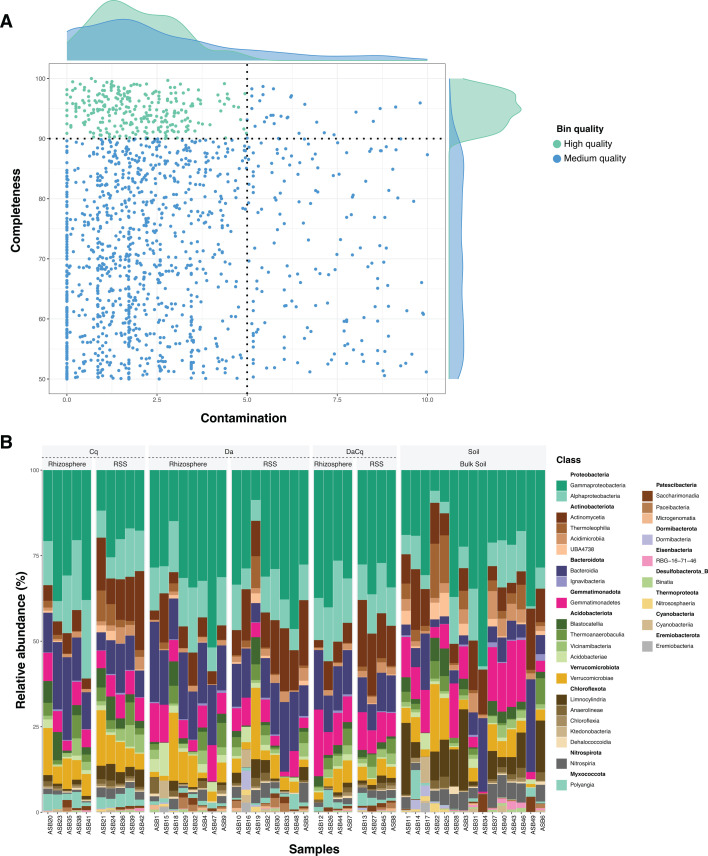 Figure 1
Peer Reviews
No public reviews on file for this paper yet. If you reviewed it on a platform where reviews are public (OpenReview, ICLR, NeurIPS, ICML), you can paste yours below so the community can read it here.
Videos
No videos yet. Explain this paper in a talk, walkthrough, or lecture? Add one.
Taxonomy
TopicsPolar Research and Ecology · Microbial Community Ecology and Physiology · Genomics and Phylogenetic Studies