Metagenome-assembled genomes of two salt-tolerant methylotrophs enriched from a sulfur-rich Zodletone spring in Oklahoma, USA
Imam Alam, Fares Najar, Babu Fathepure

TL;DR
This paper presents two salt-tolerant bacteria from a sulfur-rich spring in Oklahoma that can oxidize methane.
Contribution
The study provides new metagenome-assembled genomes of methylotrophic bacteria adapted to high-salinity environments.
Findings
Methylohalobius sp. ZOD2 and Methyloligella sp. ZOD6 were identified as salt-tolerant methylotrophs.
The genomes reveal methane oxidation capabilities under high-salinity conditions.
Abstract
We obtained metagenome-assembled genomes (MAGs) of two salt-tolerant methylotrophic bacteria, Methylohalobius sp. strain ZOD2 and Methyloligella sp. strain ZOD6, from an enrichment culture derived from sediment collected at a sulfur-rich spring in Oklahoma, USA. These MAGs offer insights into the methane oxidation capabilities of these bacteria under high-salinity conditions.
Genes, proteins, chemicals, diseases, species, mutations and cell lines named across the full text — each resolved to its canonical identifier and authoritative record.
Click any figure to enlarge with its caption.
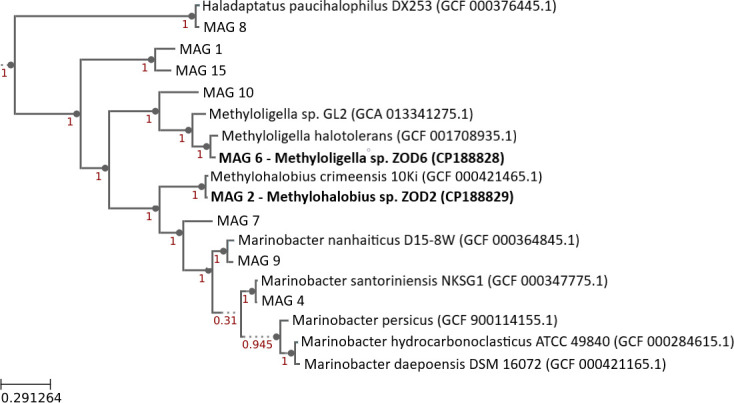 Figure 1
Peer Reviews
No public reviews on file for this paper yet. If you reviewed it on a platform where reviews are public (OpenReview, ICLR, NeurIPS, ICML), you can paste yours below so the community can read it here.
Videos
No videos yet. Explain this paper in a talk, walkthrough, or lecture? Add one.
Taxonomy
TopicsMicrobial metabolism and enzyme function · Methane Hydrates and Related Phenomena · Anaerobic Digestion and Biogas Production