The Legacy of Mercury Contamination from Colonial Nonferrous Mining in the Southern Hemisphere
Larissa Schneider, Saul Guerrero, Gavin Mudd, Marco A. A. Lopez, Kristen K. Beck, Ruoyu Sun, Simon G. Haberle, Michael-Shawn Fletcher, Atun Zawadzki, Holger Hintelmann, Alan Griffiths, Colin Cooke, Patrice de Caritat

TL;DR
This study examines mercury pollution from a historical copper mine in Tasmania, showing how smelting methods significantly impacted mercury emissions and environmental contamination.
Contribution
The study provides the first record of mercury concentrations and accumulation rates from lakes near the Mount Lyell mine, highlighting the impact of smelting methods.
Findings
Mercury concentrations and accumulation rates increased with smelting and peaked with the introduction of flotation processing.
Mercury isotopic signatures confirmed the anthropogenic origin of mercury emissions from the mine.
The estimated total mercury loadings from the mine ranged from 23 to 43 tons.
Abstract
The Mount Lyell copper (Cu) mine in Tasmania, Australia, underwent historical operational changes that influenced mercury (Hg) emissions from ore processing and smelting. This study presents the first record of Hg concentrations (HgC) and accumulation rates (HgAR) using sediment cores from four lakes around Mount Lyell. HgC and HgAR increased from the 1890s (onset of smelting), peaked from the 1920s (introduction of the flotation processing method), and declined after 1969 (smelter closure). Mercury isotopic signatures confirmed its anthropogenic source. Modeling of Hg deposition vs distance over the period 1922–1969 showed that it followed a power-law function. The Mount Lyell emissions may have affected an area up to ∼270,000 km2, beyond which deposition was indistinguishable from the natural background. Estimated total Hg loadings ranged from 23 to 43 t, compared to an estimated ∼150…
Genes, proteins, chemicals, diseases, species, mutations and cell lines named across the full text — each resolved to its canonical identifier and authoritative record.
Click any figure to enlarge with its caption.
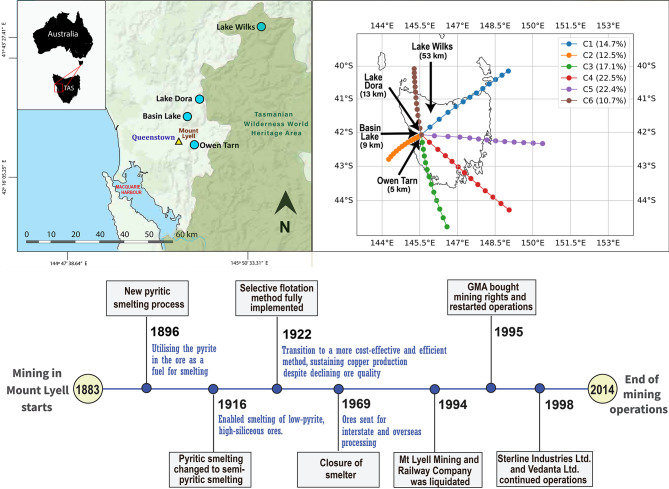 Figure 1
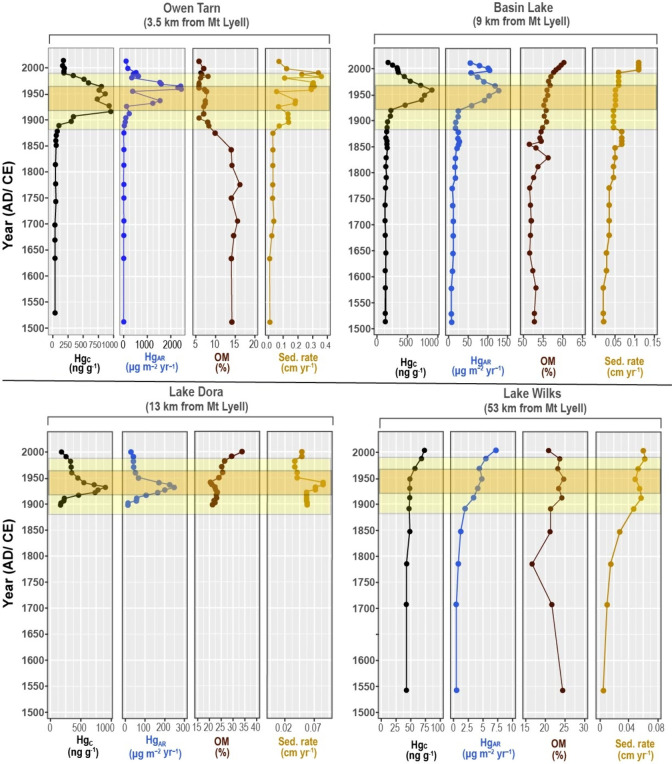 Figure 2
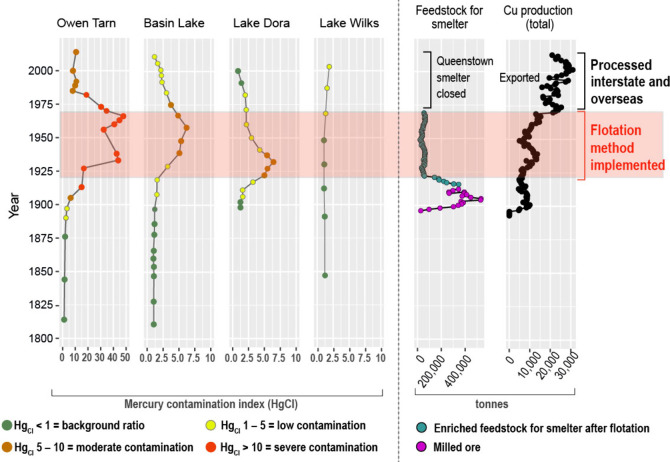 Figure 3
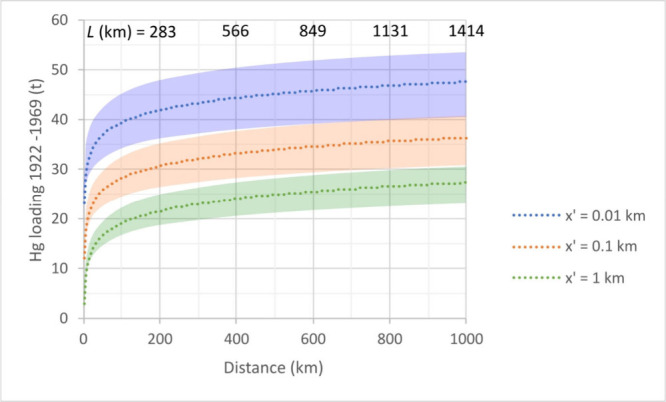 Figure 4
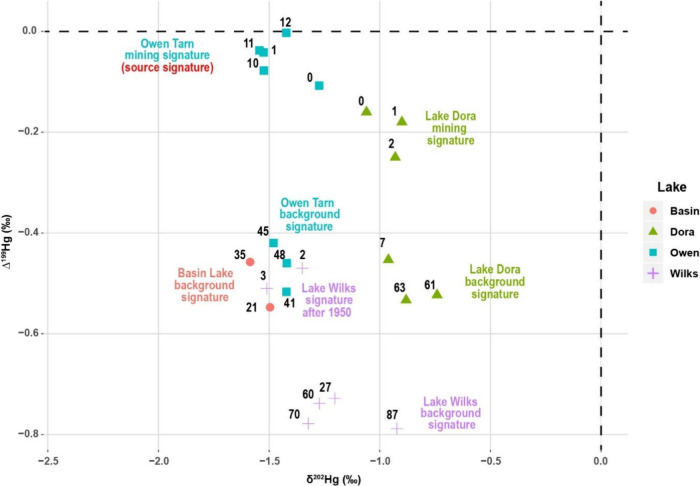 Figure 5
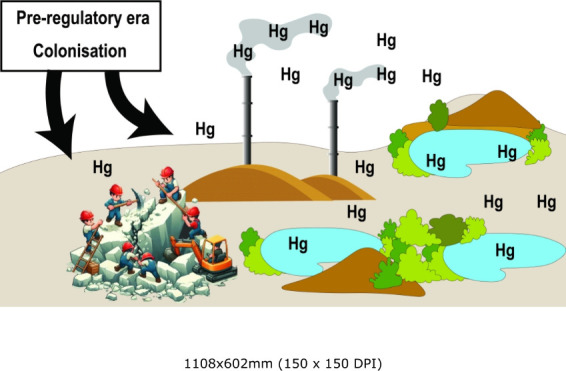 Figure 6
 Figure 7
 Figure 8
Peer Reviews
No public reviews on file for this paper yet. If you reviewed it on a platform where reviews are public (OpenReview, ICLR, NeurIPS, ICML), you can paste yours below so the community can read it here.
Videos
No videos yet. Explain this paper in a talk, walkthrough, or lecture? Add one.
Taxonomy
TopicsMercury impact and mitigation studies · Heavy metals in environment · Heavy Metal Exposure and Toxicity