Differences in Real-world Functioning Between Adoptees With High or Low Risk for Schizophrenia Spectrum Disorders—The Finnish Adoptive Family Study of Schizophrenia
Matilda Raiskila, Helinä Hakko, Karl-Erik Wahlberg, Sami Räsänen

TL;DR
This study compared the real-world functioning of individuals at high or low genetic risk for schizophrenia and found no overall differences in functioning.
Contribution
The study provides new insights into the role of genetics versus environment in schizophrenia-related functioning.
Findings
No significant differences in real-world functioning were found between high-risk and low-risk adoptees.
HR-adoptees were less likely to have achieved formal education.
LR-adoptees needed more help with basic needs.
Abstract
Schizophrenia spectrum disorders are known to affect the patient’s functional performance. The functioning of those who are at familial risk for these disorders is less well understood. In this study, we compared the real-world functioning of adoptees with a genetic high-risk (HR) for schizophrenia spectrum disorders with adoptees without this risk (low-risk, LR). We hypothesized that the HR-group would have more difficulties in real-world functioning compared to the LR-group. The data were based on the Finnish Adoptive Family Study of Schizophrenia project. The study sample included 127 HR- and 130 LR-adoptees. An interview-based method, Strauss–Carpenter Level of Function (SCLF)-scale, was used to measure functional performance in a setup of adoptees living in comparable adoptive families. The SCLF-scale comprises domains for function, symptoms, social contacts, and work. The…
Genes, proteins, chemicals, diseases, species, mutations and cell lines named across the full text — each resolved to its canonical identifier and authoritative record.
Click any figure to enlarge with its caption.
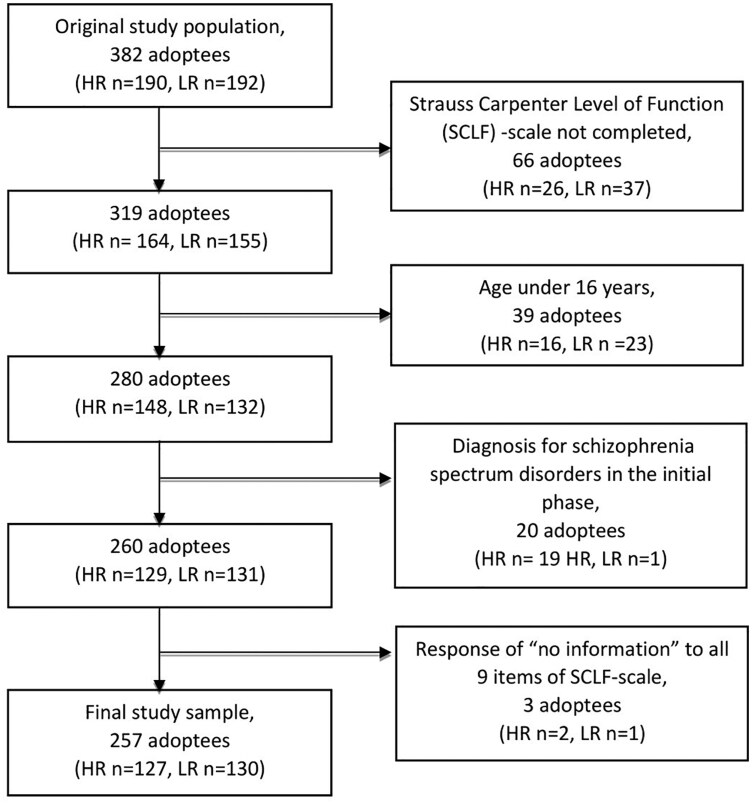 Figure 1
 Figure 2
 Figure 3
Peer Reviews
No public reviews on file for this paper yet. If you reviewed it on a platform where reviews are public (OpenReview, ICLR, NeurIPS, ICML), you can paste yours below so the community can read it here.
Videos
No videos yet. Explain this paper in a talk, walkthrough, or lecture? Add one.
Taxonomy
TopicsChild Welfare and Adoption · Mental Health and Patient Involvement · Family Support in Illness