Insulin receptor substrate family member IST-1 regulates the development of Caenorhabditis elegans age-1 and aap-1 mutants
David Guerrero-Gómez, Juan Cabello, Antonio Miranda-Vizuete

TL;DR
The study shows that the IST-1 protein in C. elegans plays a key role in regulating development through the insulin signaling pathway.
Contribution
The paper identifies IST-1 as a positive regulator of PI3K in C. elegans insulin signaling during development.
Findings
IST-1 mutants combined with age-1 and aap-1 mutations cause sterility and larval arrest in C. elegans.
IST-1 functions as a positive regulator of PI3K in the canonical insulin pathway.
No major interactions are observed with other genes in the insulin pathway.
Abstract
Insulin receptor substrate (IRS) is a class of adaptor proteins that mediate the activation of transmembrane tyrosine kinase receptors to downstream effectors. The IST-1 protein is the sole IRS present in Caenorhabditis elegans , which has been poorly studied in this animal model. Here, we show that ist-1 mutants develop normally but exhibit sterility, larval arrest and dauer phenotypes when combined with mutations in age-1 and aap-1 genes, which encode the catalytic and regulatory subunits of phosphatidylinositol 3-kinase (PI3K), respectively. In contrast, no major genetic interactions are observed with mutations in other genes of the worm insulin pathway, either upstream or downstream AGE-1 / AAP-1 . We conclude that IST-1 , the only IRS in C. elegans , functions as a positive regulator of PI3K in the canonical insulin pathway during development.
Genes, proteins, chemicals, diseases, species, mutations and cell lines named across the full text — each resolved to its canonical identifier and authoritative record.
Click any figure to enlarge with its caption.
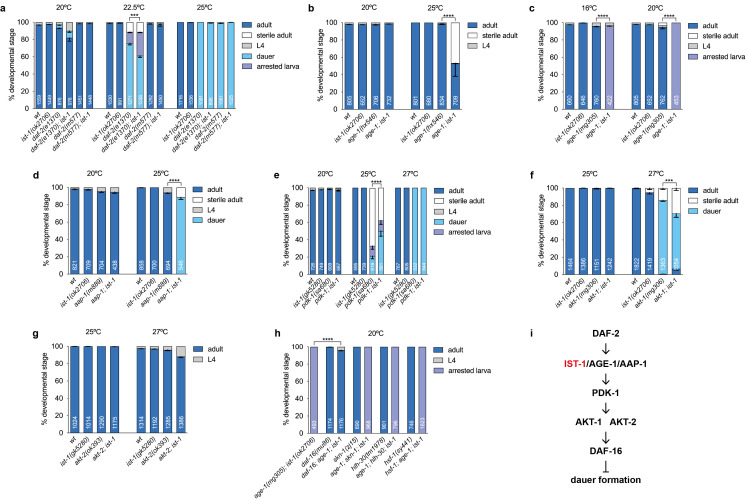 Figure 1
Peer Reviews
No public reviews on file for this paper yet. If you reviewed it on a platform where reviews are public (OpenReview, ICLR, NeurIPS, ICML), you can paste yours below so the community can read it here.
Videos
No videos yet. Explain this paper in a talk, walkthrough, or lecture? Add one.
Taxonomy
TopicsApelin-related biomedical research