Prevalence and characteristics of metaraminol usage in a large intensive care patient cohort. A multicentre, retrospective, observational study
Tarren Zimsen, Lachlan Quick, Gentry White, Rahul Costa-Pinto, Stephen Whebell, Jason Meyer, James McCullough, Kiran Shekar, Kevin B. Laupland, Mahesh Ramanan, Sebastiaan Blank, Alexis Tabah, Stephen Luke, Peter Garrett, Antony G. Attokaran, Aashish Kumar, Kyle C. White

TL;DR
This study examines how often metaraminol is used in ICU patients and finds that it's given to a smaller group of less critically ill patients compared to noradrenaline.
Contribution
The study provides new insights into the real-world usage patterns and patient characteristics associated with metaraminol in ICU settings.
Findings
Metaraminol was administered to 11.3% of ICU patients receiving single-agent vasopressor therapy.
Patients receiving metaraminol were less likely to have ischaemic heart disease and higher APACHE III scores compared to noradrenaline users.
Most metaraminol patients did not convert to noradrenaline infusion, and factors like after-hours admission and regional ICU location were linked to its use.
Abstract
Noradrenaline is the most prescribed vasopressor in intensive care units (ICUs). Although there is limited supporting evidence, metaraminol is often used as an alternative agent in some regions. We aimed to describe current practice and elucidate the factors associated with metaraminol prescription in a large cohort of ICU patients. A multicenter, retrospective cohort study of granular, routinely collected electronic medical record–based clinical data was performed in 12 ICUs in Queensland, Australia, between January 1, 2015, and December 31, 2021. Patients who received at least four consecutive hours of either metaraminol or noradrenaline in the first 24 h of their ICU stay were included. In total, 17,432 patients received single-agent vasopressor therapy and 1,963 (11.3 %) patients were administered metaraminol. For the entire cohort, the median age was 61 (interquartile range, IQR:…
Genes, proteins, chemicals, diseases, species, mutations and cell lines named across the full text — each resolved to its canonical identifier and authoritative record.
Click any figure to enlarge with its caption.
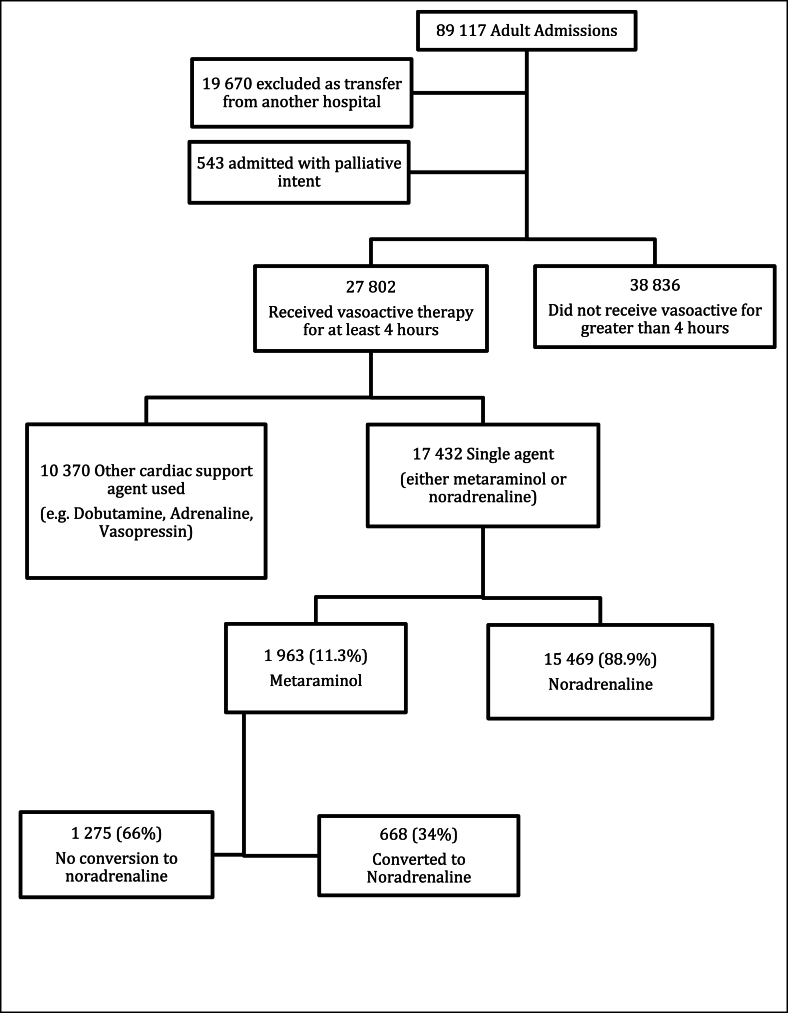 Figure 1
Peer Reviews
No public reviews on file for this paper yet. If you reviewed it on a platform where reviews are public (OpenReview, ICLR, NeurIPS, ICML), you can paste yours below so the community can read it here.
Videos
No videos yet. Explain this paper in a talk, walkthrough, or lecture? Add one.
Taxonomy
TopicsHemodynamic Monitoring and Therapy · Intensive Care Unit Cognitive Disorders · Renal function and acid-base balance