Wolbachia Feminises a Spider Host With Assistance From Co‐Infecting Symbionts
Virginija Mackevicius‐Dubickaja, Yuval Gottlieb, Jennifer A. White, Matthew R. Doremus

TL;DR
A Wolbachia strain causes male spiders to develop as females, and other bacteria help increase this effect.
Contribution
First evidence of Wolbachia-induced feminization in spiders and synergistic effects of co-infecting symbionts.
Findings
Wolbachia strain W1 is essential for feminization in Mermessus fradeorum spiders.
Co-infection with W3 increases feminization rates by ~10%.
Lower abundance of Rickettsiella and Tisiphia correlates with stronger feminization.
Abstract
Arthropods commonly harbour maternally‐transmitted bacterial symbionts that manipulate host biology. Multiple heritable symbionts can co‐infect the same individual, allowing these host‐restricted bacteria to engage in cooperation or conflict, which can ultimately affect host phenotype. The spider Mermessus fradeorum is infected with up to five heritable symbionts: Rickettsiella (R), Tisiphia (T), and three strains of Wolbachia (W1‐3). Quintuply infected spiders are feminised, causing genetic males to develop as phenotypic females and produce almost exclusively female offspring. By comparing feminisation across nine infection combinations, we identified a Wolbachia strain, W1, that is required for feminisation. We also observed that spiders infected with both W1 and W3 produced ~10% more females than those lacking W3. This increase in feminisation rate does not seem to be due to direct…
Genes, proteins, chemicals, diseases, species, mutations and cell lines named across the full text — each resolved to its canonical identifier and authoritative record.
Click any figure to enlarge with its caption.
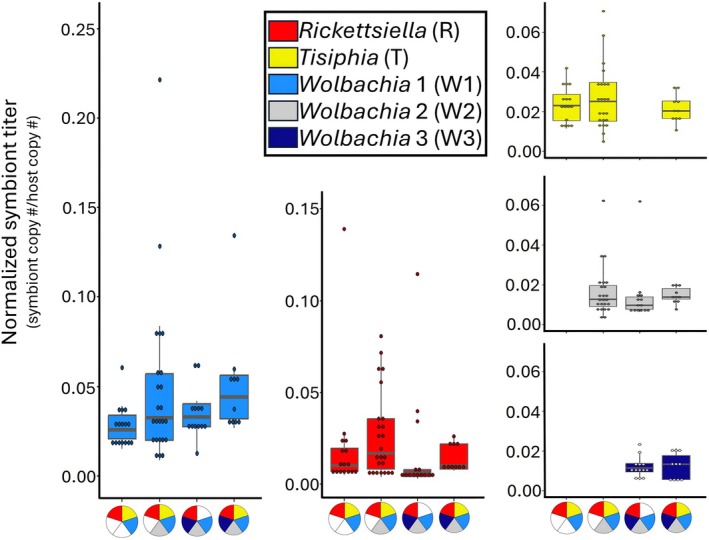 Figure 1
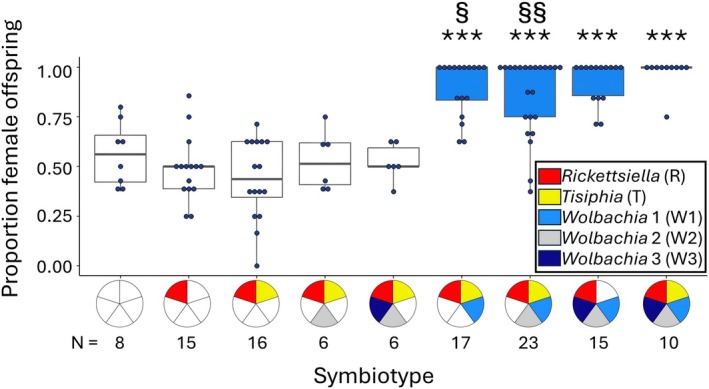 Figure 2
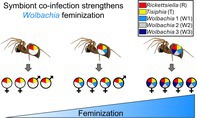 Figure 3
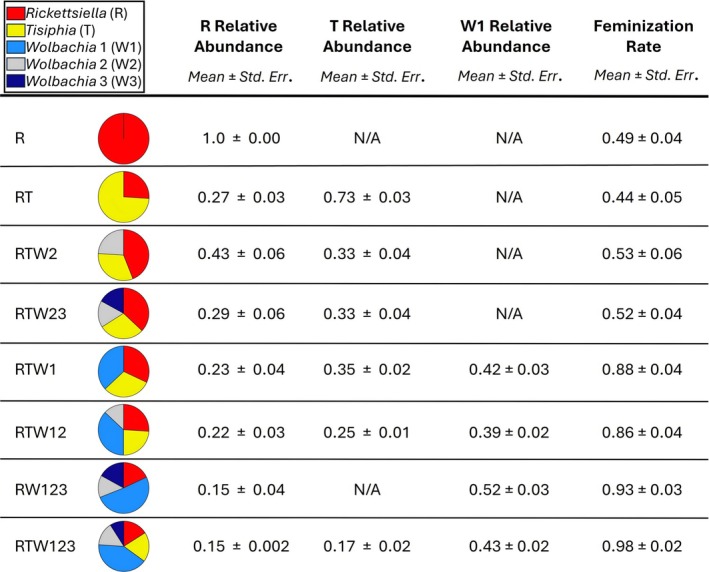 Figure 4
Peer Reviews
No public reviews on file for this paper yet. If you reviewed it on a platform where reviews are public (OpenReview, ICLR, NeurIPS, ICML), you can paste yours below so the community can read it here.
Videos
No videos yet. Explain this paper in a talk, walkthrough, or lecture? Add one.
Taxonomy
TopicsInsect symbiosis and bacterial influences