Exploring Stakeholders’ Perceptions of Using Digital Health Technologies to Improve the Conservative Treatment of Adolescent Idiopathic Scoliosis: Qualitative Study
Kamila Sykorova, Anna Mathew, Nenad Pavel, Parisa Gazerani, Trust Saidi, Marianne Bakke Johnsen, June Ullevoldsæter Lystad, Helen Bull, Mette Fløystad Kvammen, Hong-Gu He, Julia Jacoby, Minna Pikkarainen

TL;DR
This study explores how digital health tools can improve treatment for adolescent scoliosis by examining what patients, caregivers, and doctors think about using these technologies.
Contribution
The study provides new insights into stakeholder perspectives on using digital health technologies to improve conservative treatment adherence and outcomes in adolescent idiopathic scoliosis.
Findings
Participants emphasized the need for accessible, adolescent-friendly, and multilingual education about AIS.
Digital platforms for peer support and improved remote communication with healthcare providers were identified as important.
Gamification features like brace compliance tracking and real-time feedback were seen as ways to improve treatment adherence.
Abstract
Adolescent idiopathic scoliosis (AIS) affects 2%-3% of adolescents, with conservative treatments like bracing and physiotherapeutic scoliosis-specific exercises (PSSEs) recommended for mild to moderate cases. However, patient compliance with these treatments is often low. Digital tools, including smartphone apps and web applications, offer capabilities such as spinal curvature monitoring, remote consultation, and reduction of health care professionals’ workload. These tools may also enhance adherence by increasing motivation and providing real-time feedback, which can be particularly beneficial for patients struggling with brace discomfort or self-esteem concerns. Despite these potential benefits, research remains limited on how digital health technologies can specifically enhance conservative AIS treatment and improve patient outcomes. This study aimed to explore the perspectives of…
Genes, proteins, chemicals, diseases, species, mutations and cell lines named across the full text — each resolved to its canonical identifier and authoritative record.
Click any figure to enlarge with its caption.
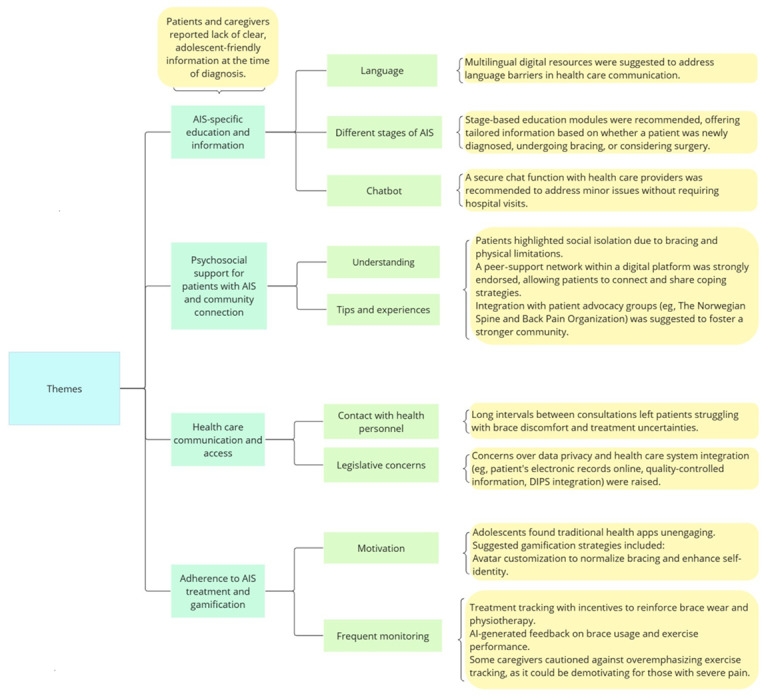 Figure 1
Peer Reviews
No public reviews on file for this paper yet. If you reviewed it on a platform where reviews are public (OpenReview, ICLR, NeurIPS, ICML), you can paste yours below so the community can read it here.
Videos
No videos yet. Explain this paper in a talk, walkthrough, or lecture? Add one.
Taxonomy
TopicsScoliosis diagnosis and treatment