Ethno-Racial Differences in Age and Symptom Severity Among Pre-Menopausal Women Commencing Treatment for Benign Gynecological Conditions with a Levonorgestrel-Releasing Intrauterine Device
Michael J. Green, Kemi M. Doll, Mollie E. Wood, Annie G. Howard, Lauren G. Anderson, Joacy G. Mathias, Natalie A. Rivadeneira, Erin T. Carey, Timothy S. Carey, Wanda Nicholson, Til Stürmer, Evan R. Myers, Whitney R. Robinson

TL;DR
The study found that Hispanic and Black women starting LNG-IUD treatment for gynecological issues tend to be older and have more severe symptoms than White women, possibly due to healthcare access barriers.
Contribution
This study identifies ethno-racial disparities in age and symptom severity among women starting LNG-IUD treatment, linking them to socioeconomic and medical factors.
Findings
Hispanic patients were older than White patients at LNG-IUD insertion.
Black and Hispanic patients had more severe bleeding and bulk symptoms than White patients.
Insurance status and fibroid diagnoses were associated with disparities in treatment timing and symptom severity.
Abstract
Levonorgestrel-releasing intrauterine devices (LNG-IUDs) can be effective treatments for benign gynecological conditions, but there may be ethno-racial differences in how patients receive treatment. Data were from a health care system in the U.S. South (April 2014–September 2019). We identified 783 female patients aged 18–44 years with an LNG-IUD for a benign gynecological condition (455 White, 208 Black, and 120 Hispanic patients). Abstraction of medical notes preceding insertion gave symptom severity scores for uterine bleeding, pelvic pain, and uterine bulk. Linear and negative binomial regression models assessed differences in patients’ age and symptom severity scores, respectively. Covariates included insurance status, parity, prior treatments, and fibroid and endometriosis diagnoses. White patients’ mean age was 32.4 years. Black patients were similarly aged (+0.9 years [95%…
Genes, proteins, chemicals, diseases, species, mutations and cell lines named across the full text — each resolved to its canonical identifier and authoritative record.
Click any figure to enlarge with its caption.
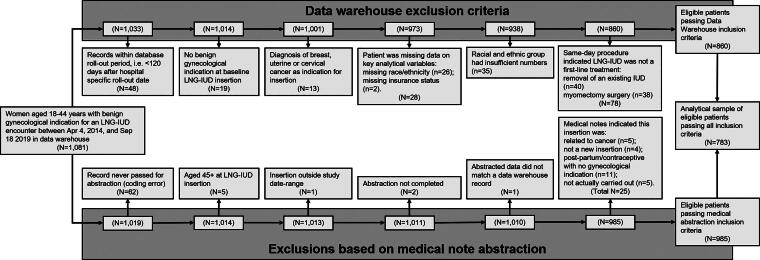 Figure 1
Peer Reviews
No public reviews on file for this paper yet. If you reviewed it on a platform where reviews are public (OpenReview, ICLR, NeurIPS, ICML), you can paste yours below so the community can read it here.
Videos
No videos yet. Explain this paper in a talk, walkthrough, or lecture? Add one.
Taxonomy
TopicsEndometriosis Research and Treatment · Reproductive Health and Contraception · Uterine Myomas and Treatments