A Case of Spontaneously Resolving Cushing Disease
Aongus O’Brolchain, Simon Ryder, Kathryn Berkman

TL;DR
A young woman with Cushing disease experienced spontaneous remission of her pituitary tumor and symptoms, despite initial treatment for hyperprolactinemia.
Contribution
This case highlights the rare possibility of spontaneous resolution in Cushing disease, offering insights into its unpredictable clinical course.
Findings
A pituitary lesion associated with Cushing disease spontaneously resolved on MRI after initial treatment for hyperprolactinemia.
Hypercortisolism symptoms and laboratory results normalized following the tumor's disappearance.
The case suggests that Cushing disease may have unpredictable outcomes, even with standard treatment.
Abstract
We report a case of spontaneous resolution of Cushing disease (CD). A 20-year-old female individual, previously healthy, was referred for investigation of galactorrhea and a prolactin level of 31 ng/mL (<20 ng/mL) (SI: 31 µg/L, <20 µg/L). A magnetic resonance imaging (MRI) scan revealed an 11 mm pituitary lesion. Cabergoline was commenced to address symptomatic hyperprolactinemia. Over the following months, signs of hypercortisolism evolved. Initial tests revealed a positive 1-mg dexamethasone suppression test (DST), prompting further evaluation. Midnight salivary and 24-hour urinary free cortisol tests confirmed hypercortisolism, consistent with a pituitary source which was confirmed with a peripheral corticotropin-releasing hormone (CRH) stimulation test. While cabergoline successfully resolved the galactorrhea, an MRI scan 6 months later showed an increase in the pituitary lesion’s…
Genes, proteins, chemicals, diseases, species, mutations and cell lines named across the full text — each resolved to its canonical identifier and authoritative record.
Click any figure to enlarge with its caption.
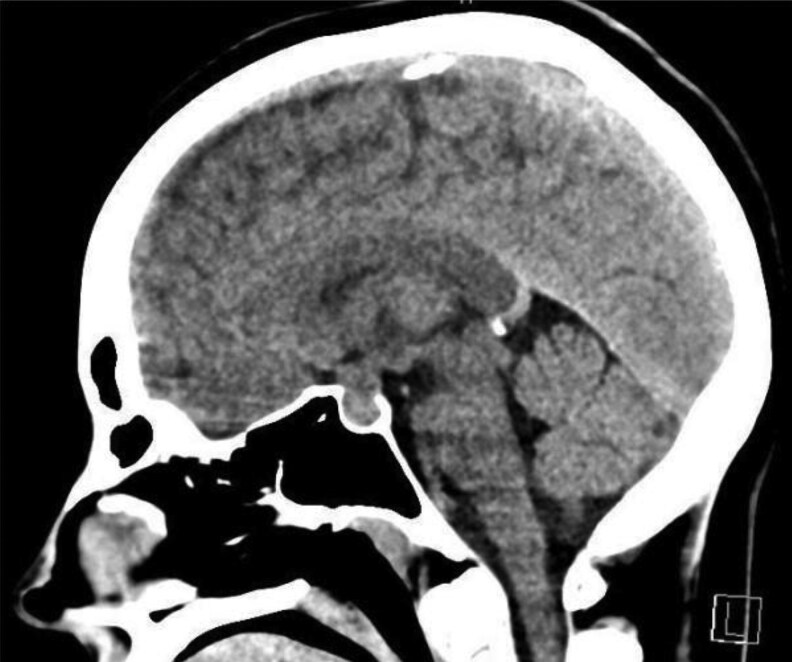 Figure 1
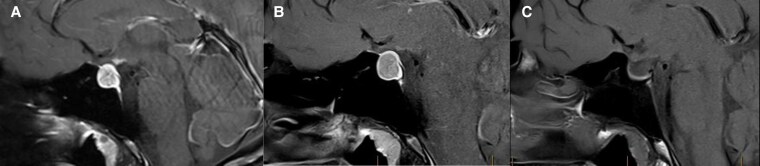 Figure 2
Peer Reviews
No public reviews on file for this paper yet. If you reviewed it on a platform where reviews are public (OpenReview, ICLR, NeurIPS, ICML), you can paste yours below so the community can read it here.
Videos
No videos yet. Explain this paper in a talk, walkthrough, or lecture? Add one.
Taxonomy
TopicsPituitary Gland Disorders and Treatments · Adrenal Hormones and Disorders · Adrenal and Paraganglionic Tumors