Cartilaginous fish and mammalian connectin evolved independently from an ancestral bony fish-like structure
Akira Hanashima, Yoshihiro Ujihara, Misaki Kimoto, Momoko Ohira, Yuu Usui, Ken Hashimoto, Satoshi Mohri

TL;DR
This study shows that connectin in cartilaginous fish and mammals evolved independently from a bony fish-like ancestor, leading to differences in muscle structure.
Contribution
The study reveals the connectin gene structure in cartilaginous fish and shows independent evolution from bony fish-like ancestors.
Findings
Elephant shark connectin has six 6-Ig and one 10-Ig super-repeat, differing from human and zebrafish.
Tissue-specific isoform distribution is conserved between cartilaginous fish and mammals.
Ancestral jawed vertebrates likely had a bony fish-like connectin structure.
Abstract
Connectin, also known as titin, is the largest protein that connects the Z-line to M-line of the sarcomere, functioning as a molecular spring to regulate muscle extensibility. While comparative studies have illuminated vertebrate muscle evolution, connectin structure in cartilaginous fishes remains unexplored. Here, we investigated the connectin gene and domain structure in the elephant shark (Callorhinchus milii), revealing a 238 kb gene with 300 exons, with an overall domain structure similar to that of mammalian connectin. PCR analysis revealed tissue-specific expression, with the N2BA isoform present in the heart and the N2A isoform in skeletal muscle, indicating conservation of isoform distribution between cartilaginous fishes and mammals. Molecular phylogenetic analysis showed that the elephant shark has six 6-Ig super-repeats and one 10-Ig super-repeat within the middle-Ig…
Genes, proteins, chemicals, diseases, species, mutations and cell lines named across the full text — each resolved to its canonical identifier and authoritative record.
Click any figure to enlarge with its caption.
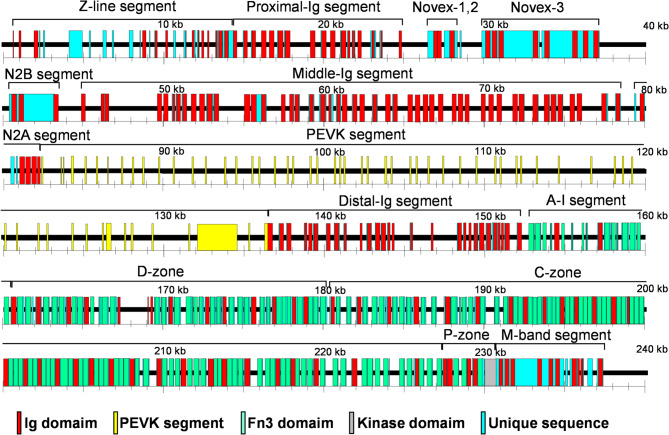 Figure 1
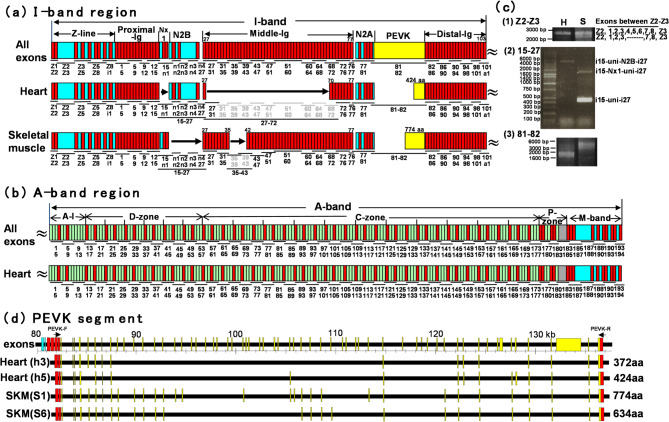 Figure 2
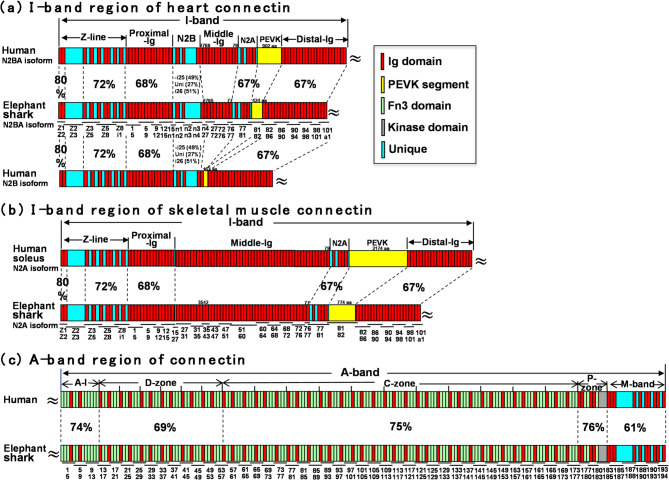 Figure 3
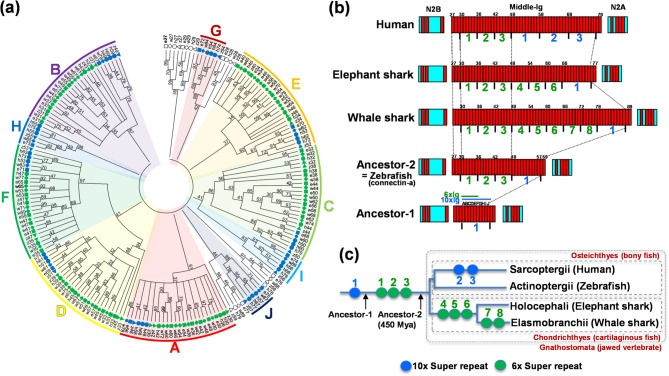 Figure 4
Peer Reviews
No public reviews on file for this paper yet. If you reviewed it on a platform where reviews are public (OpenReview, ICLR, NeurIPS, ICML), you can paste yours below so the community can read it here.
Videos
No videos yet. Explain this paper in a talk, walkthrough, or lecture? Add one.
Taxonomy
TopicsConnective tissue disorders research · Hippo pathway signaling and YAP/TAZ · Connexins and lens biology