Clinical impact of fetal sac size on closed neural tube defects
Sierra D. Land, Taryn Gallagher, Sanjana R. Salwi, Tom A. Reynolds, Leny Mathew, Edward R. Oliver, Dana A. Weiss, Tracy M. Flanders, Juliana S. Gebb, N. Scott Adzick, Gregory G. Heuer

TL;DR
This study shows that fetal sac size in closed spina bifida is linked to worse postnatal outcomes like talipes and bladder issues.
Contribution
The study introduces a novel classification of fetal sac size and links it to specific clinical outcomes in closed spina bifida.
Findings
Patients with a sac had higher rates of talipes and detrusor overactivity compared to those without.
Those without a sac showed better ambulation and less need for catheterization at 5 years old.
Repeat tethered cord release was more common in patients with a sac.
Abstract
To evaluate the association between lesion volume and postnatal outcomes in patients with closed spina bifida (SB). Single-center retrospective review of all patients diagnosed with a closed SB evaluated between 2013 and 2023. Prenatal lesion volume < 3 mL was categorized as “no sac,” and volume ≥ 3 mL was categorized as “sac.” Of eligible patients, 22 had a sac, and 33 did not. Myelocystocele patients more commonly had an associated saccular lesion than lipomyelomeningoceles (80% vs. 28%, p = 0.02). Lipomyelomeningocele patients demonstrated less prenatal lesion growth compared to myelocystocele patients (6.26 vs. 58.0 mL) over a median of 12.7 and 10.5 weeks, respectively. Patients with a sac had a higher proportion of talipes (40.9% vs. 9.1%; p = 0.007) compared to those without. At 5 years old, a higher proportion of patients with no sac was able to ambulate independently and…
Genes, proteins, chemicals, diseases, species, mutations and cell lines named across the full text — each resolved to its canonical identifier and authoritative record.
Click any figure to enlarge with its caption.
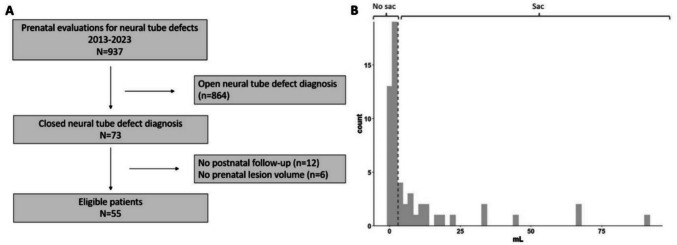 Figure 1
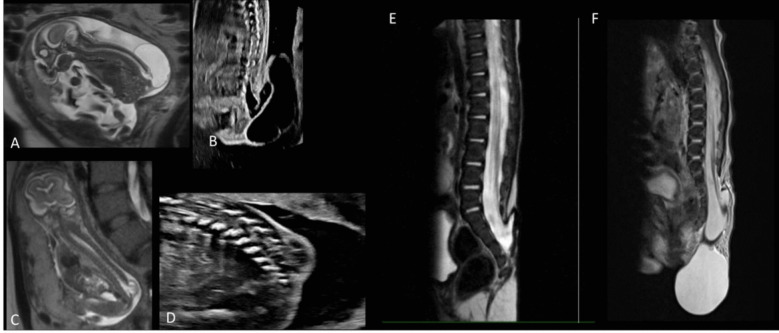 Figure 2
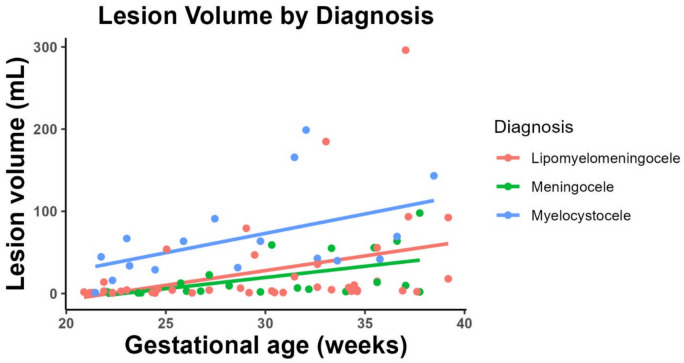 Figure 3
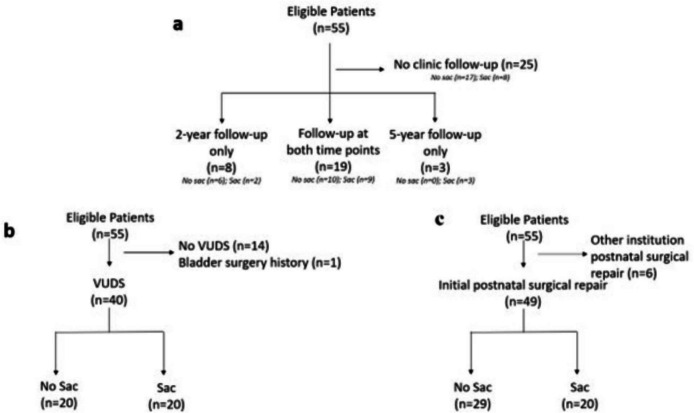 Figure 4
Peer Reviews
No public reviews on file for this paper yet. If you reviewed it on a platform where reviews are public (OpenReview, ICLR, NeurIPS, ICML), you can paste yours below so the community can read it here.
Videos
No videos yet. Explain this paper in a talk, walkthrough, or lecture? Add one.
Taxonomy
TopicsSpinal Dysraphism and Malformations · Congenital Anomalies and Fetal Surgery · Congenital Diaphragmatic Hernia Studies