Post-marketing surveillance study on the effectiveness and safety of molnupiravir in high-risk COVID-19 outpatients: a prospective case series study
Renato Ferreira-da-silva, Lurdes Silva, Cristina Costa-Santos, Manuela Morato, Jorge Junqueira Polónia, Inês Ribeiro-Vaz, Manuela Pinto, Marta Pereira, Inês Marques Figueira, Sofia Baptista, Helena Farinha, Fátima Falcão, Ana Mirco, Liliana Calixto, Madalena Melo

TL;DR
This study examines the real-world effectiveness and safety of molnupiravir in high-risk COVID-19 outpatients, finding no deaths or hospitalizations and common side effects like nausea and dizziness.
Contribution
The study provides real-world evidence of molnupiravir's effectiveness and safety in high-risk patients ineligible for first-line therapy.
Findings
No deaths or hospitalizations were reported among high-risk patients treated with molnupiravir.
Common adverse events included nausea, dizziness, bitter taste, and headache, with older and overweight individuals more affected.
Molnupiravir showed potential as an alternative treatment for patients ineligible for first-line therapies.
Abstract
Molnupiravir, approved for treating mild to moderate COVID-19 in adults, aims to reduce hospitalisation and mortality rates. Although it was withdrawn from the market after the present study was conducted, understanding its long-term effects remains pertinent. We aimed to assess the real-world effectiveness and safety of molnupiravir in high-risk COVID-19 outpatients. This prospective, multicenter, noninterventional, postmarketing cohort study enrolled high-risk COVID-19 outpatients with mild to moderate COVID-19, eligible under national prescribing criteria, who initiated molnupiravir within five days of symptom onset and were ineligible for first-line antiviral therapy. Patients were consecutively enrolled from eight Portuguese study sites and monitored for three months. Effectiveness was assessed by all-cause mortality and hospitalisation through day 29. Safety was evaluated by the…
Genes, proteins, chemicals, diseases, species, mutations and cell lines named across the full text — each resolved to its canonical identifier and authoritative record.
Click any figure to enlarge with its caption.
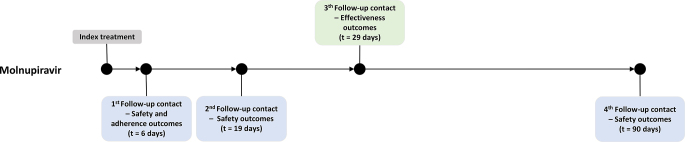 Figure 1
Peer Reviews
No public reviews on file for this paper yet. If you reviewed it on a platform where reviews are public (OpenReview, ICLR, NeurIPS, ICML), you can paste yours below so the community can read it here.
Videos
No videos yet. Explain this paper in a talk, walkthrough, or lecture? Add one.
Taxonomy
TopicsCOVID-19 Clinical Research Studies · SARS-CoV-2 and COVID-19 Research · SARS-CoV-2 detection and testing