Measurement of the inhomogeneity of the KATRIN tritium source electric potential by high-resolution spectroscopy of conversion electrons from 83mKr
H. Acharya, H. Acharya, M. Aker, D. Batzler, A. Beglarian, J. Beisenkötter, M. Biassoni, B. Bieringer, Y. Biondi, F. Block, B. Bornschein, L. Bornschein, M. Böttcher, M. Carminati, A. Chatrabhuti, S. Chilingaryan, B. A. Daniel, M. Descher, D. Díaz Barrero, O. Dragoun, G. Drexlin

TL;DR
The KATRIN experiment measures the electric potential inhomogeneity of its tritium source using high-resolution spectroscopy of conversion electrons from 83mKr to improve neutrino mass determination.
Contribution
A new method using conversion electrons from 83mKr to measure tritium source potential inhomogeneity in the KATRIN experiment is presented.
Findings
Several-weeks long measurement campaigns were conducted to infer tritium source potential observables.
The inhomogeneity of the electric potential in the tritium source impacts the neutrino-mass determination.
Precision spectroscopy of 83mKr conversion electrons quantifies potential distortions in the beta-spectrum.
Abstract
Precision spectroscopy of the electron spectrum of the tritium \documentclass[12pt]{minimal} \usepackage{amsmath} \usepackage{wasysym} \usepackage{amsfonts} \usepackage{amssymb} \usepackage{amsbsy} \usepackage{mathrsfs} \usepackage{upgreek} \setlength{\oddsidemargin}{-69pt} \begin{document}\end{document}β-decay near the kinematic endpoint is a direct method to determine the effective electron antineutrino mass. The KArlsruhe TRItium Neutrino (KATRIN) experiment aims to determine this quantity with a sensitivity of better than \documentclass[12pt]{minimal} \usepackage{amsmath} \usepackage{wasysym} \usepackage{amsfonts} \usepackage{amssymb} \usepackage{amsbsy} \usepackage{mathrsfs} \usepackage{upgreek} \setlength{\oddsidemargin}{-69pt} \begin{document}\end{document}0.3eV…
Genes, proteins, chemicals, diseases, species, mutations and cell lines named across the full text — each resolved to its canonical identifier and authoritative record.
Click any figure to enlarge with its caption.
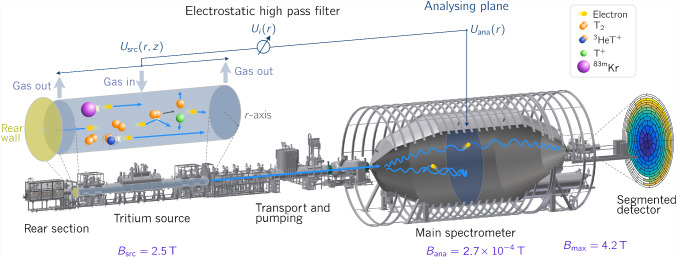 Figure 1
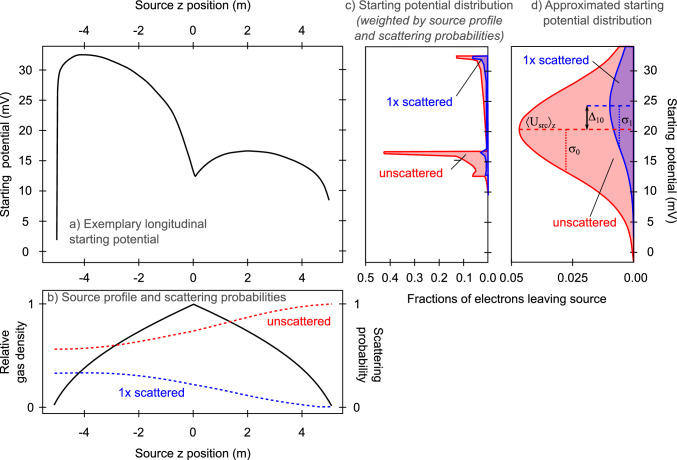 Figure 2
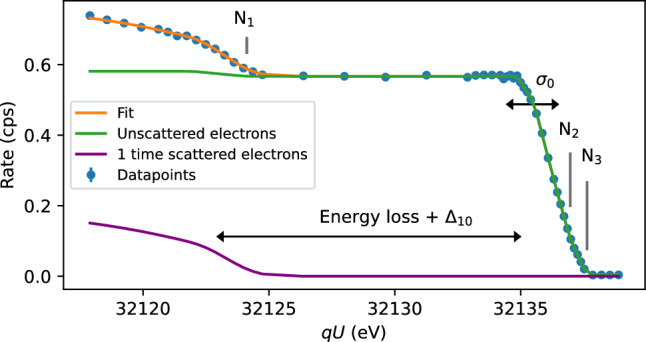 Figure 3
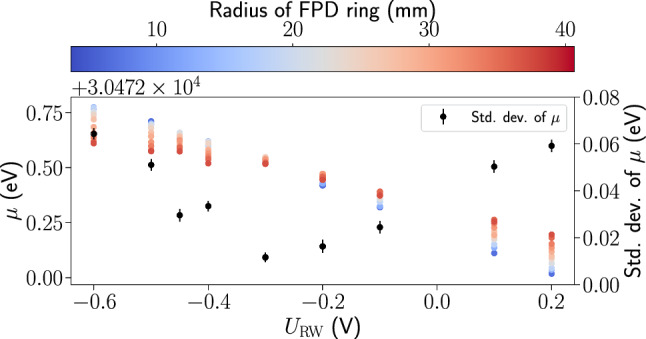 Figure 4
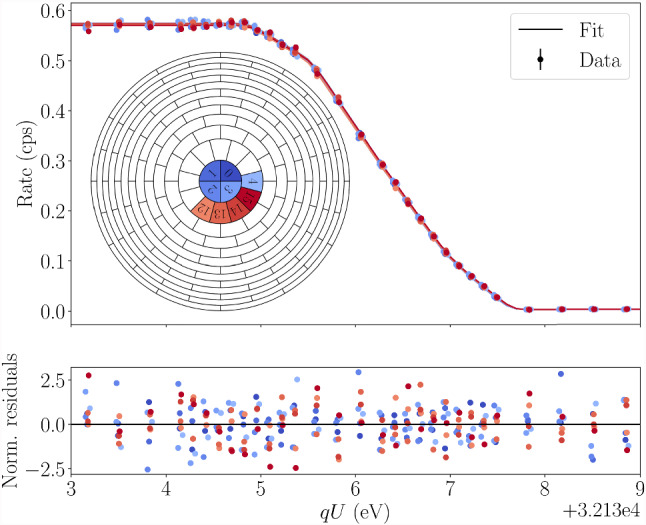 Figure 5
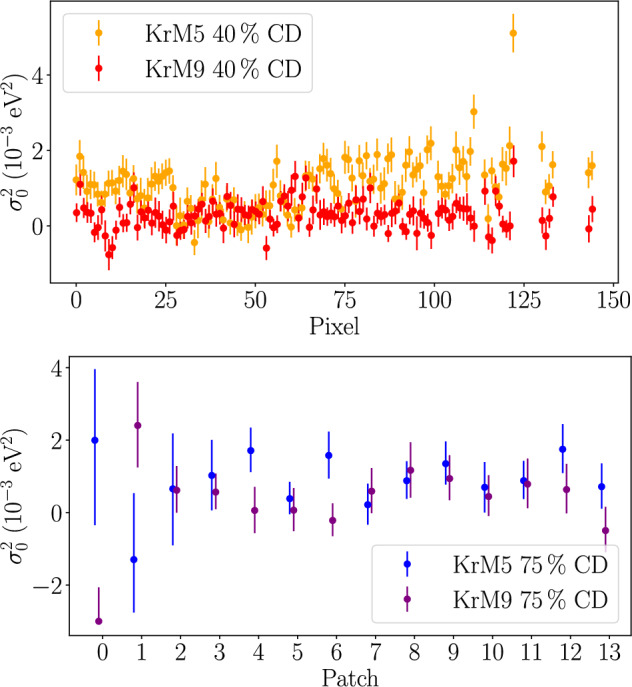 Figure 6
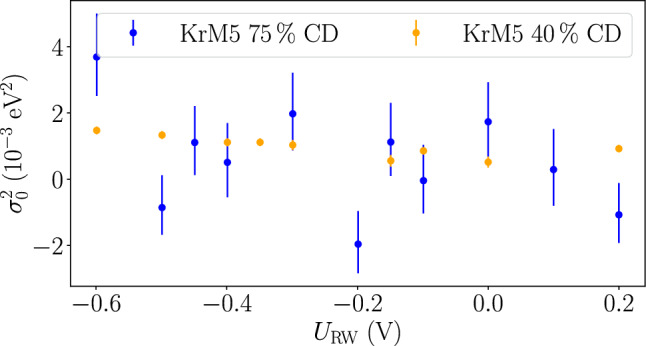 Figure 7
Peer Reviews
No public reviews on file for this paper yet. If you reviewed it on a platform where reviews are public (OpenReview, ICLR, NeurIPS, ICML), you can paste yours below so the community can read it here.
Videos
No videos yet. Explain this paper in a talk, walkthrough, or lecture? Add one.
Taxonomy
TopicsNeutrino Physics Research · Muon and positron interactions and applications · Ammonia Synthesis and Nitrogen Reduction