Object permanence in domestic cats (Felis catus) using violation-of-expectancy by owner and stranger
Jemma Forman, Jordan S. Rowe, David A. Leavens, Mary Diane Clark, Mary Diane Clark, Mary Diane Clark, Mary Diane Clark

TL;DR
This study explores object permanence in domestic cats and how familiarity with the person handling the task affects their behavior.
Contribution
The study introduces a novel method to assess object permanence in cats using violation-of-expectancy with both owner and stranger manipulators.
Findings
Approximately half of the cats did not find the hidden toy in single visible displacement trials.
Cats showed more toy-directed behaviors in consistent trials than in violation trials during invisible displacement tests.
Person familiarity significantly influenced cats' engagement and behaviors in the study.
Abstract
Object permanence, the understanding that objects continue to exist while out of sight, is a key part of the sensorimotor stage of cognitive development. Cats have been shown to reach Stage 5 object permanence by passing successive visible displacement tests, but their understanding of Stage 6 object permanence is less clear. We tested 18 domestic cats on their understanding of Stage 4 and Stage 6 of object permanence in their home environment. Additionally, we investigated how person familiarity may influence study engagement. In single visible displacement (SVD) tests, the box manipulator (owner or researcher) hid a toy in one of two cardboard boxes for the cat to find. In invisible displacement (IVD) tests, we implemented a violation-of-expectancy procedure in which the box manipulator showed a toy re-appearing out of either a) the same box it was hidden in (consistent trials) or b)…
Genes, proteins, chemicals, diseases, species, mutations and cell lines named across the full text — each resolved to its canonical identifier and authoritative record.
Click any figure to enlarge with its caption.
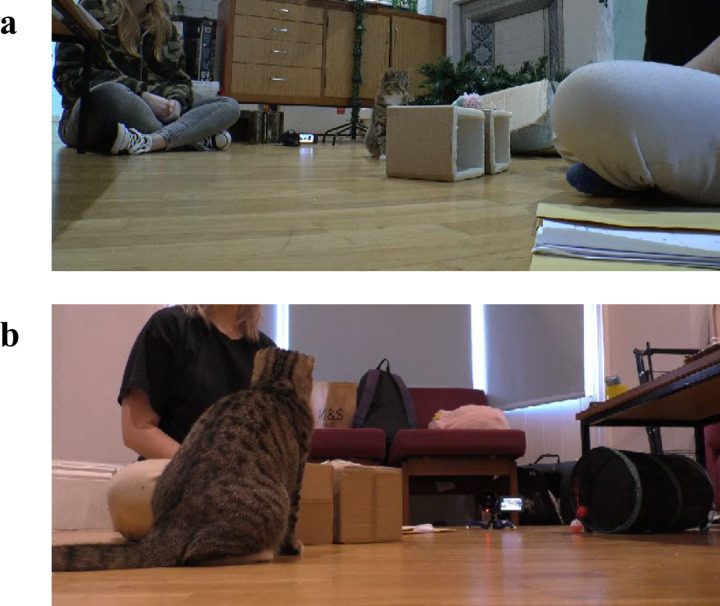 Figure 1
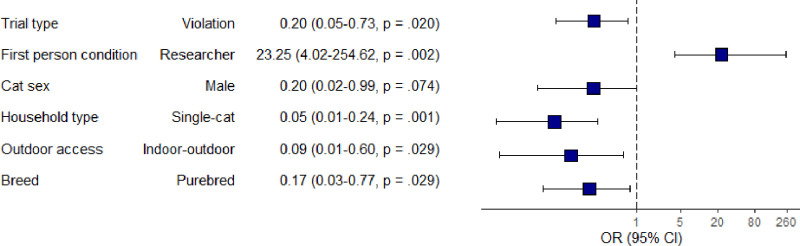 Figure 2
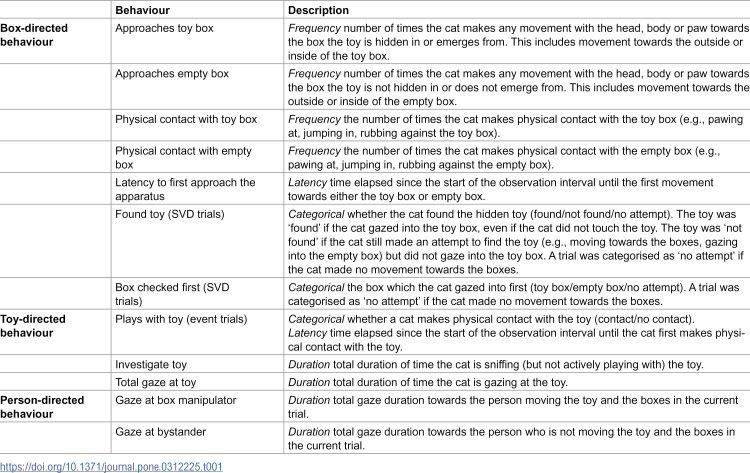 Figure 3
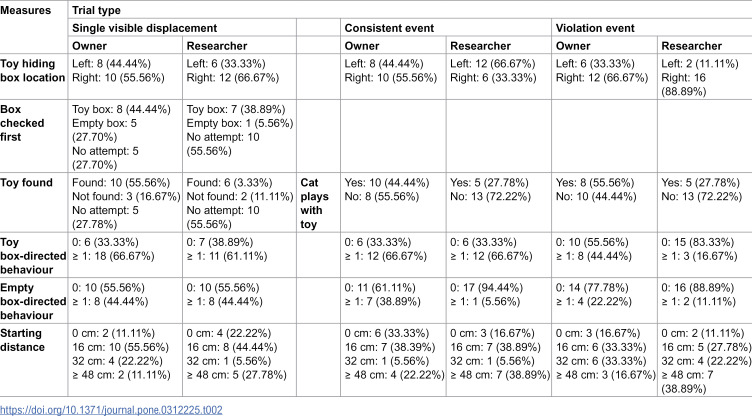 Figure 4
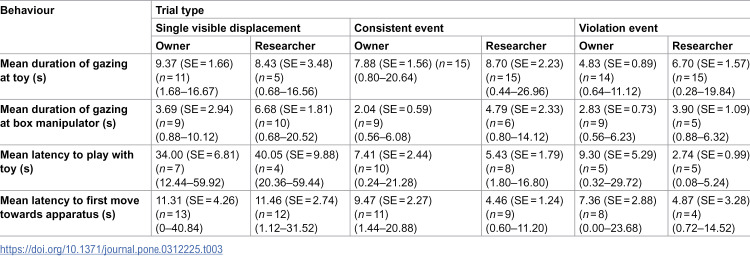 Figure 5
Peer Reviews
No public reviews on file for this paper yet. If you reviewed it on a platform where reviews are public (OpenReview, ICLR, NeurIPS, ICML), you can paste yours below so the community can read it here.
Videos
No videos yet. Explain this paper in a talk, walkthrough, or lecture? Add one.
Taxonomy
TopicsHuman-Animal Interaction Studies · Child and Animal Learning Development · Neuroendocrine regulation and behavior